
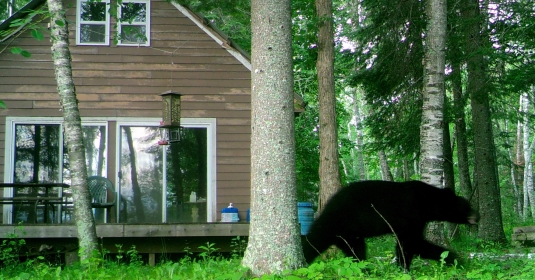
CAUGHT ON CAMERA - Shown here are some pictures that were captured on my trail cameras at the cabin.
I love the cool weather
Wed, 10/08/2025 - 11:00pm
I have said it many times, fall is my favorite time of the year. I will be going to the cabin with my son, Brad, next week. I am wishing for some good weather so, that we can get a little fishing in.
I still get that little kid feeling when I prepare for a trip to the cabin with one of my sons or grandsons. I believe that being able to spend time with my family gives me a feeling of fulfillment.
I have to admit that I have not visited the cabin as many times this year as in other years. In years past I had no reservations about heading to the cabin by myself, hooking up the boat and heading to a lake. Recently, I have had reservations about going there alone, mainly for health reasons. I hope to get to a point where I can take the boat out by myself once again.
The farmers are sill busy with the harvest, so if you are planning to take a drive in the country, be aware of any slow-moving farm machinery that is going from field to field on the road.
A few years ago, I read an article in the Minnesota Conservation Volunteer magazine about a forest east of Marcell where they are researching climate change in the forest.
Marcell Experimental Forest
The Marcell Research Center opened in 2006 as the headquarters of research and has bunkrooms, office, preparatory laboratory, kitchen, laundry, bathrooms, and conference/meeting room.
Streamflow, weather, and well data collection began on the Marcell Experimental Forest in 1960. This 1,141-ha site has six research watersheds, each consisting of a mineral soil upland and organic soil peatland; an intermittent or perennial stream drains each peatland and its larger watershed. Formally established in 1962, the Marcell contains two units on land owned by the Chippewa National Forest, State of Minnesota, Itasca County, and a private individual. Previous and ongoing research addresses the ecology and hydrology of peatland. Research concerns typical upland/wetland watersheds in the Lake States, atmospheric chemistry, nutrient cycling, soil quality, tree-stand dynamics, and a variety of watershed treatments applied to upland or bogs to investigate impacts on water yield, peak streamflow, water quality and nutrient processing.
Please show your support for our troops who are now deployed. These service men and women are making that sacrifice, so that we may have the many freedoms that we enjoy today.