
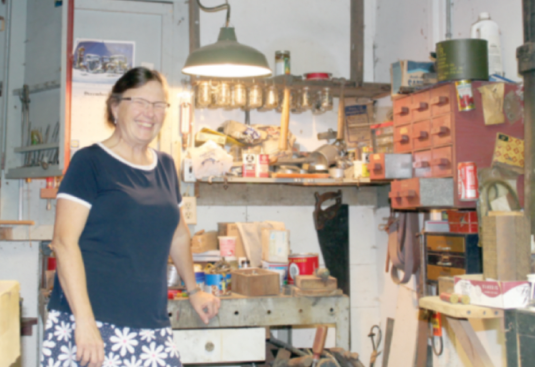
The Waseca County Historical Society will benefit from the final estate sale being held October 11 and 12 to find "good homes" for the belongings of Gloria and Ray Pommerenke. Their daughter Lori has spent more than seven years gradually sorting through their lifelong accumulations.
A complicated journey
Estate sale to benefit county historical society
Estate sale to benefit county historical society
Wed, 10/09/2024 - 11:00pm
“I dislike the process of selling things,” comments Wasecan Lori Pommerenke. “But this is more like storytelling.”
Pommerenke is speaking of an upcoming estate sale scheduled for 9 a.m. to 5 p.m. Oct. 11 and 12, at which she will be clearing out her parents’ possessions, so that their home can be placed on the market. A special feature of this sale is that all proceeds will benefit the Waseca County Historical Society (WCHS) where her mother had a life membership. The WCHS has also taken an interest in the range of locally-acquired vintage items that have come to light at the estate.
On day one, Oct. 11, shoppers will have the chance to buy items on a “no reasonable offer refused” basis. On day two, beginning at 9 a.m., they may take whatever items they wish, giving only the donation of their choice in payment.
“It’s time for this to come to an end,” Lori says of the seven years and more she has spent sorting through, assessing, cleaning and redistributing the massive collection of possessions her parents had acquired.
The sale will be at 600 Eighth Street Southeast at a house and alleyway outbuilding filled with items which belonged to her parents, Gloria and Ray Pommerenke, who lived in their Waseca home from just before their marriage in 1951 until Gloria’s death in 2017. The couple raised two daughters who graduated high school in the 1970s: Brenda, who has lived in the Washington D.C. area for nearly four decades, and Lori, who, after earning advanced degrees and working for the Peace Corps for more than two decades, moved back to Waseca in 2004 to raise her then-infant daughter, Rose.
Asked to supply one word to describe each of her parents, Lori begins with her father: “He was brilliant. He could fix anything.” She points to his basement work area, indicating the spaces where an array of power tools once allowed him to carry out his projects.
“My mother was…busy,” says Pommerenke, choosing her word carefully. “She was an excellent, dedicated cook, I think partly because she loved the social aspect of sharing what she had made.
“For much of her life, the rest of the house might be in chaos, but the kitchen would be neatly organized.”
The heartbreaking story of losing her father began with the onset of dementia in 1999, which eventually led to a stay in an assisted living facility until his death in 2013.
Her mother’s passing at age 90 in 2019 was a shocking surprise: She experienced sudden cardiac failure while she was home alone packing for an out-of-state trip. Though she had been plagued by heart health problems, she was still a licensed driver and was preparing for a flight to Washington D.C. to attend a grandson’s wedding. Lori found her collapsed and cold at the bottom of the basement stairs, still holding some of the clothing she apparently intended to pack.
The story has stretched itself across an additional seven years because…well…because things were left in a state of…disarray. “My mother threw out nothing,” Lori declares, suggesting the foundation for that came from both her mother and father being born in the 1920s and raised in the 1930s. “That generation lived with the memory of struggle, and having to ‘do without.’ She probably didn’t want to see it happen again.” The results, however, were disastrous.
“You could barely move through the house,” Lori recalls. She gestures into rooms where items once stood in bags, baskets and boxes nearly ceiling high. “There was no rhyme or reason to it,” she continues, explaining that hairbrushes, office equipment, dishes, linens and even food items such as canned goods would be mixed together in the various locations.
Of course, Lori had known about the impassable nature of many rooms during her mother’s lifetime, but Gloria had rejected all assistance, even complaining she “couldn’t find things” if Lori did some cleaning while her mother was away.
While the easiest course for emptying out the household might have been “simply to haul it all to the dump,” Lori says that course went against her “sense of responsibility as a citizen of the world.”
As a trained conservation biologist, she can’t help commenting, “Humanity does not benefit from piles of rubble. Useful items should keep being used, and re-used, then recycled, repurposed or composted when possible.”
Her work proceeded with those principles in mind.
When items no longer had any practical value, her objective was to see them recycled rather than buried in a landfill. When they were useful but not terribly valuable, she would find a person or organization in need of them. An example is several boxes of sewing notions, fabric, tape measures, pin cushions, sewing needles, and the like, which she boxed up and mailed to a charity. More than three tons of scrap metals were hauled to recycling from Ray’s collections.
A fairly large collection of song sheets, music books and related papers was given to the Waseca Music Store—the place most of it was originally purchased from, Lori recalls. Many carloads of books were driven to the Twin Cities and given to a company called “Better World Books,” which markets used publications online.
“My friends and I have done everything we can to disperse the items to places where they will be used,” she says of the past seven years. “I could not have gotten this far without help. A small crew of friends volunteered many hours helping me. A handful of them will again be helping at the sale.
“Countless people offered referrals for disposing of specific items. Customers and repeat customers provided the motivational boost for continuing to use the slow clean-out process. It takes a village to slowly dismantle what two people collected.”
When items were soiled, she cleaned them, taking “hundreds of loads” of fabrics home to be washed, since the dryer in her mother’s house had not been functioning for some time. The good news? “I will still be using the cleaning supplies and laundry detergent I collected from among her things for some time to come,” comments Lori with a laugh.
Ten times or more over the past few years, she has set out an “Estate Sale” sign and brought the public in to consider taking some of “Gloria’s Vintage and Ray’s Leftovers” home for their own use. The sales have been successful and helpful. Lori tells the story of one shopper who was interested in a vintage toy box. Lori offered it to her for free, but declined to let the box leave unless—also at no cost—the customer took the toys inside it.
“I can say without exaggeration that most of my customers got more than they bargained for,” jokes Lori.
The process of sorting, cleaning, and then seeking “homes” for her parents’ belongings has been a genuine journey, Lori points out. One moment of heartwarming nostalgia came when she found a jacket she remembered wearing as a child. “It just washed over me how much I used to like that jacket, and how I felt when I would wear it,” she recalls. In her parents’ bedroom, she came across a small figurine of a bullfighter; she recognized it immediately because her father had shared the story often of how, at age 6, he had traveled with his parents to the western United Sates and even into Mexico—where his parents had bought him the bullfighter as a souvenir.
Also among the items were boxes and boxes of cards and letters, many of them with surprising return addresses. “My parents’ generation came of age, and then they went off to war,” she points out. “Mother must have written to her friends and classmates prolifically, because they wrote back to her.” Though Lori says she is still making her way through the letters, she has found some to be profound for their observations about traveling halfway across the world to fight in a war.
There were moments of sheer surprise. In one attic storage space, Lori came across a bag which had clearly been given to visitors at the 1948 Minnesota State Fair. Inside were pamphlets, pencils, and all the other sorts of gifts frequently given away by vendors. “It had been there all that time, unused, undisturbed,” comments Lori.
In her mothers’ closet were “nylon stockings” from the 1950s—the sort which had a seam up the back, reached to the wearers’ thighs, and had to be held in place with a garter.
The heartwarming moments and surprises have continued at the sales Lori has held so far. “I truly enjoy hearing people’s reactions to the items,” she comments. “They share their memories of similar items, explain why they want to buy things, and tell me how they’re going to use them.”
That last part—“use them”—is music to Lori’s ears, since that’s what the journey has been about.
“It’s going to be a busy, hectic pair of days,” Lori says of Oct. 11 and 12. “But there are three things that will make it worth it. First, the money will go to benefit the Historical Society. Second, the items will be going to people who will appreciate them and use them as they’re intended.
“And third, this long journey—taken on out of my love and respect for my parents, and my desire to see their legacy handled in a responsible way—will be over.”