
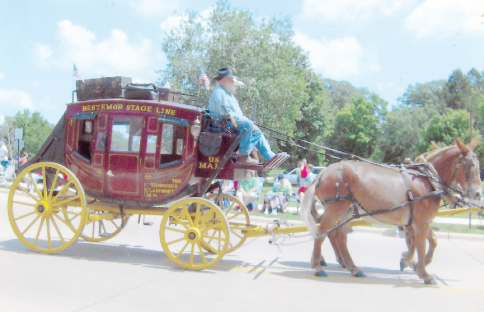
The Bestemore Stagecoach in use. Hand built by Donna Thoreson's brother, Glenn Adams, the stage will be available for viewing during the county fair at the Waseca County Historical Society's display. Thoreson is loaning the coach to the historical society; its presence is meant to call attention to the recent publication of "Stagecoaches across Waseca County and Neighboring Counties" by Waldorf area resident Judy Joecks.
A piece of living history
Wed, 07/03/2024 - 11:30pm
Self-proclaimed “muleskinner” Donna Thoreson, 85, has owned a stagecoach since 2003. She and her husband LeRoy traveled over a five-state region taking it or other mule-drawn vehicles to parades, “wagon train” trips, horse shows and historic reenactments.
While she has an extensive collection of fond memories, she says one of her favorites was taking the stagecoach to the Albert Lea area’s Big Island Rendezvous. There at the pioneer village, she would dress in period costume and tell the groups of school children who visited that she was a traveler who had been stranded when robbers attacked the stage and stole not only all the valuables aboard the coach, but the horses which had been pulling it as well.
She says she used her narrative to educate the children about the hardships and realities of early settlement days, as well as the determination and hardiness shown by those arriving in the newly opened territory.
After she and LeRoy farmed for 50 years between Owatonna and Blooming Prairie, and after raising sons Kraig and Kevin and daughter Sheri–all of whom are now parents and two of whom are already grandparents–on the farm, Donna is now retired and living in Albert Lea. The stagecoach, however, is not retired and, if she has anything to say about it, never will be.
“I’ve told my kids,” she jokes, “that if they ever get rid of that stagecoach, I will come back from the dead and haunt them.”
Donna has consented to loan the stagecoach to the Waseca County Historical Society (WCHS) for the duration of the Waseca County fair from July 10 to 14. Though planning continues, her current thought is that she will be giving her “stranded traveler” presentation at 6 p.m. the evening of Thursday, July 11.
Joan Mooney, WCHS director, says the organization requested the coach because of attention called to early settlement travel by the June release of Waldorf-area writer Judy Joecks’ self-published book, “Stagecoaches across Waseca County and Neighboring Counties.”
The coach will be kept indoors throughout the fair, will not be giving rides, and will be available only for viewing.
Donna believes being able to see and stand near the coach will help people begin to understand the time and places when such vehicles were “luxurious” in comparison to typical means of travel.
She is also willing to share it because, she says, she wishes to honor the people who have been associated with it.
First on that list is her brother, Glenn Adams. “He was an amazing woodworker,” Donna recalls. “He could make anything and it would look beautiful.”
While visiting the Thoreson farm, “He was just fascinated with the mules,” Donna said. “One time he said to me, ‘I would like to build a stagecoach before I die.’ Then he asked me, ‘If I build a stagecoach, could I give it to you?’”
Donna remembers saying to her husband, LeRoy, afterward, “I may be blonde, but I knew enough to say yes.” She learned later that anyone desiring to buy a full-sized replica of a stagecoach is likely to pay $40,000 or more. Glenn was in his seventies and beginning to experience macular degeneration as he began the project. He lived in Washington State. Over the three years he continued to plug away at the various steps, his wife was diagnosed with dementia, placed in a skilled care facility, and eventually died. Donna remembers his work on the stagecoach as being a kind of therapy. “I know there were times he would be in that workshop of his night and day.”
He touched base with her persistently to find out her preferences and send her pictures of how the work was progressing. She consulted back and forth with him and paid for the materials. During that time, Donna says she remembers sometimes being nervous that she and her brother were coming at the project from two different angles: “Me being a muleskinner, and him being a woodworker, there were times I worried we weren’t on the same page,” she said.
As more time passed, Glenn’s macular degeneration gradually worsened, but he continued working on the coach. Donna remembers he would wear his glasses and a jewelers’ headband magnifier, and also kept a magnifying glass handy.
Though Glenn had intended to build the wheels for the stagecoach, by the time the project had advanced that far, his health no longer left room for the possibility.
Donna remembers the 2003 trip with LeRoy out to Washington State to pick up the body of the stagecoach.
“We were so proud,” she remembers of herself, Glenn and LeRoy. “Glenn had accomplished so much, and he was thrilled to be sending it home with us.
“Seeing what he had built, I realized we were on the same page all along.”
The wooden wheels were built by wheelwright Gene Jacobson of Kiester. Donna remembers that he happened to have hubs actually made by a stagecoach company, and so they were used at the centers of the four handmade wheels. The wheels, she mentions, are somewhat smaller than were used in the 1800s. The body of the coach, though, is within an inch of the length of an original stagecoach.
The lettering was done by Ryan Bergeson of Twin Lakes. Though Bergeson specialized in motorcycles, Donna comments she would have been willing to believe he spent all his time on stagecoaches. She says she chose the burgundy color with yellow accents because she liked the combination and thought it would look striking. The fictional business name, Bestemor Stage Line, uses the Norwegian word for “grandmother.”
“I’m a grandmother, and it was given to me,” she says lightheartedly. “That’s how I chose the name.”
Donna says she did the upholstery herself, using a sturdy, leather-like vinyl to cover the seats, make the curtains, and cover the “boot,” the otherwise open back end of the carriage.
Donna is pleased to report her brother saw and rode in the finished stagecoach more than once. She remembers he was nearly speechless each time.
The coach was road ready in 2004 and began some of its many travels.
It was nearly always pulled by the mule team of Nellie and Nacho, both of whom were bred and raised on the family farm. Donna remembers the synchrony she and LeRoy shared with the two, who were part of their daily lives for nearly two decades. She and LeRoy had owned riding and driving horses for most of their time on the farm, then followed through on an interest in raising mules.
Numerous online sources say the word “skinner” was slang used in the 1800s for anyone who could “outsmart” mules enough to get them to do what was needed.
“People say mules are stubborn,” says Donna of her experiences. “But they’re not stubborn. They’re smart, and they have long memories. If they got away with something once, they’re more likely to try and get away with it again.
“I had to stay one step ahead of them, and then everything would be fine.”
She remembers that, when LeRoy would be asked how he managed to work with mules, his standard answer was, “You’ve got to be their mother, father, and god.”
LeRoy, who was “120 percent Norwegian,” died in 2021. The two of them had been married 62 years. Before meeting him, Donna said she had “never even touched a horse.”
“He taught me everything I knew about it,” she remembers of her path to becoming a muleskinner. “I loved every minute of it.”
And so, in addition to honoring her brother for building the stagecoach, Donna says she wants it to be seen and used to honor her husband and his beloved mule team.
She remembers the many children at the Rendezvous who were fascinated by the coach and by her “stranded traveler” story. She remembers the real-life travelers who once crammed as many as nine people into a single stagecoach to journey across rough, barely passable roads. She remembers the horses who would pull the coach, often at a full gallop, working so hard they had to be changed out about every 10 miles.
“All of that deserves to be remembered,” she says. “So of course I’m willing to let the historical society use the stagecoach.”
She is also grateful her son Kraig continues to keep mules and make use of the stagecoach; it is available for hire for special events including weddings, birthdays, and other gatherings. Anyone interested is invited to contact Donna at 507-456-3373, or Kraig at 507-363-1910. Emails with inquiries can be sent to kraigth@gmail.com.
