
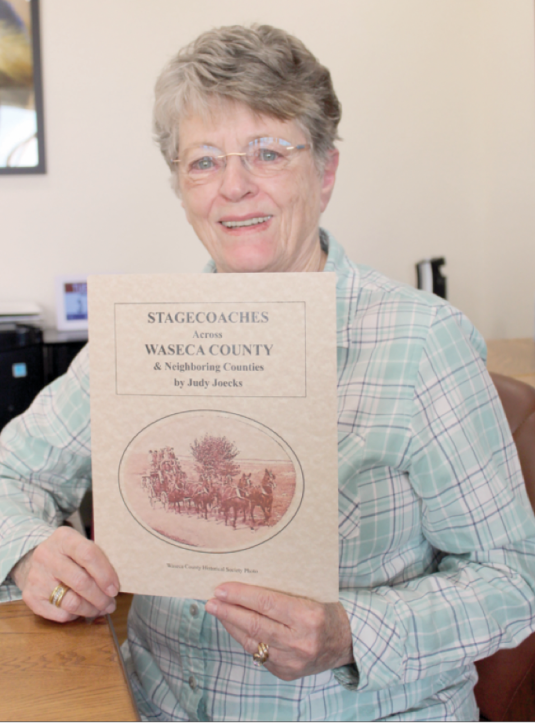
Waldorf area resident Judy Joecks, 84, has compiled four books documenting elements of local history. She has recently completed a 220-page book about stage coach routes and stops throughout Waseca County.
Stagecoaches across Waseca
Joecks pens fourth book
Joecks pens fourth book
Thu, 05/16/2024 - 12:30am
Since last September, Waldorf area resident Judy Joecks has been putting in some very long days to meet a self-imposed deadline of May 15. She is happy to report she has accomplished her goal: her most recent self-published book–this one titled “Stagecoaches Across Waseca County and Neighboring Counties”–goes to a Mankato printing company next week to be reproduced.
For the time being, she is collecting the names of interested individuals, so she knows how many of the 220-page, comb-bound book to have made; so far she’s planning on about 100. The price for books in this first printing will be $35.
Joecks, 84, admits that when she becomes curious about a topic, she feels compelled to learn more.
That was the case with her 1999 book, “A Touch of Waldorf History,” her 2018 book about the “Pink Schoolhouse,” and her 2023 book focusing on P.T. Barnum and the famous circus owners’ impact in southern Minnesota and most especially Waseca County, where he once briefly owned a farm near Waldorf.
Joecks became curious about stagecoach routes and practices in the county late last summer. Her research began with a visit to property formerly owned by one-time Waseca County Sheriff Mert Schwarz and now owned by Lyle and Judy Kunz. The crude foundation of the stagecoach barn and the remains of a trail are still visible on the property, which is located within an area that was part of Waseca County’s first county seat, the “memory town” of Wilton.
The barn was near the LeSueur River where it is now crossed by the “Wilton bridge” along County Highway 4 roughly 4 miles south of Waseca. Joecks points out, however, that there was no bridge at that time: In pioneer days, travelers had no choice but to find a shallow place to “ford” any rivers they wished to cross.
Joecks says she went on to visit many locations across the county looking for signs of former barns and trails. One of her most important sources as she continued her research was the Waseca County History Center, located in Waseca. She compliments Joan Mooney and other staff members who were supportive and helpful as she searched for all the information she could gather. In fact, Joecks says, she plans to donate any profits from the sale of her most recent book to the History Center to help ensure its work continues.
Joecks says she was also impressed by the enthusiastic response she got to requests placed with similar agencies in nearby counties. She pored through many hundreds of pages of information and referred to books and online sources as she gathered information.
“I don’t like to sew or make crafts,” she observes, “so I guess I could say my hobby is collecting, organizing, compiling and sharing information.”
In the course of her research, Joecks learned the county, like the southern region of the state, was once criss-crossed by stagecoach routes. A major source of income for the coach companies came from the U.S. Postal Service, which contracted with them to deliver mail to the towns gradually becoming established across the prairie.
Waseca County’s first homesteader was Asa Sutlief, who staked his claim in what is now Wilton Township in 1854. By 1857, Wilton had been named the county seat and had a post office. As other towns were incorporated, they, too, were linked by stagecoach routes.
Through those pioneer days, stagecoaches were the pipeline connecting communities to the larger network of the state and nation. According to Joecks, news and letters delivered by stagecoaches were a source of communication and comfort which helped them feel less secluded. Through her research, she came across many interesting anecdotes, including that, "The first mail delivery from Fort Snelling to Mankato was made on foot as far as Traverse Des Sioux (near St. Peter) and then down the river in an Indian Canoe to Mankato. A horse and light wagon were obtained for the return trip."
“Even after everything got better established, it was still a rough ride. The roads were really only rough, bumpy trails. Dust and rain could get inside the wagon. Sometimes wheels would break.”
When things were going well, it was still a slow ride; the coaches stopped every 15 miles or so to change horses. A stagecoach ride from Mankato to Owatonna took more than two days.
Anyone interested in arranging to receive a copy of “Stagecoaches in Waseca County and Neighboring Counties,” can contact Joecks either at her email address: judyjoecks@gmail.com, or by texting her phone at 507-317-1345.
Joecks compiles the originals of her books on her computer. She writes the text based on historically accurate sources including newspapers and local history books–perhaps most notably “James Child’s History of Waseca County 1854 to 1904.” She takes photographs using her smartphone, and finds other useful images online and in books and newspapers.
Acknowledging that many octogenarians are not well acquainted with computers, Joecks comments she doesn’t “pay much attention to my age.”
Joecks and her husband Dale have been married 65 years. They ran a farm operation for decades on land previously owned by Dale’s parents, raising three children. Their son Todd now operates the home farm near Waldorf, which is well on its way to becoming eligible as a century farm.