
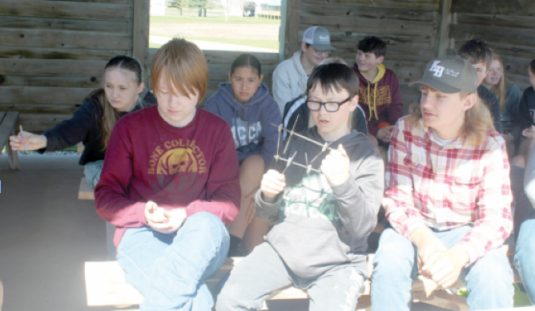
A student holds frames which are used to align and correct severe fractures or broken bones of animals, Dr. Troy Summers explained their use during a demonstration at Farmamerica on Friday, May 3.
Ag day at FarmAmerica
Wed, 05/15/2024 - 11:30pm
About 300 junior high students visited Farmamerica near Waseca on May 1 and 3 to learn about a range of diverse careers in the field of agriculture. The students came from Waseca; New Richland Hartland Ellendale Geneva (NRHEG); Janesville Waldorf Pemberton (JWP), and United South Central (USC) schools.
Students were divided into groups which then rotated to twenty-minute presentations at various locations.
Waseca fire chief Jason Forshee informed students about work in safety and rescue. He demonstrated a number of different types of gear and explained their uses. One of the first items Forshee explained was the “tripod” fire departments use for entering and exiting confined spaces. Another item Foreshee talked about was a metal enclosure used to prevent someone trapped in a grain bin from being buried; the enclosure also has a ladder attached to allow a victim to escape.
After one student asked whether Forshee had ever used the equipment, Forshee responded that he’s never had to in his career and he hopes it stays that way. He told students he has been called to only one incident involving grain storage. Fortunately, during that call in Hope, the victim was easily recovered.
Dr. Troy Summers from Summers Ridge Vet Clinic in Janesville told students about the four different oaths a veterinarian takes after finishing eight years of school. He revealed that veterinarians promise to meet continuing education requirements and to keep updated on issues in animal health. Besides that, they take an oath to relieve and reduce animals’ suffering, and to protect public safety by being aware of diseases which might migrate from animals to humans. Part of that promise is also protecting the public food supply.
“You don’t think about veterinarians protecting the food supply, but that comes in at a lot of different levels,” Summers stated, adding he learned that from being a large animal veterinarian for many years. “We set up vaccine protocols, quarantine protocols, sanitation protocols – whatever we need to do to keep animals healthy.”
Jason Leary, AG Technology Manager from Crystal Valley Coop, demonstrated a few different sizes of drones he uses for different purposes. One small enough to be held in his hands is used to assess and photograph crops from above. A larger drone is used for planting or spraying crops; it is capable of carrying up to eight gallons of liquid, so after about two acres, the drone returns for a refill. At the same time, the battery typically must also be replaced since it lasts for only twenty minutes.
Since drones are such a new technology, Leary told students the government is still determining what laws should be in place to regulate them.
“Right now you need a couple of different licenses, including one to commercially fly the drone,” Leary said and added that a custom applicator license is needed for the drone. Every drone must also be registered and insured through the state and on the federal level, he said, which can play into a reason why it’s mostly agriculture businesses that own drones right now.
During the day, David Trcka, Ag lender and Jaelyn Hebert, an assistant teller from FM Bank, conversed with the students about taking out a loan, interest accumulation, and building up savings. FM Bank emphasized the importance of repaying loans promptly, and of keeping strong rapport with the bank. If someone takes out a loan and doesn’t pay it back in a timely manner, Trcka explained, the bank might not grant a loan to that person again.
Trcka also gave examples to the students of how or why he will approve or disapprove a loan based on the farmer’s income, property, and the crop sales.
Hebert also suggested that the farmer can set up a certificate of deposit (CD) so they can save money for a fixed amount of time. But, she warned, any farmers who break agreement can be penalized with a fee. She also said there are some benefits to keeping part of an operation’s money less readily accessible.
Several employees from Dotson Iron Castings demonstrated to students how cast iron is molded into products for tractor parts. Students put sand into molds provided by the company; those were placed into a furnace that heated up the product for a few minutes. Students expressed apparent amazement about what could be done in a short amount of time.
Representatives from Bushel Boy Farms spoke about heir business, and all the different careers involved with growing vegetables. They also explained to students about the important inspections, testing, and quality control measures they take within their plant to supply their customers with their freshest food products. Students were offered samples of mini cucumbers, strawberries, and cherry tomatoes.
Larry Olson from Feedmill Operations worked a simple but enlightening math problem which revealed it takes fifteen percent of protein to make up the feed for growing hogs. As Olson also explained, sometimes the ratio for the measurements needs to be changed so a chosen goal can be met. He explained that the State of Minnesota tests feed products to ensure they have the nutrients needed for different animals.
Nathan Hanel and Courtney Spence from Southern Agriculture Center of Excellence also centered a discussion about how different products like Red Wing Boots are created from cowhide, so they involve the agriculture industry in that way. Paints and crayons are made from soybean oil and brushes originate from cattle hair. Hanel and Spence also explained that soybeans are cleaned, cut into flakes, refined and cooked before pigments, resins, and waxes are added to create soy ink.
“Bottom line is – think about this – agriculture is everywhere,” Hanel said.
Becca Habinck, Lab Manager and LeAnn Erickson, Environmental, Health, and Safety (EHS) Manager partnered from Guardian Energy shared information about making ethanol.
“Anything we make goes into gasoline, it raises the octane of the gasoline, and it makes the gasoline a cleaner fuel,” Habinck said. “Renewable energy is a big topic now, so it’s a good industry to get involved in,” Habrinck said. “It’s not going anywhere and there’s going to continue to be a huge push towards it, especially with the constant innovations, upgrades, and updates.”