
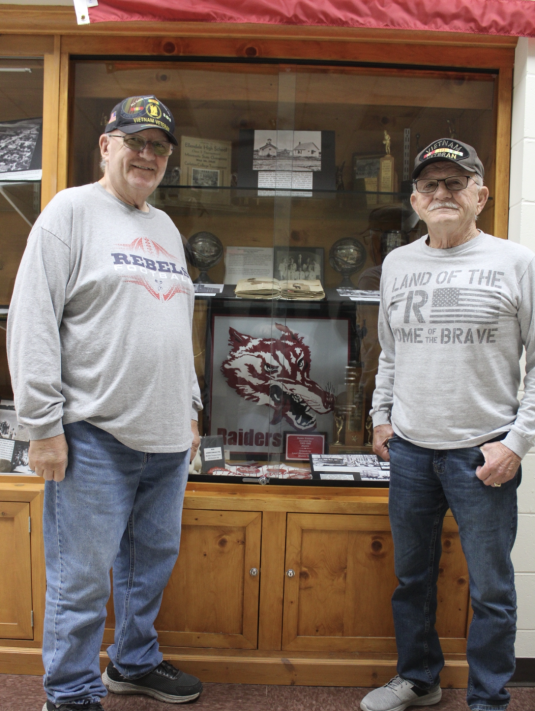
WARTIME REMINISCENCES - Larry Crabtree, left, and Dan Richards have a long list of life experiences in common, including having both been members of the 1967 Ellendale Raiders football team, and having served tours in Vietnam. Star Eagle photo by Deb Bently
Ellendale Veterans tell of shared experiences
Thu, 11/05/2026 - 8:00am
Geneva veteran Dan Richards believes he survived his service in Vietnam thanks to an astounding coincidence.
“I was sitting in this little airport. I’d just come in country and I was scared as could be what was going to happen to me, when he walks by, cocky as a rooster, swinging his short-timer stick,” remembers Dan as he describes seeing his lifelong friend and fellow Ellendale Raider football player walk past.
“I couldn’t believe it.”
Larry Crabtree had every reason to be in a good mood that day. After a bit over one year in country, he was within hours of catching his freedom bird home. But when he heard his nickname “Hiker” called out and discovered one of his best friends had been drafted, he stayed an extra day to show him the ropes.
Dan firmly believes the warnings Larry shared–the “everything” about guarding against dangers ranging from leeches to infections to bombs planted by innocent-seeming locals–were a big part of the reason he lived to catch his own freedom bird one year later.
Married to Suzie, the love of his life, and father to a baby only one month old when he arrived in country, going home was what he cared about most.
Larry had ended up in Vietnam after volunteering. The fall after graduating high school and still 18 years old, he and friend Steve Knutson had gone to a local army recruiter and asked whether they were due to be drafted: the answer was yes, within a few months.
“This was before draft numbers,” clarifies Dan. “For a while at the start, each county had a four-member draft board. They were the ones who decided who would be called up and who wouldn’t.”
Larry and Knutson were told that, if they volunteered, they could be part of a “buddy” program and could serve their time together. Since they would be going in a few months anyway, they decided to sign on. Crabtree celebrated his nineteenth birthday at home with family on Oct. 1, 1968, and flew to basic training Oct. 7.
Perhaps not surprisingly for those acquainted with Army “snafus,” he and Knutson completed basic training together, were chosen for different types of specialty training, and didn’t see each other again until after they’d returned to “the World.”
Larry was selected to be a radio operator–the one person in a 25-soldier platoon who sent and received crucial information while on patrol. He believes he was selected for the role because he had done well on a sound recognition test he took as he began basic training. The theory, he speculates, is that his good score indicated he would have an aptitude for learning Morse Code.
“I learned Morse Code in training,” he describes. “Then I never had any reason to use it again.
“In Vietnam, you learned what you needed to know by living it.”
It was commonly known that, when the enemy attacked an American platoon, the radio operator was one of the chief targets.
“They were ingenious,” says Larry of VC methods. Taking out the radio operator, he explains, removed the group’s connection to the main base. Without communications, the group could not report its position, call in defensive mortar rounds or air attacks, or arrange to have the wounded evacuated.
After a year of surviving not only forays and battles, but also deadly disguised traps, infection-carrying insects, flooding rains and landslides, and the apparent meaninglessness of marching into the jungle to fight a “relentless,” often invisible enemy, staying an extra day to help a friend was perhaps more of a sacrifice than most people can recognize.
Fortunately, Dan feels life afforded him some opportunities to pay Larry back.
Dan says new draftees were asked whether there were any roles they might choose to fill during their service. Perhaps because his mother was a nurse, and perhaps because he pictured himself working in a “nice, safe hospital somewhere,” he indicated he would like to train as a medic.
What he didn’t know at the time is that, along with radio operators, the VC targeted medics. “I think it was about morale,” he speculates. “With the medic gone, soldiers knew there would be no one left to keep them alive if they were wounded.”
After completing basic and specialty training, most draftees were allowed to go home for one month before being transported to Vietnam.
“I was called in to meet with the commanding officer,” he remembers. “I guess I thought I was in trouble, so I was nervous.
Instead, the officer informed him, “You lucked out.”
Dan was told that his performance in training had been the best in the group, earning him the chance to learn advanced skills by taking part in special, additional training.
That did not feel like “luck” to him at the time, since rather than going home for a month, he would spend those weeks learning medical and surgical techniques for treating typical battlefield wounds.
In response to Dan’s displeasure, the officer predicted, “If you survive Vietnam, you’ll thank me for this someday.” Dan says he never crossed paths with the officer again, but if he had, the prediction would have come true.
Because of that special training, he was stationed at the hospital on the company’s main base. He says he served a role much like the characters in the book, movie and television series M*A*S*H, receiving wounded from the field and performing initial surgeries needed to save their lives and minimize the negative effects of their wounds. The biggest differences, he mentions, are that he treated patients in a multi-floored building and “we didn’t act quite so crazy” as the characters in the series.
His life at base was not without dangers or discomforts. The work was complicated and demanding, with people’s lives hanging in the balance. He had the assurance of sleeping in the same bed each night (“If you can call it a ‘bed’,’’ interjects Larry), but it was in a tent, where the insects, the monsoon rains, and even the leeches could not be kept out.
Along with that, as Larry describes, “No matter where you were, you were in enemy territory.”
Dan shakes his head as he remembers a local who used a straight razor to give him a professional quality haircut. That same local was among the enemy casualties one night when the VC cut the defensive fences and came slipping through.
His most vivid illustration of danger, he says, occurred when “I made a mistake one night.” He describes that his tent was next to one occupied by two medivac helicopter pilots. They were notified they needed to pick up a wounded soldier, and the medic who usually accompanied them was sick with malaria.
“‘Richards,’ they shouted. You gotta come with us!” He says he had just served a 15-hour shift and wanted to sleep, but they wouldn’t take no for an answer.
“They told me it was a safe mission,” Dan recalls. “That there was no way I wouldn’t come back safely.
“So I decided to go.”
That one ride taught him a great many things.
“Those pilots were crazy, but they were also crazy good,” he says of their ability to maneuver at low heights just above jungle treetops. He describes a break-neck pace and a sudden stop above an unknowable landscape.
The gurney holding the wounded soldier, it turned out, had to be lifted from the battle below. In the meantime, the helicopter hovered there taking enemy fire.
“I was dancing around like a monkey,” Dan describes. “I was dodging bullets and shrapnel, with no idea which way to jump.”
When he set foot on ground back at base, he made a vow he had no trouble keeping: “Never again,” he says simply. “Never again.”
Both veterans shared their stories while wearing hats bearing the words “Vietnam Veteran.”
When asked whether, despite the reputation the Vietnam War carried, they were proud of their service, Dan says, “I wouldn’t be wearing this hat if I weren’t.” He does admit, however, that it took him decades to open up regarding his experiences with anyone other than fellow veterans.
He also comments that he is among very few Vietnam veterans who went on to make use of his Army training and experience. Encouraged by his former employer Harold Wayne, he attended an interview with some surgeons in Albert Lea. Based on what he had done in emergency surgeries, the hospital hired him as a physicians’ assistant–a position he held for 44 years, helping with surgeries of all types.
He is pleased that the job allowed him to “pay back” the lifesaving day Larry gave him in Vietnam in 1970 by helping with the C-section delivery of two of his children, and with a surgery Larry himself needed later on.
Dan and Suzie have been married 59 years. Dan still remembers the day he disembarked from a plane in the Twin Cities to find out that, despite being a timid driver at the time, Suzie had driven herself and their son to the airport to meet him. “She was the most beautiful sight I’d ever seen,” he remembers.
Larry recalls being greeted by his whole family. “They never told me anything about how things were while I was gone,” he describes. But words weren’t really necessary when Larry’s stoical father, who seldom allowed anyone to see his feelings, ignored the hand Larry was offering in greeting and instead clutched him in a powerful hug.