
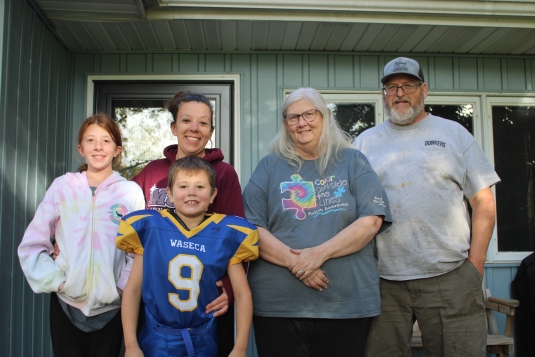
REBUILDING HOME - Next-door neighbors on Aspen Avenue, the Priebe and Wigham households both experienced flooding which reached into the main floors of their homes. Pictured here, from left, are Lizzy, Shelby and Hunter Priebe and Susan and Steve Wigham. Star Eagle photo by Deb Bently
Worry, uncertainty follow abrupt evacuations for local families
Lives on hold as family seeks answers
Lives on hold as family seeks answers
Thu, 10/15/2026 - 9:15am
“We don’t go in there,” Shelby Priebe says of her family’s home at 123 Aspen Avenue in New Richland. “There’s mold everywhere and I don’t think the air is safe to breathe.”
Shelby, her husband Tyler, their daughter Lizzy, 11, and son Hunter, 9, have been living with family since their property was inundated with water the morning of Sept. 19. When they last left the home around 8:30 that day, Tyler placed each of his family members in turn on his shoulders and carried them through the still-rising, thigh-deep water.
It was the last step of an evacuation that had begun about midnight the night before.
The lowest-lying building on the property is a spacious garage workshop where Tyler’s penchant for mechanical work had allowed him to gather a wide-ranging collection of vehicles, including snowmobiles, a vintage truck, their own lawnmower and one or two being repaired for friends, and the family’s cars.
Shelby describes that Tyler did not go to bed at all on Friday: given the heavy rain, his preparations began with protecting the basement from water that was rising up through the floor drain. With the inflow blocked, two built-in pumps were keeping the basement dry. As the rain continued, they were taken by surprise when water began rising in the utility sink. That, too, was blocked, and at 11:30 there was no water in the basement, an unfinished space used for storage.
With that accomplished and the rain continuing, Tyler checked outside. There, he saw that water was within one or two feet of the garage. At first, vulnerable items were being moved from the lower to the higher areas inside the building.
“We watched it,” remembers Shelby. “And we figured the water was rising at about a foot an hour.”
Friends, family, and trailers were called in. The machines were moved a few blocks to high ground onto land owned by a friend.
By about 5:30 Saturday morning, the endangered vehicles, equipment, tools and supplies had been removed. “I would say we saved about 90 percent of the things in the garage,” Shelby says of that long night’s work.
Shelby shakes her head as she remembers, “Hunter’s football team had a 9 a.m. game in Jordan. At 5:30, I still thought we would be going to that game.”
At 6:30, the house was completely surrounded by water. A basement window broke open under the pressure and the downstairs began to flood. Around the house, water continued to rise rapidly.
Shelby says she gave up on the football game and began to gather a few supplies.
Her mother, who was among the family members who had been helping through the night, observed how deep the water was and suggested she should pack for an extended absence.
At this point, the children were awake and frightened. Shelby says she was very grateful for her parents who distracted the kids while she tried to think what she would need.
“I asked myself, ‘What do we touch on a daily basis?’ and I started packing.”
As they left, the last suitcases and bags were lifted up over people’s heads as they worked to keep their footing against the cold water and the current.
By Monday, it was dry enough to approach the house. Shelby remembers being repulsed. “The whole place smelled like poop,” she describes.
A group of about 10 volunteers from Christian Ministries came to help with the cleanout. Tyler supervised in the basement. The youthful volunteers carried everything up the basement stairs and set it outside. It was Shelby’s job to say whether items were to be kept or discarded.
Some of the storage tubs in the basement remained sealed, so that their contents were salvageable. Others had apparently been pushed around by the current and were actually broken apart. A freezer full of meat was a loss. Items of winter clothing and two high-end snowmobile helmets were discarded: “We would never be able to get the smell out of them,” Shelby observes.
Between the number of items which went past her and the speed with which the volunteers worked, Shelby says it may be a very long time before she knows what she still owns and what is gone forever. “I have so many totes full of stuff, and so many different people helped pack them,” she says. “I don’t know where to look for things.”
In a particularly ironic twist, Shelby and Tyler had invested in a $100,000 remodeling project just this year, having lived at their address since 2013. They have seen flooding in that time, and had developed systems to be prepared for it. Water had never before risen anywhere near the levels reached during the Sept. 19 flooding.
“Never did I ever think water would reach our main floor,” Shelby says. “I couldn’t have imagined a time when water would push the basement windows in.”
As traumatic as it was to have to evacuate her home through floodwater, and as difficult as it was to see many of her family’s possessions discarded, she finds the difficulties which have followed just as bad.
“We don’t know what to do,” she says. “We want to know whether we will get some disaster funding. We want to know whether our house will be condemned. We want to know if we can make it safe to live in again.
“But we haven’t found the people yet, who can give us some answers.”
Shelby expresses gratitude to all the volunteers, family and friends who have given so much help. She says she is grateful that her family can stay with parents, and says doing so will probably be the “new normal” for some time.