
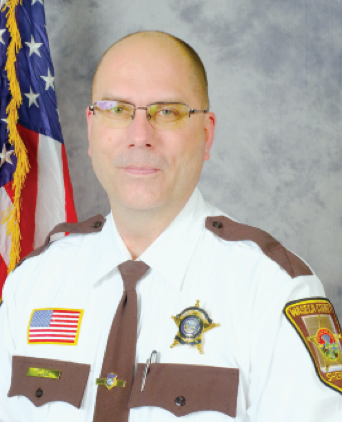
Dulas
Peace officers share impressions
Thu, 03/14/2024 - 1:00am
“Crime doesn’t stop at the borders of large metropolitan areas, and it doesn’t stop when the sun sets,” observes Waseca County Sheriff Jay Dulas. “Drugs and crimes continue to travel through Waseca County.”
Between the sheriff’s department and the police departments in Waseca, Janesville and New Richland, there are about 40 full- or part-time officers dedicated to protecting the welfare of Waseca County’s citizens. The Star Eagle asked representatives from all of those agencies about the status of their work.
Among the spokespersons, Waseca police chief Penny Vought has the longest history in law enforcement, having begun as a patrol officer in Waseca in the 1980s. “We’ve seen a lot of change,” she says simply. She and Waseca police captain Kris Markeson remember a time when the city advertised a job opening and received 50 applications. “These days we’re lucky to get two or three,” said Markeson, who has been with the department since 1999.
Nearly all the department leaders interviewed commented they feel fortunate their officers tend to remain on staff. Janesville police chief Steven Johnson credited a recent pay increase which he said helped make working for his department “competitive.”
Still, Sheriff Dulas observes, “Many officers have chosen to leave the field. The pay simply hasn’t kept up with the responsibilities, expectations and pressures of the job.” Between that attrition and a vast reduction in the number of people entering the field, there are hundreds of unfilled law enforcement jobs all over the state.
Here in Waseca County, only the Waseca department mentioned it is currently hiring.
While recent high-profile events may lead to the impression violent crimes are on the rise, local agencies have mixed responses. If “violent crimes” means shootings, armed robberies and the like, “There have always been occasional happenings,” said Waseca’s Vought. Janesville’s Johnson, on staff in the city for 23 years, said the town actually experienced a decrease of such instances when state highway 14 was rerouted, thus reducing the amount of traffic moving through city streets.
Still, speaking of the shooting which occurred in Janesville’s downtown last summer, he observed, “It opens your eyes. We may think of ourselves as a peaceful little bedroom community, but we shouldn’t convince ourselves things like this don’t happen here.”
New Richland police chief Tanyce Bruegger believes the widespread problem of substance abuse has fueled increases in violent crimes. “People are engaging in riskier behavior,” she observed. “And they have the perception there are fewer law enforcement officers.” Bruegger, who has been with the New Richland department since 2018, suggests unfavorable coverage of law enforcement in social and public media may have harmed the public’s perception of officers and the work they do.
“There’s always more to the story,” she said of such publicity. “It’s easy to manipulate a piece of video or items of information; people shouldn’t trust everything they hear or see.”
Along those lines, Bruegger mentioned that fraud and scams, often carried out over the phone or on the internet, seem to be on the rise. She cited phone calls received by area residents from someone claiming to be an IRS representative telling victims they had underpaid on their taxes and must make up the shortfall immediately to avoid criminal prosecution.
“Never give out private account information or your social security number unless you know for certain you are talking to someone reputable,” Bruegger advised.
Sheriff Dulas mentioned the chief objective law enforcement officers have as they carry out their daily duties is to support and protect area residents. “We know our community members,” he said. “We know their schedules, and so we usually know if something is out of place.”
“Just call,” said Waseca’s Vought. “If you ask any officer why they entered law enforcement, the answer is always the same: ‘To help people.’ So if you think something is odd or out of place, we want you to feel free to call us.” Though they are not “the rumor police” and cannot fix negative interactions on social media, she says officers will be sympathetic and may know of some resources that will be helpful.
Vought and Markeson say their department’s strong retention rate can be at least partly credited to the connection their officers build to the community and to each other. “We are truly grateful for the support and goodwill shown to us,” said Vought.
“We feel we’re respected and appreciated,” said Dulas.
“Sometimes law enforcement is painted with a broad brush,” observed Janesville’s Johnson. “It’s something for us to overcome if some of those negative images from the media overshadow our work with our citizens.”
When the topic of change is introduced, the response from law enforcement agencies is universal. “Change is constant for us,” said New Richland’s Bruegger, naming alterations in statewide laws as well as the ongoing training law enforcement officers must take part in to keep their licenses current.
She also mentioned that cultural changes within a community lead to changed expectations from the people officers serve.
Waseca’s Markeson also pointed out changes within a community, saying increased mobility has led to greater diversity among the city’s residents. For everyone’s safety, he suggested, “We all need to do a better job of being neighbors. We should get to know each other, build connections. That sort of network can be really important when there is a problem or a crisis.”
“Law enforcement doesn’t make the laws,” said Janesville’s Johnson. “We enforce them.” He described his role as “ever-evolving,” saying it follows trends set by society and by legislators. He named changes in DUI laws, regulations involving the use of force and the legalization of marijuana as changes which have impacted his job and how he performs it.
Sheriff Dulas and others also note a change in the overall approach of law enforcement. “There was a time when we felt our job was to locate people breaking the law and punish them,” said Waseca’s Markeson. “The perspective now is to approach every situation with the intent to find the best outcome for all parties.”
Over the past few years, perhaps the biggest sea change for law enforcement officers has to do with mental health.
“No call is the same as any other,” said New Richland’s Bruegger, mentioning factors ranging from elderly people experiencing dementia to others undergoing a perceived crisis. “You might get a call that there is a suspicious person walking around town at three in the morning. As you approach them, they might run or they might pull out a knife. You never know how something is going to play out.”
Bruegger named the dual demands of being “constantly on your guard” while also interacting with others reasonably and compassionately.
Janesville’s Johnson offered a similar example: “There might be someone standing in the middle of the street shouting at cars,” he said. “Since you might not know anything about that person’s state of mind, you have to assess all the levels of danger happening at once.”
Many individuals being held in the county jail, Sheriff Dulas observed, are there for their own protection, or to give them time to recover from a “bad trip.” Jailers have observed every behavior from cowering quietly in a corner to screaming at loud volume, from mentioning a desire to commit suicide to threatening to kill others. Inmates have endangered themselves by trying to “dig bugs” out from under their skin or by remaining awake for days.
As officers county-wide respond to calls involving drug use or mental illness, Dulas pointed out, they must constantly assess the situation and any safety risks to themselves and other parties nearby.
Among possible sources for what every department named as “exponential” increases in cases involving mental illness, Janesville’s Johnson named homelessness, illicit drug use, financial difficulties and the isolation caused by the years of Covid lockdown. New Richland’s Bruegger named physical and emotional abuse, depression, anxiety, and financial struggles. Also suggested was the decrease in personal interactions which has come about because of electronic communication and the vulnerability of young people’s self esteem when insulted on social media.
In line with seeking “the best outcome for all parties,” Dulas said, officers do their best to reason with persons in crisis.
“But of course they’re not thinking straight,” commented Waseca’s Markeson. “The reason we’re talking to anyone is because they’re having a bad day. We may have been called for anything from a flat tire to an attempted stabbing.
“Our decisions often have to be made very quickly with the information we have available to us at the time.”
It is clear from these leaders’ observations that area law enforcement personnel face many demands. Those who choose the profession, and then choose to stay in it, “show tremendous regard for the people and communities they serve,” said Dulas.
“We’re very proud of our officers,” said Waseca’s Vought. “They come to work ready to face the challenges of the day. Things are always in motion.”