
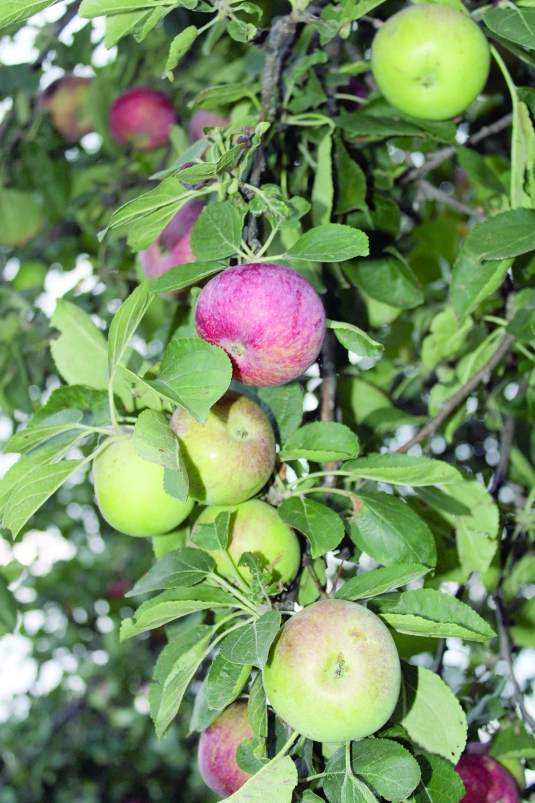
MOON OF MUCH RIPE FRUIT - These apples on a tree in Deb’s yard got her thinking about time, and the ways we refer to it. Star Eagle photo by Deb Bently
Dividing the year into moons
Wed, 07/29/2026 - 11:00pm
I am fascinated by the Native American way of dividing the year into “moons.” That is, they did not designate weekdays or assign them names, but simply referred to the four weeks between one full moon and the next with a single name. What I enjoy is that the name for the “moon” creates a picture in one’s head of the circumstances and climate happening at the time.
“Geese Laying Eggs Moon.”
Close your eyes and think of this name. Do you almost feel yourself traveling in time? For me, I can practically hear the geese honking as they arrive at area lakes. I feel as if I am inhaling the invigorating spring air that fills a person with promise and anticipation as the last of the ice is breaking up on area lakes and the grass is turning that vibrant shade of green.
“Tree Popping Moon.”
Now close your eyes and repeat the name to yourself. Do you feel the world constricting, the cold taking you by the shoulders and shaking you? But there’s also the purity of the air, as though it’s so clean it shines. The forest floor is a changed place, with the impassable undergrowth now reduced and made powerless. Snow is still fresh and friendly, something to kick up with your feet or decorate with deliberately placed footprints.
The internet provided the three above as having been named by the Dakota, the people who occupied this part of the state for centuries.
The Anishinaabeg (also called Ojibwe) occupied the more northern portion of the state, although their territories did overlap in places with the Dakota.
Among the Anishinaabeg, what we think of as August is “Wild Rice Making” moon. Here, too, the pictures in one’s head are abundant: a lake covered in ripe grain–food to feed families through the winter–if only it’s collected in time.
Pretty much all native peoples in North America named their months like this. The Navajo, whose ancestral territory is in the southwest, named the weeks of February as the “Moon of Hatching Eagles” and March the “Moon of baby animal sounds.”
The Mohawk people, whose traditional territory was what we think of as the Northeast and northward into Canada, named the weeks of July the “Moon of much ripe fruit” and October as the “Moon of the fading landscape.”
These speculations entered my head when I looked at the apple tree in my front yard. Back in the Moon of Geese Laying Eggs, the tree was a giant bouquet, white with flowers, filling the yard with a heart-winning perfume. Bees and other insects moved busily across its surface as though time itself honored their efforts.
Now, in the Moon of Much Ripe Fruit, the branches are weighted with apples the size–and almost the color–of tennis balls.
If I name the time that has passed since The Moon of Small Leaves (a name used by the Mohawk) “April to July,” the magic and mystery are diminished, in fact, almost completely lost.
Admittedly, if I abandoned the Gregorian calendar, I would probably never meet the newspaper deadlines that make this publication possible.
But I am also not letting completely go of the Lunar way of measuring time. If you research the sources of month names that appear on our printed calendars, you will find their stories pretty dull. In fact, the months from September to December are simply based on the Roman names for the numbers seven through ten. The earlier months are named after figures in Roman mythology, and two are the results of egotistical chest-thumping by Roman emperors, specifically Julius Caesar and Caesar Augustus.
Nope. I would much rather have the Moon of Boiling Maple Sap and the Strawberry Moon. Rather than December, I much prefer the Little Spirit Moon, a time set aside for storytelling, resting, and enduring the early cold of winter.