
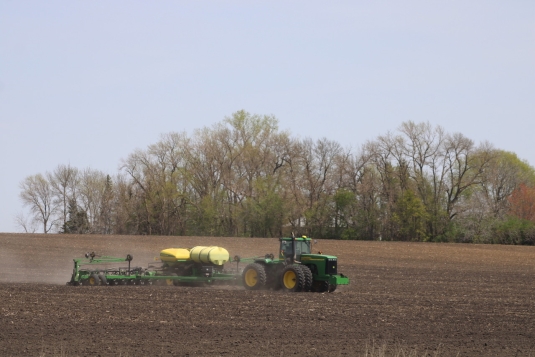
The Annual Ag Summit took place at Wedgewood Cove in Albert Lea on Feb. 5. It included presentations, breakfast, and a gathering of farmers.
Ag Summit
Wed, 02/18/2026 - 11:15pm
It was the 26th Annual Ag Summit that took place at Wedgewood Cove in Albert Lea on February 5.
The audience comprised people who had become blood brothers or blood sisters with a farm implement after a wrench had lost its grip, resulting in skinned knuckles for the user.
Why do farmers attend meetings? Here are six essentials.
1. To network with peers and to socialize with other producers and experts.
2. To learn.
3. To improve profitability.
4. To solve a problem.
5. The meeting is held in the winter to avoid planting and harvesting times, and the meeting is at a pleasant location with ample and easy parking.
6. A meal is served.
How did the Ag Summit do on those requirements? As my late friend Irvin Loe would answer, “One hundred percent.”
A continental breakfast started the day followed by the introduction of Tom Sorenson, CIC, AFIS, CPIA-Agency Director of Americana Insurance Group. Tom’s presentation was “Americana Insurance Producer Statistics, Trends, & Averages: A look at Americana Insurance Group Farmers as a whole.” In 2025, Tom was named Minnesota Agent of the Year by the Big I, a professional trade association for independent insurance agents. That’s a big deal from the Big I.
The statistics Tom highlighted were based on the Group’s business and showed the 10-Year APH (Actual Production History) is 201.95 bushels per acre for corn and 56 bushels per acre for soybeans. The trends indicated that sellers receive a lower price seven out of ten years when they sell the crop right out of the field.
Liz Ludwig from the Freeborn County FSA (Farm Service Agency) office gave an informative talk on various deadlines that are looming. Deadlines are always looming.
Pauline Van Nurden, the Associate Director/Extension Economists, Center for Farm Financial Management at the University of Minnesota, presented “From Field to Finance: Navigating Farm Finances and Crop Production Costs.” She said farm profitability is based on: Production, marketing, cost control, capital management, a willingness to change, and it is about base hits, not home runs. The bottom line as to why some farmers are more profitable than others is that small improvements equal profit gains. Minnesota is projected to see a decline in net farm income in 2026.
Rob Holcomb, Extension Educator at Agricultural Business Management Extension, addressed the topic “Business & Farm Entities: Why and what type of entity should a farmer consider, if any?” Why would you consider a different entity? Rob listed the reasons: Liability, taxes, ownership and management, authority and formalities, capitalization, transfer and estate planning, and government programs. Limited Liability Company (LLC) has become a popular entity. An LLC may have as few as one member. The owner decides how it is to be treated for taxes, and personal assets are not available to satisfy business liabilities.
Chelsea Ferrie, Senior Field Crops Liability Coordinator for Practical Farmers of Iowa, discussed “N Rate Risk Protection Program, a free program that lowers the financial risk associated with trialing reduced nitrogen rates for corn.” Included were Cover Crop Cost-Share and Cost-Share for Extended Rotations.
Representatives of AgriSompo reviewed the updates that were made under the Big Beautiful Bill to SCO (Supplemental Coverage Option) and ECO (Enhanced Coverage Option), which are federal crop insurance endorsements that provide county-level, area-based coverage for a portion of a farm's deductible, supplementing the main farm-level policy.
Right before lunch, there was an agriculture forum panel, which offered a question-and-answer session with representatives from various agricultural industry services. The audience was attentive, and not even one asked, “What’s for lunch?”
A tasty Italian meal was what was for lunch. My mother didn’t raise any fools, so I ate. It was mighty good.
After lunch, Jolene Honcomp, CLU, ChFC, CLTC, Benefits Advisor for Noah Insurance Group & Member of Americana Insurance Group Financial Partnership Group, presented “Land as Your Legacy: Where do you start when it comes to planning the future of your farm?”
This ink-stained wretch needed to be elsewhere, so I missed Jolene’s presentation. One can’t be two places at one time. I remember when my mother told me that. It was a painful thing to hear at the tender age of 27 years. She should have waited until I was more mature before telling me.
I know from experience that Jolene does a wonderful job of explaining how a transition plan helps. It preserves a family‘s legacy. It provides an orderly transition of ownership and management. It provides financial basics. It turns illiquid assets into cash for taxes and expenses. It preserves the value created by a farm. It is imperative that important family conversations about the future of a farm are initiated. Basic questions need to be answered and discussed with family members to get a sense of what steps to take for a successful transition.
There were a proper number of breaks. Any Ag Summit worth its salt knows the importance of properly timed breaks that include refreshments. Without suitable breaks, 10 minutes can seem like 10 hours.
It was a treat for me to be involved with such a fine day spent in the company of ag folks. I have a great job.
No two years are the same. No two days are the same. Perhaps 2026 will be the year that the weather will be perfect in every way.
Even if it is not, I know the farmers will carry on.