
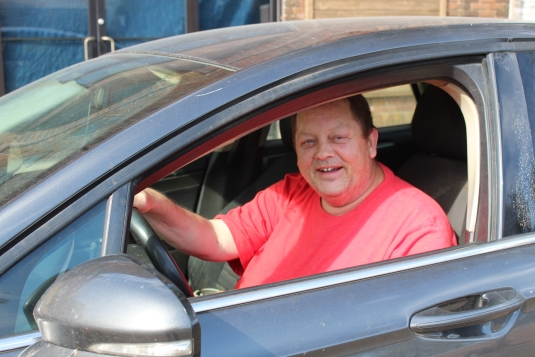
RECOVERED - Darin Reese is now back at the part-time job odf delivering copies of the NRHEG Star Eagle and the Waseca County Pioneer to newsstands every week. Star Eagle photo by Deb Bently
Back from the edge
Local man recovers from nearly fatal infection
Local man recovers from nearly fatal infection
Thu, 10/09/2025 - 12:30am
"I'm really grateful because now I understand I truly am lucky to be alive." -- Darin Reese
Though he wouldn’t admit it then, New Richland area resident Darin Reese, 57, acknowledges he was being both stubborn and irrational that day in June. He says with warm gratitude that, without the determined intervention of as many as 10 people, “I would have gone back into the house, laid down, and died.”
Reese is disturbingly well acquainted with illness: a diabetic and someone who was diagnosed with Hodgkin's Lymphoma in 2018, he had already beaten one set of odds by living with the rare form of cancer past the expected maximum of two years.
When discovered, the lymphoma was treated by surgically removing a lump in one of his lymph nodes and then by eight rounds of chemotherapy. Since then, he says it has “flared up” every two to two-and-a-half years, requiring additional rounds. Such had been the case a few weeks before, at the beginning of the month.
That day near the end of June he was convinced he had a severe flu. It started several days before when he had gone outside in the dark, forgotten about a construction project underway on some steps, and fallen down “hard” landing on his tailbone.
“It hurt so much, I wondered if I had broken a bone in there,” he said of his pelvic region. Within a day or two, along with a sore bottom, he began to experience flu-like symptoms. “It just kept getting worse and worse,” he remembers. “After about a week, I felt so awful I wanted to cry.”
Darin’s wife Kim looked him over and asked what was wrong. He answered only that he figured he had the flu.
“I’ve called an ambulance,” she told him. He acknowledges now it was the right thing to do. He remembers he was in pain, pale in color, and drenched in sweat. “If you had put a bucket under my chin, I probably would have filled it in a few minutes,” he says. “My clothes were wet.”
At the time, however, he told her not to call an ambulance. If he had to go for medical treatment, he would drive himself rather than pay for an expensive “taxi” ride.
He got out of bed, walked out of the house, and saw the ambulance had already arrived. Using less-than-polite language, he told the emergency medical technicians (EMTs) to leave and got behind the wheel of his car.
Others told him he was in no shape to drive, that he was likely to hurt himself or someone else. Law enforcement was called; a sheriff’s deputy and police officer placed their cars, so it would be impossible for him to drive away.
“But I still wasn’t going to get into that ambulance,” he remembers, shaking his head.
Soon lead EMT Sarah Sundve, who had been one of the technicians to arrive first, called Darin’s adult daughter Karen Cully, who is also an EMT.
Though he refused her request to get into the ambulance, he did at least allow Karen to take his vital signs.
“She started to cry,” Darin says somberly. “She said, ‘Dad, those are the worst vital signs I’ve ever seen. Please, please get into the ambulance.
“‘You could die.’”
His daughter’s tears finally broke through his defiance. He said he would consent to the ride “in five minutes.” Then, with everyone waiting and his deeply concerned daughter watching him closely, he lit a cigarette and smoked it.
To Karen’s amazed question he responded, “If they’re going to put me in the hospital, it’s going to be a while before I get another one.”
Finally he allowed himself to be sped to the hospital in Owatonna. There, after some preliminary attention, he was informed he needed to be transferred to a Twin Cities hospital. He protested again, saying “You guys are going to charge me $10,000 for that.”
He remembers a nurse looked at him sternly and responded that yes, it would be expensive. “But look at it this way, at least you’ll be alive to pay for it.”
He was soon on his way. By this time, he admits, he was so sick he was nearly lethargic.
“I just wanted to go to sleep,” he remembers. “But they wouldn’t let me.
“When I asked why, there was that word again.
“‘If we let you go to sleep, you’ll probably die.’”
Even yet at this point he remembers thinking everyone was being overly dramatic.
He arrived at United Hospital in St. Paul and was told he would be having surgery almost immediately. A little of his spunk had apparently returned, because he says he told the anesthesiologist “I’m gonna fight you,” meaning he believed he could resist becoming unconscious.
“He leaned over me,” Darrin remembers, “and he said ‘Good night, Mr. Reese.’
“The next thing I knew, I was waking up from surgery.”
After the haze of illness and fever cleared, he was able to listen when doctors told him what all the “drama” had been about.
The surgery had removed a section of Darin’s behind which had been infected with flesh-eating bacteria.
His first reaction was to tell them they had clearly “missed the mark” in their diagnosis, that he had not been outside the state of Minnesota in years, and so could not have contracted a mysterious tropical infection.
Their response was to inform him the alarming-sounding bacteria are everywhere, including on people’s skin. Two circumstances limit their ability to infect people. One, they cannot enter the body through a “natural” opening, for example, the eye sockets, nostrils, mouth or anus, but can enter through a wound as small as a mosquito bite. Second, they are easily defeated by a healthy immune system.
Having just recently gone through chemotherapy, Darin’s immune system was compromised; apparently scuff marks caused by his fall had provided the entry point. From there the bacteria had been multiplying rapidly. Since they were immune to antibiotics, the only solution was to remove them surgically.
He says the wound from the surgery was 17 inches long, 7 inches wide, and as much as 4 inches deep. He asked the doctors whether they had gone so far down they could see bone, and they answered they had.
With a wound that size and a chance the bacteria might have spread to nearby bone, Darin spent the next two weeks at United Hospital, and was then transferred to “acute care” at Glencoe Hospital. He stayed in acute care for 40 days.
He claims that, having come to understand the seriousness of his infection, he was not rude or irrational to the staff there, although he did somehow arrange, after a while, to take occasional drives through the town of Glencoe on his own. He had convinced family members to bring up his car.
“I would just drive around town for a little bit,” he states. “I would get some fresh air and have some time away.”
He admits staff members were not entirely supportive of his brief escapes, but it was a compromise they were willing to make.
Darin says time away was important to him because, frankly, it was embarrassing to have a wound as large as his in the place where it was located. It needed to be examined regularly and “packed” with gauze. Darin is not above making occasional crass jokes about his situation.
Which is why, he says, it’s important to him to express his gratitude to the nursing and healthcare staff at Glencoe. Everyone, he says, was compassionate, considerate and open with him, and more than once he has bought treats to show his gratitude.
In fact, he says only one staff member at the hospital was ever unkind or inconsiderate–a Dr. H who not only shouted at him one time, but also caused difficulties for other staff members, chief among them the nurses. “That man had no bedside manner whatsoever,” Darin recalls. “I can’t help wondering why they keep him on staff.
“It’s bad enough being sick. No doctor should make it worse.”
Speaking of difficult moments, Darin–a talker and storyteller who can usually go on and on–remembers some news which left him literally speechless.
It had come to be August. He had been in acute care for a number of weeks and was feeling much better.
“Four nurses came into my room and they told me ‘We have to talk.’
“Then they told me I didn’t need acute care any more, so I was going to be transferred to another part of the hospital.
“And I was going to stay there until April.”
Darin describes thinking of the last weeks of summer, Halloween, the harvest, Thanksgiving, Christmastime, New Years, Easter and everything they bring.
His thoughts spun and his throat closed up. “I could barely breathe, let alone say anything,” he recalls. “I was having a full-on panic attack.”
The nurses talked him down, got him a drink of water and even gave him some medication.
“Me, speechless!” Darin observes jokingly. “Can you imagine it?”
With the crisis averted, he was ready to ask: “You’re saying I won’t be leaving here until the bunnies are making babies again?”
And the nurses claimed, yes, given the size of the wound and the treatment that would be needed to help it close, medical experience indicated it would be that long before he was ready to leave.
Yet again, though, Darin describes beating the odds. He recalls an incident when a nurse who had not treated him before came into the room and began following the provided protocols.
“She got all flustered,” Darin remembers. “She asked me, ‘What don’t I understand?’
“Then she went and got another nurse.”
He goes on to summarize that, after being told in August he would need another seven months of treatment, he was released from the hospital on Sept. 8. His wound, he said, healed faster than anyone would have predicted. The total length of his stay, from June to September, was 78 days. He describes the time as “surreal.”
“It really makes you wonder about the power of prayer,” he comments, explaining Randy Cirksena, pastor of United Methodist Church in Ellendale, had visited him regularly, and had told him members of the congregation were praying for him.
“I really don’t have any other explanation,” says Darin. “I survived. My wound is healed, and the doctors had no reason to keep me any longer.”
Darin is now back at the part-time job he does delivering copies of the NRHEG Star Eagle and the Pioneer to newsstands. “I’m not completely back to normal,” he says quickly. “They told me that for every day you spend in the hospital, it takes five days to get your strength back.
“So I’m moving kind of slow, but at least I’m moving.”
He returns, then, to the point where he started. “Those people in June, they were a well-oiled machine.
“I wasn’t making much sense, but they were kind to me, and they did what they needed to do to get me into that ambulance.
“I’m really grateful because now I understand I truly am lucky to be alive.”