
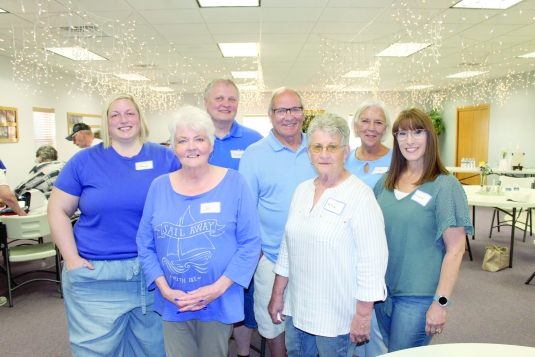
Members of the Community of Ellendale Foundation board of directors organized and operated a "restart the beat" education session meant to teach residents about operating the new Automatic External Defibrillators (AEDs) due to be installed soon at a number of different community churches. The AEDs were purchased using Foundation funds.Board members are (from left) Tiffany Krueger, Jo Lerberg, Jack Harpel, Arlen Brekke, Allie Larson, Colleen and Michelle Sletten.
Restart the Beat teaches use of AEDs
Wed, 06/04/2025 - 8:04pm
Staying calm may be both the most important and the most difficult element of responding to a crisis, suggested emergency medical technicians (EMTs) Brittany Boswell, Merisa Thompson and Caleb Carnes during an event sponsored by the Ellendale Area Foundation the evening of May 12.
About 25 people gathered at the Ellendale United Methodist Church for a training session titled “Restart the Beat,” an opportunity to learn about the operation of four newly acquired automatic electronic defibrillators (AEDs) due to be installed in three city churches and the town’s community center. The devices were acquired by the Ellendale Area Foundation at a cost of about $5,250 and are being distributed to the facilities free of charge; installation and posting of signs will be the responsibility of the organizations.
As EMTs began to describe the operation of the AEDs, reassurance seemed to be their central goal.
“Everything about operating them is pretty automatic,” said Boswell. “As soon as it’s turned on, it starts to give you instructions.”
AEDs, the presenters explained, are used when someone’s heart has stopped beating.
“If someone goes down,” said Boswell of an apparent heart attack, “you want to call 9-1-1 right away.”
“Get [EMTs] rolling,” stated Thompson. “Once you call here in Ellendale, we can get to you in about eight minutes.
Calling 9-1-1 has another advantage, Boswell mentioned. The emergency dispatcher is likely to stay on the line to answer questions, offer support and provide updates on the status of emergency response personnel.
Someone who is alone with an unconscious victim should call 9-1-1, then acquire the AED unit and begin resuscitation efforts, the EMTs advised.
“If there are people around, delegate,” said Boswell, offering the example that one person could be calling 9-1-1, another could be acquiring the AED machine, and a third could be shaking the victim, asking whether he or she is responsive, and checking for pulse and respiration.
In response to an audience question regarding a very weak pulse or very faint breathing, Boswell assured that using the machine would not harm someone whose heart is still beating faintly. She went on to mention that Minnesota’s “Good Samaritan” law protects those who are acting in good faith from liability.
She also mentioned that, if no pulse has been detected after 10 seconds of feeling for a pulse either at the neck or on the wrist, EMTs feel it is valid to say the victim has no pulse.
Packed with the AED machine are some pieces of equipment useful when preparing to use the device. Central to the defibrillator’s function are two adhesive pads about 5 inches square. These are to be adhered to the skin in locations above and to the left of the heart and below to the right of the heart, creating a pathway for an electric pulse. Since it’s very important that the pads have strong contact, all clothing must be removed from the two locations, and sometimes hair must be shaved. In preparation for these needs, a scissors and razor are packed with the units.
Also included is a CPR mask, a sort of shield which can be used to perform rescue breathing without directly contacting the victim’s mouth.
EMT trainers demonstrated that the AED machines start automatically upon being opened; a recorded voice begins with instructions to locate the adhesive pads.
“From here, you follow the instructions,” said Boswell. The training crew had brought sample pads for those in attendance to practice with, and invited everyone to look at the machines and supplies.
“This is a high stress, low frequency situation,” Boswell described. “That’s why we do training. We want to acquire some muscle memory to help us perform correctly when the need arises.”