
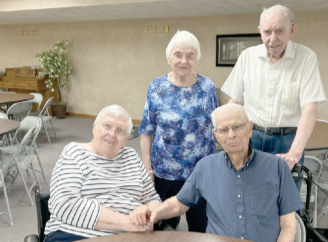
Front are Harriet and Ken Eaton. Back: Carol and Rolland Swenson. Rolland was the general contractor for the building project. Ken, along with many men of the church, donated their labor to complete the building.
Vista church building turns 60
Thu, 09/19/2024 - 12:30am
In 1962, the congregation of what was then called the “Swedish Evangelical Mission Church” was experiencing growing pains. The wooden structure that had housed their services since 1878 did not have enough space for Sunday School classes; the building’s “auditorium” was not large enough to provide comfortable seating for those attending services.
The church owned five acres of land located along what is now known as 275th Avenue in Otisco Township; it had been purchased in 1882 for $100.
In May of 1962, members voted for two significant changes: they would rename their congregation “Vista Evangelical Lutheran Church” and would begin assembling funds for a new structure to be built on their existing site. The objective was to raise at least half of the needed money before the work began.
By December of 1962, the congregation had received about $23,500 in donations. In September of 1963, a special “building fund” service included choirs performing in German, Swedish and English. Funds raised then, including a $5,000 donation from Edgar F., Marvin L. and Everett Johnson and their wives, energized the group’s efforts. A building committee was formed and groundbreaking took place in October of 1963.
Otisco-based construction contractor and Vista Covenant member Rolland Swenson was selected to lead the project. His company agreed to coordinate the construction schedule in a way which allowed church members to volunteer their time and save on costs.
Swenson remembers traveling to Kansas with fellow construction committee member Reuben Youngberg. The two visited a recently-constructed church building and decided its design could suit Vista Covenant’s needs. Swenson began taking measurements and recording notes when the members of the church simply offered him a copy of their blueprints.
Another astounding timesaver was the process of ordering the laminated arches needed to support the church’s high, open interior. Swenson says that, when he went to an Albert Lea company which specialized in the process, he was informed someone else had placed an order for arches meeting the needed specifications and then canceled: the company had the needed materials on hand, ready to deliver, saving the project a four-month wait.
Another example of what members regarded as divine intervention was the range of skills represented among the congregation. Reuben Youngberg coordinated the construction of the pews with a company in Mankato. Lloyd Peterson, an electrician, was able to lead that phase of the project. Bricklayer Darrold Steen had the knowledge and skills to coordinate the raising of the walls. Church member Floyd Calhoun was familiar with using fiberglass in construction, a skill needed to build and connect the church’s steeple.
“Do you think God wanted to see our building built?” asked church member Paula Hansen during a special anniversary celebration held at the church on Sept. 15. “God knew what we would need in 1964, and began putting it in place years ahead of time. We only had to follow the path that had been laid out for us.”
Another remarkable coincidence was the weather. Hansen described the harvest season as providing opportune, even “beautiful” fall weather, making it possible for farmers to spend the necessary time in their fields and also have free time to volunteer. She mentioned that on the December day workers were about to finish putting shingles on the roof, they were in a race against a snowstorm forecast to reach the area any time.
“Soon after they nailed down the last shingle,” Hansen said, “it began to snow.”
About 50 people were present in church for the Sept. 15 celebration and for a dinner which followed.
Gratitude was expressed to the construction committee members who are still church members: Carol and Rolland Swenson, Harriet and Ken Eaton, and Lloyd Peterson.
Hansen also pointed out that many “youth” members of the church performed unskilled tasks to assist in 1964, including cleanup projects around the site and unloading sod for the new building’s lawn the next spring. Hansen asked those youth members, including herself and sister Pam Coyer, to raise their hands: about 10 individuals, now in their 60s and older, made themselves known.
Hansen also mentioned an observation shared by the still-living construction committee members. “They said the enthusiasm, the collectedness, and the dedication of the volunteers was truly a blessing,” stated Hansen. “They said it was a blessing to be part of the work.” Thanks to the many remarkable coincidences and to the dedication of the workers and volunteers, the 1964 structure was completed in less than 10 months, holding its inaugural open house in August of 1965.
That original building was expanded with an addition completed in 1977.
Planning committee members for the Sept. 15 observance were Hansen, Coyer, Laurie Hendrickson and Sharon Robran.