
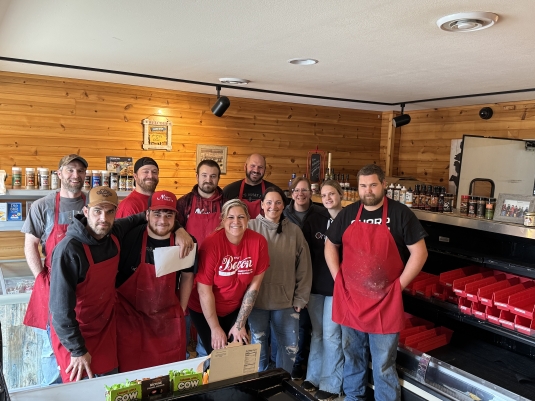
STRONGER THAN WATER - At left, Dan and Amber Lewer, owners of Neighbor’s Meats in New Richland, are grateful to their employees whose work and dedication helped make it possible for the company to be back in operation only three days after flood water receded from their building. Star Eagle photos by Deb Bently
Vigilance, resilience allow quick response at businesses
Thu, 10/08/2026 - 8:45am
The pictures–and the rumors they spawned–implied complete ruin.
New Richland businesses Neighbor’s Meats, owned by Dan and Amber Lewer, and New Richland Auto Repair owned by Isaac Kofstad, were both completely surrounded by water during the flooding that hit the community the morning of Sept. 19.
Both also had their doors open and were serving customers within 2 to 3 days after the water’s retreat, though rumors had suggested they would be forced to close their doors forever or move to alternate locations.
At New Richland Auto, water levels eventually reached about 30 inches. The lower third of all plaster walls in the building is now stripped to studs. Cabinets and desks have been removed and scrapped, and Isaac estimates recovery costs could reach $100,000. The company’s most valuable diagnostic equipment, including some sensitive electronics, survived undamaged because Isaac placed what he could on one of the workshop’s hydraulic lifts and raised it to maximum height. Shelving and a tall hay rack located in the workshop also held equipment high enough to keep it dry.
Wearing hip waders, he was able to remove the company’s computer, complete with essential financial records, the morning of Sept. 19 as water continued to rise past levels he had experienced in prior flooding incidents.
At Neighbor’s Meats, an estimated $20,000 worth of meat products in the company’s retail displays had to be discarded, along with some recently processed wild game. Dan estimates the lost product and any so far unrevealed repair needs for the building, wiring or equipment may cost the business up to $500,000. Dan and Amber say that, despite the dire appearances on Saturday, their business was able to be back in production by Wednesday for four main reasons: Efforts to block water out held rather well; where water did enter, drains continued to remove it. The power stayed on, keeping meat in unaffected freezers and coolers within required temperature ranges. No sewage infiltrated their space. And most of their 20 or so employees were quick to provide help. In one freezer where water did penetrate, Dan was able to adjust the temperature controls: had he not done so, there would have been not water, but ice, to remove along with the contaminated product.
The USDA Inspector visited their plant essentially as soon as it could be accessed and performed safety checks and tests, then offered guidance about how to proceed. Company equipment was not damaged, and was cleaned, washed and sanitized twice before being returned to use.
Asked how they managed their phenomenal turnaround, Isaac, Dan and Amber share stories that begin with watching the weather forecast and being prepared to respond.
In the case of Neighbor’s Meats, Dan and Amber remember feeling torn–the weather forecast predicted less than three inches of rain. The two live outside of town, and could see and hear fierce thunder and lightning, and radar images showed red. A phone call alerted them the water in the creek that runs alongside their business was rising. “I was here every hour,” Dan describes. A trip to town around 1 a.m revealed the creek was still inside its banks; nearby, a city employee was pumping water.
Around 4 a.m., Dan and some helpers used a pickup truck and skid loader to place heavy duty plastic at the business’s exterior doors, then to weight it down with sand.
Shortly after sunrise when Amber took a pickup into town, she drove through water up to the floorboards on both Highways 13 and 30, but found that, although water was on the sidewalk out front, it had not yet reached their building.
With all the preparations they could make taken care of, the couple was in for a tense day of monitoring their property to see what would develop.
Isaac arrived at the auto repair building around midnight and took the precaution of lifting what he could as high as possible. Around daylight, with water high and still rising, he was able to move vehicles to higher ground, although parking spaces there were difficult to find. He left four vehicles that were scheduled to go to the salvage yard where they were.
Water levels continued to rise much of the day, finally leveling off late in the afternoon and then beginning to recede.
At Neighbor’s Meats, the water was no longer touching the doors at 10 a.m. on Sunday.
That afternoon, they were able to remove the plastic and sand, open the doors, and let the building begin drying out. Dan and Amber express their gratitude to the Geneva Bar and to Midwest Refrigeration, both of which loaned them refrigerated trucks or vans to store product in as they cleaned.
In addition to having been able to protect or remove important equipment and records, Isaac is able to identify one small silver lining: “We’re using it as a chance to go through everything and clean out what we haven’t used in a while,” he comments. Also, although the plaster walls will require time to repair, at least the tile flooring in his office spaces is undamaged. Out in the workshop, employee Andrew Hoelscher is able to do some vehicle repairs, in addition to being available to reorganize the workspace when cleanup is complete.
“We’re taking some time as we plan how to move forward,” observes Isaac. “We’ll do what we can to be ready, because I’m convinced there will be another flood.”
