
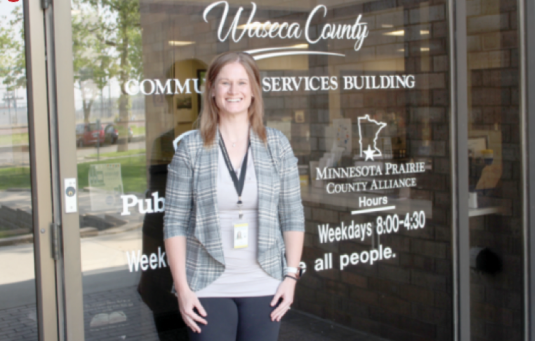
Tara Reich has been leading the MNPrairie human services agency, which includes offices in Dodge, Steele, and Waseca counties, since 2023, and was named its executive director in March. She describes her job as “a combination of keeping us moving forward internally while also expanding our paths into the communities."
Tara Reich is executive director at MNPrairie
Thu, 06/13/2024 - 12:30am
Tara Reich, appointed executive director of MNPrairie this past March, has a number of goals she is working toward in her new position.
One of them, she says, is to reduce the number of people who ask her what “MNPrairie” is. With offices in Steele, Dodge, and Waseca counties, the Minnesota Prairie County Alliance (commonly shortened to MNPrairie) is a human services agency that provides a wide array of programs for the 77,000 or so residents living in their combined borders.
According to information from the agency, it results from a 2015 merging of three human services departments, as agreed upon by the leadership of the three counties. The philosophy behind the merger is that, faced with increasing needs and decreasing state and federal funding, all three counties could deliver services more cost effectively by centralizing some of the tasks, especially administrative ones.
There are still offices in each of the three counties where residents can go for guidance and assistance. In Waseca’s case, the office is at 1000 West Elm Avenue, where about 40 people work to deliver services.
MNPrairie is governed by a joint powers board which consists of two commissioners from each county, with Waseca’s Doug Christopherson as the current chair.
Reich’s office is in the Dodge County location. As executive director, it is her job to oversee all the departments in all three locations, looking for ways to keep the necessary balance between the types and numbers of services people need and the staff and funding needed to provide them.
At its simplest, Reich says her job as executive director is to run MNPrairie as the six county commissioners on the agency’s joint powers board direct her to. She describes this as “a combination of keeping us moving forward internally while also expanding our paths into the communities.”
She mentions that her two highest personal values are integrity and humility.
Reich says that, working in the human services field, she has learned “You aren’t going to please everybody, but there are those times when you are part of something so rewarding, it makes up for those other times.”
Reich began her career as a case worker in the area of adult and disability social services, joining Steele County’s staff in 2006. She received consistent promotions, so that in 2023, when former executive director Jane Hardwick left to take a state-level position, she was appointed to serve as interim director and then, recently, executive director.
She remembers that, when she began college the year after high school, she signed up to major in elementary education. Over the summer, though, she got a job working with disabled adults. “I loved the job so much, I even went home on weekends to work,” she said. “Gradually I began to realize I wanted to make a career of that kind of work, so I changed my major.”
As a case worker, she recalls being impressed with many of her clients. “It is amazing to see how the brain can repair itself,” she observes, elaborating that she saw people achieve amazing levels of recovery even after catastrophic injuries.
Although Reich no longer works directly with clients, she says her work keeping the agency cost effective is still ensuring such people receive the help they need.
Reich is responsible for overseeing four departments, three of which involve direct delivery of services.
“Income and Health Care Assistance” manages program areas including child support, emergency health care assistance, and the supplemental nutrition assistance program (SNAP).
“Child and Family Social Services” oversees child protection, child welfare, adoption and truancy, and licensing of child care and foster care providers.
“Adult and Disability Social Services” has program areas including adult mental health, substance use, services for individuals who are elderly or have disabilities, licensing of adult foster care facilities, and more.
Another type of “balance” she must work toward is between mandates imposed on human services departments and what it takes to comply with those mandates. As a member of the Minnesota Association of County Social Services Administrators (MACSSA) she stays up to date with discussions within the legislature; the organization often rallies to help inform legislators about needs and trends within the human services field.
Another goal Reich has had in mind is doing what she can to reduce any stigma attached to working with human services departments.
”Sometimes the general public has a negative perception about people who come to agencies like MNPrairie,” Reich observes.
“Occasionally people hesitate to come to us because they don’t want to be 'one of those people’ who need our help.
“I hope everyone can recognize that sometimes just one unfortunate experience–an accident, a medical emergency, a fall–can change the whole trajectory of our lives.
“Any of us could be ‘one of those people’ at almost any time.
“I want people to begin thinking about our agency in terms of what they hope will be available for their loved ones if they should encounter a life-changing incident beyond their control,” says Reich.
In keeping with the idea of working cost effectively, Reich says she sees it as her job to find ways to “streamline” people’s experience as they seek assistance. She points out, for example, that many private agencies provide programs similar to those managed through MNPrairie. Local food shelves and emergency housing shelters are examples. Reich says it would be beneficial if there were a “one-stop” venue where people could learn about all the services available to them in their time of need, rather than having to search for them individually.
Since she is relatively new to her position, and since needs and trends in the public are always shifting, Reich says she sees it as a goal to remain responsive, to do what she can to guide MNPrairie, so that it not only meets current needs, but it is in place to support needs in the future.
Fortunately, she does not feel alone in this endeavor.
“We have a wonderful staff,” she says. “We have compassionate people who also have the knowledge and experience they need to do their jobs well.
“I feel honored to work with them.”