
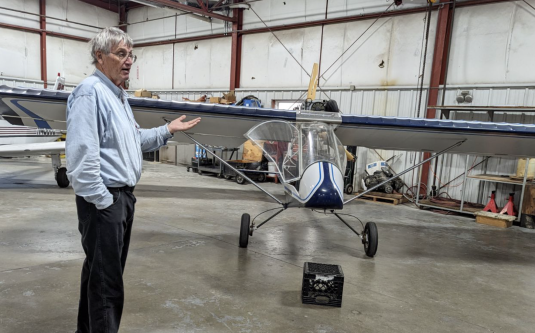
Jim Hanson, a 77 year old pilot, got his pilot's license when he was 16.
Take off
Eagle Flights encourages newcomers
Eagle Flights encourages newcomers
Thu, 05/09/2024 - 2:00am
The Albert Lea Municipal Airport was a hub of activity on Saturday, May 4 as several members of the local chapter of the Experimental Aircraft Association (EAA) greeted guests who arrived on a rainy 8:30 a.m. to participate in the annual Eagle Flights program.
EAA Eagle Flights is a program designed to welcome and encourage newcomers who are interested in learning to fly, but may not know how to begin. The event on Saturday gave all those in attendance the opportunity to fill in the blanks, learning from the experts who've been flying the friendly skies for decades, as well as a free six-month membership to the EAA.
The conference room at the airport was filled to capacity as those gathered learned about the history of the EAA Vintage Chapter 13 in Albert Lea. They had the opportunity to meet several current members, who engaged in the topic and answered questions with enthusiasm.
Marcy Drescher recalled pretending to be a pilot as a child. She grew up to be a commercial pilot, flight instructor, and member of The Ninety-Nines, an international organization of women pilots founded in 1929, whose first president was Amelia Earhart.
Jim Hanson, who began flying 63 years ago at the age of 15, said his flight certificate has taken him to 87 different countries, as well as Antarctica. “It probably saved my life,” Hanson added, “because, instead of becoming a combat medic in the army, I ended up doing some flying.” Hanson still flies gliders, hot air balloons, helicopters and airplanes. He added to general laughter, “And in 63 years I haven't hurt myself even once.”
Bill Koza, who has engaged in several airplane restoration projects, began flying in the Air Force in Great Falls, Mont. He moved to Minn. in 1980, where he finally attained his pilot's license. “It's a whole different realm when you're floating around up there,” Koza said, “looking down and seeing where we are, and trying to put into perspective as to why we're here. It's enjoyable beyond words.”
Chuck Sandager, who led the instruction on Saturday, accompanied by his wife, Denise Sandager, began flying in 1978. He was a private pilot for over 40 years. Six of seven years ago, he decided to get his instrument, commercial, and flight instructor certificates. Most recently, he flew to Perryville, Mo to see the solar eclipse. He chuckled at the recollection of looking down at the traffic backed up on the Interstate as he flew back home.
Sandager explained the various levels of flight certification, beginning with Private Pilot and Sport Pilot, as well as the possibility of flying ultralight aircraft for which one does not need a certificate, but for which training in nonetheless highly recommended. In order to attain a Pilot's Certificate, interested parties must be at least 17 years old, attain a medical certificate to ensure one is healthy enough to fly, pass an FAA knowledge exam, and log in at least 55 hours of flight time before the practical exam. Sport Pilot certificates require at least 40 logged flight hours.
The cost of attaining a certificate in either Private Pilot or Sport Pilot categories was discussed at the Eagle Flights event. Renting an aircraft will cost in the ballpark of $160 to $175 per hour with the cost of fuel included. Ground and flight instruction costs $60 - $70 per hour, and miscellaneous supplies will cost anywhere from $700 - $1,500. The total investment for a Private Pilot certificate would be around $13,300 - $19,120. The total investment for a Sport Pilot certificate would be between $9,500 - $10,300. These costs will vary depending on how many flight hours the student needs in order to be proficient and feel confident enough to test out of the program. The instructors had several tips for shaving down the cost of attaining a flight certificate, such as studying the Pilot's Handbook of Aeronautical Knowledge at home rather than logging in classroom time, practicing with a large photo of the instrument panel and mentally going through the motions of piloting, using a flight simulator, flying often to “keep the rust off,” and inquiring about block rates from flight instructors, rather than paying hourly. Free online instructional videos at www.sportys.com, www.boldmethod.com, and MzeroA.com encourage at-home study of aviation. There is also the possibility of receiving a scholarship from the EAA to help defray the cost of attaining a flight certificate. For information on scholarships, go to www.eaa.org, and click on “Aviation Scholarships.”
There are various locations in the area for learning to fly, including 360 Aviation at the Albert Lea Municipal Airport; Austin Aeroflight Incorp. in Austin; Accelerated Aviation Instruction in Owatonna; and North Iowa Air Service at Mason City Municipal Airport in Mason City, IA.
Wherever you study, the instructors at the Eagle Flights event highly recommend joining an EAA chapter. Statistically, 80% of people who begin flight training, which must be completed within one year, don't finish it. Due to its supportive role and sense of community, the EAA has been able to turn that number around: 80% of those who begin flight training and are also EAA members actually finish their training and receive a flight certificate. Since, as the instructors mentioned, there is a current shortage of qualified pilots in the U.S., a higher percentage of people successfully completing their flight training is a step in the right direction.
The EAA Vintage Chapter 13 has monthly meetings. Members go on field trips, and a yearly excursion in July to Airventure Oshkosh in Oshkosh, Wis., where EAA members get a discount on tickets. The Albert Lea chapter also hosts two yearly glider events, where glider enthusiasts can land their gliders on the specially dedicated grass runway designed for the purpose. One of these glider events is “just for fun,” and the other is a national competition. In addition, EAA Vintage Chapter 13 hosts a yearly Eagle Flights event like the one on Saturday, and a Young Eagles event, where kids ages 8 – 17 can get a free flight.
A free flight was planned for the Eagle Flightss event, but was postponed due to inclement weather. Instead, attendees got a tour of the hangar, where, among several other airplanes and a helicopter, Jim Hanson's first airplane, a Cessna 120, is stored. The event culminated in lunch and the opportunity to talk with the instructors.