
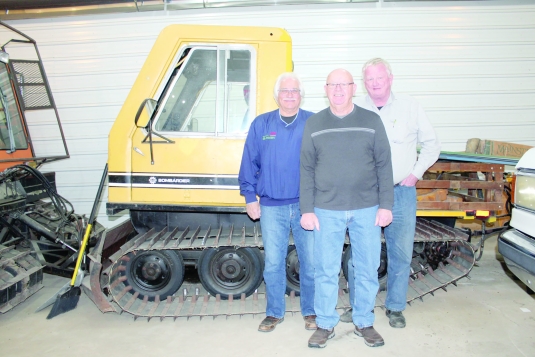
Long-time snowmobile riders (from left) Brian Wayne, Dale Waage and Ed Nelson with a 1970s era trail groomer which is owned--but no longer used--by the Steele County Snowmobile Trails Association. Star Eagle photos by Deb Bently
Snowmobilers remember the ‘good old days’
Wed, 03/05/2025 - 7:52pm
Long-time snowmobile riders Dale Waage, Ed Nelson and Brian Wayne remember a time when someone looking to buy a new snowmobile in the region of Steele, Freeborn and Waseca counties had quite an array of choices. The three list off dealerships handling Chapparal, Arctic Cat, SnoJet, John Deere, Yamaha, Herter’s, Polaris, Scorpion and MotoSki in the area, stating the high point was probably during the late ‘60s and early ‘70s.
Waage, 82, Nelson, 70, and Wayne, 71, are lifelong Ellendale area residents who remember a time when the Herter’s company had manufacturing buildings in both Waseca and New Richland to build snowmobiles. Waage remembers buying his first machine–a 10-horse Herter’s–for $550. The older snowmobiles, the three riders recall, would top out at 40 or 45 miles an hour, but that was perhaps fast enough back then for a number of reasons. “There weren’t any trails yet,” mentions Nelson, who, in 1980, went with area resident Hank Lensey to lobby with the state legislature about providing funding so that snowmobile clubs like the Steele County Sno-Blazers could afford to groom the trails which began in this area around 1972, as well as to arrange for additional trails.
Prior to that time, though, “You just went wherever you wanted.”
Wayne mentions an adage the group shared: “You weren’t lost until you ran out of gas.” He then goes on to tell of a time when he was “lost.”
“We were out in the middle of nowhere with no gas stations in sight,” he remembers. “People were siphoning gas out of their tanks and giving it to me so I would have enough to make it.” Machines at the time typically held between 5 and 6 gallons; how far a tankful would last “depended on how hard you drove,” comments Wayne.
Waage, Nelson and Wayne all three say early snowmobile rides were “an adventure.”
“Those old machines were always breaking down,” comments Waage.
“People would ride around with spark plugs and machine parts in their pockets,” remembers Nelson. Getting replacement parts, at least, could be simple and cheap. “If you knew someone who worked at the Herter’s factory,” jokes Waage, “it might only cost you a bottle of whiskey.”
Between the need for repairs and the fact that the earlier machines required oil to be mixed in with the gas, Waage remembers, “We would get to a bar or a restaurant and people would tell us ‘Get away from me. You smell like gas.’”
Nelson remembers a time when he was part of a group of riders who pulled in at a gas station and pub located near St. Olaf Lake. The owner of the establishment would display and sell homemade negligees. One member of his group purchased one and pushed it into his pocket, apparently with the intent of giving it as a gift.
“I can’t help wondering how that went,” speculates Nelson. “That flimsy thing in that pocket with all those spark plugs and small tools.
“Who knows what it looked like, or what it smelled like, when he decided to give it to his lady?”
The three recall those early rides were commonly a combination of riding in road ditches and across lakes. “You had to know the area pretty well,” remembers Waage.
According to Wayne, Interstate 35 north of Albert Lea opened in 1968. For two to three years prior to its opening, the roadway was graded but was “essentially an unused gravel road.” Nelson and Waage remember being with groups of snowmobilers who used the roadway as a trail, riding all the way to Albert Lea and back a number of times. Waage says he still thinks of some of the delicious steaks he was served at an establishment called Club 16.
Some members of the group would detour up alongside the route where entrance and exit ramps and overpass bridges were under construction. “Some of the bridges had decks on them,” Waage remembers, “and some didn’t.”
Something else the three remember about snowmobiling prior to the mid-1980s is that it was very much a community activity. They recall being on rides where the line of headlights would extend over hilltops for long distances behind them.
“Husbands and wives would ride together,” remembers Wayne, smiling. “Until they didn’t.”
The three share the story of fellow rider Afton Langlie who discovered a hundred feet down the trail that his wife Trudi had fallen off. Not long after that, they remember, Trudi got her own machine.
Another aspect of group rides was “being with good friends.” The three share endless stories of helping and being helped. Wayne tells of one time when a group of riders had taken their snowmobiles to northern Minnesota. He remembers an invisible soft spot in deep snow which pulled his sled into a snow “shadow” under a large evergreen. “I thought to myself, ‘I’ve got to get back up there so they find me, or I’ll be here by myself.”
All three remember it was a significant task to get the sled up out of the hole.
Nelson mentions the Steele County Sno-Blazers once had 110 member families; now there are 30.
“It seems like people are always on social media watching what other people are doing,” jokes Nelson. “We went out and lived it.”
Something else that’s changed since those early days is the amount of snow the area gets over the winter. The three share the story of March, 1965, when there was such a deep snowdrift in downtown Geneva that the city created a one-lane tunnel for traffic, giving up entirely on the idea of removing the drift.
Waage remembers stories his father, a lineman for the telephone company, would tell. During the 1950s, he shares, there were sometimes snow drifts so tall that they came within about 18 inches of reaching the phone lines. Since this was a time before large-scale snowplows, he remembers men going out with shovels to dig out roadways so school buses could get through.
In the 45 years snowmobile trails have been being groomed, Nelson summarizes, there have been “maybe 15 good snow years,” which meant that groomers would go out more than once a month. In his assessment, the last “good” year was 2018.
In the not-so-good snow years, groups of local riders would travel elsewhere for fun. A fair number of times they headed to destinations in northern Minnesota; 20 or more snowmobiles would be loaded on a flatbed trailer while the riders traveled together in a motor home.
Wayne describes how the large vehicles would stay parked in one place while the group took their snowmobiles in a gigantic circle from town to town, staying in hotels overnight and continuing their ride the next day.
A factor which supported that type of ride, he recalls, is that smaller towns back then had the bars, restaurants and hotels to handle their groups, and there were usually at least a few places to stop in between towns for gas and a rest. These days businesses are distributed differently, he observes, with the majority of resources all centered in larger communities.
He remembers groups would include riders from a number of area towns, and there would frequently be pranks and shenanigans along the way.
The three tell the story of convincing one group member that, at a certain bar, it was a common prank to throw people’s headwear into a large fireplace. Having convinced him to keep his helmet on, they then taped a picture of a pinup girl to the back.
Waage, Nelson and Wayne acknowledge the master prankster was Gary Hanson, a banker in Hartland. “He was always full of tricks,” they observe.
During one trip up north, “the Hartland group” wore business suits under their cold weather gear, and managed to keep the other members from realizing it until the last leg of the day’s ride, when they all removed their snowmobile suits and rode into town looking like a team of business executives.
Another time Hanson told the group he was going to order a deli tray from a nearby business. He then proceeded to dial the phone and begin placing an order; the conversation quickly “went south,” with Hanson insulting the business owner and using abusive language.
“We tried to stop him,” remembers Nelson. “We were all worried what the local folks would think of us, and whether we’d ever be welcome in town again.”
It was only after he finished the heated conversation that Hanson let them know his finger had been holding the receiver button down the entire time–no one had ever been on the other end of the line.
Nelson remembers a time he got a bit of a come-uppance. “It was Gary Hanson’s birthday,” he explains. A group of friends acquired a wooden crate–the type in which a brand new snowmobile would be delivered. Then they went into someone’s “back woods” and unearthed a battered, filthy, unsalvageable vintage sled.
“He came home and found that crate in his driveway,” remembers Nelson, laughing. “Probably thought his wife had bought him a brand new ride. Then he opened it up and found that piece of junk inside.”
“We enjoyed each other’s company. We helped each other when there was a problem,” summarizes Wayne. “We had some adventures, and we played a few pranks.
“It was a good, honest, easy time to be active.”