
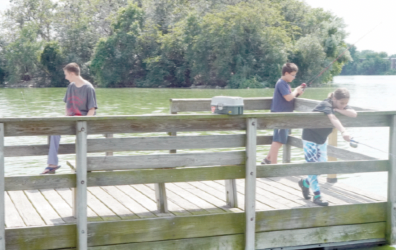
Enjoying some fishing at the Loon Lake pier are (from left) Monty, 13; Alex, 12; and Juniper Revermann, 11. Thanks to improvements over the past few years, water quality technician George Klug predicts there will be some keeper-size walleyes to be caught in the lake this winter.
Rainy Summer interferes with efforts to improve lakes
Thu, 08/29/2024 - 12:30am
Waseca area water technician George Klug has deep respect for the individual ecosystems all lakes represent. Someday, he hopes he’ll even understand them.
Locally, Klug is recognized as having installed a relatively small piece of equipment–easily of a size that will fit in a pickup bed–along the shore of Loon Lake. Now in place for the third year, that equipment has helped restore the natural balance of water in a way that wiped out the filamentous algae which had not only created a thick coating of weeds on the lake’s surface for many summers, but would then also begin decomposing and produce an obnoxious smell.
Of the transformation, Klug observes Loon Lake is “in a much better spot than it was four years ago, but it still has a long way to go” to have the balance and resilience needed to overcome the many influences which affect it.
Klug has been monitoring three lakes closely since early this summer. Loon Lake is a pet project his company, WQ3D, has taken on without reimbursement. Two others, French Lake northwest of Warsaw, about 9 miles out of Faribault, and Lake Alice, in the center of Fergus Falls, are part of a test project being funded and monitored by the Minnesota Pollution Control Agency (MPCA). Klug jokes the two lakes have been “under a microscope” given the many pieces of data he has collected regarding their physical and chemical status.
He mentions that the same filamentous algae which had plagued Loon Lake for so long is also a problem on French Lake. But while it took about 10 weeks for Loon Lake’s weeds to disappear three years ago, “it’s been more of a battle” on French Lake.
He blames what he calls the “washwater” from this summer’s excessive rains, explaining that the many chemicals which washed off of nearby streets and lawns not only delayed the effects of the WQ3D process, they did so over and over again. Readings and tests of water quality have been improving, he said, but not at the rate which might have been possible without the many contaminants. Both French and Alice have been showing faster improvement for the past month or so, he observes; French Lake is tested monthly, results on Lake Alice are recorded every two weeks.
The close monitoring not only complies with the MPCA’s requested amount of testing, Klug says, but exceeds it. “We’re using the testing process to validate that our equipment is having a positive effect,” he explains. “We hope our results will draw more attention, and we’ll be able to get funding to use our process in more lakes.”
Klug can’t help commenting on the number of individuals, agencies and organizations which assert themselves when it comes to projects on lakes. “We spend a lot of time convincing folks to let us improve their water,” he jokes. As was described in a Star Eagle article last spring, WQ3D has been working for years to attract state-level attention to its process and was delighted to announce the arrangement it had reached with the MPCA last spring.
“People always want to know ‘When will we see results?’” stated Klug. “Well, the first year is mostly a process of detoxification. The second year is when we start to see some genuine recovery, but it’s an on-going process. It can’t start until the ice is off the lake in spring, and it has to stop as freeze-up begins late in the fall.”
Along with that, he observes, “Each lake is its own ecosystem. That means results from one location are likely to be very different from results at a different site.”
Although it, too, is now beginning to recover, Loon Lake was also negatively affected by washwater; algae turned the water a murky green, and there have been a couple days when the water emitted an odor. Still, Klug says, there are perch and sunfish to be caught. He also predicts that, by winter, ice anglers may be able to pull some 14” walleye from the lake. Though there was a winter kill a couple years back, the Department of Natural Resources (DNR) has persistently stocked the lake. According to Klug, the DNR uses it as a short-term rearing pond for walleye, stocking them as fry and netting many of them out again when they have grown larger. “But they leave a few behind,” he mentions. “So surely some of them are available to be caught.”