
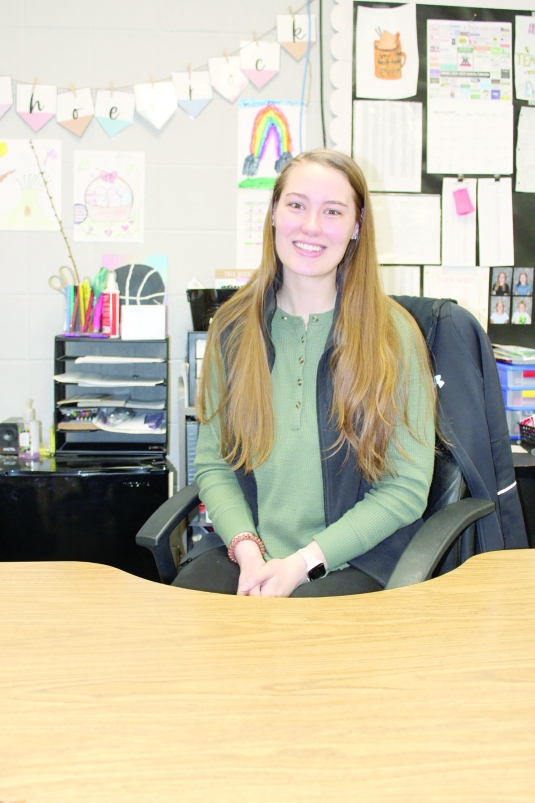
NRHEG third-grade teacher Betsy Schoenrock learned much of what she knows in some of the same classrooms where she now teaches. Star Eagle photo by Deb Bently
NRHEG teacher Betsy Schoenrock
Wed, 05/07/2025 - 8:14pm
During a recent tornado drill, NRHEG elementary teachers led their students to the parts of the building designated for them to take shelter.
Warning her third-grade students in advance that the halls would be full of different groups of students heading in numerous directions, teacher Betsy Schoenrock told class members their job was simply to stay alert and follow her. “Of all the teachers in the school,” she suggested lightheartedly, “you can’t say you can’t see where I’m going.”
At 6 foot 5 inches, she tends to stand out in a crowd.
A lifelong area resident, Schoenrock says she has “pretty much always known” she wanted to become a teacher. Daughter of area farmer Leon Schoenrock and NRHEG elementary phys ed teacher Beth, she graduated from NRHEG in 2018 and from Gustavus Adolphus College in St. Peter early in 2022 with qualifications to teach all elementary grades and math for students as high as eighth grade.
By coincidence, the NRHEG elementary site had an open position for a “math specialist,” that is, someone to meet with small groups of students and provide targeted instruction to help get them on track with their peers. She was hired to take on the task, becoming part of the district teaching staff for the last half or so of the 2021-’22 school year.
For 2022-’23, administration asked her to be a third-grade teacher, the position she has been in ever since. She says it’s exactly where she wants to be.
“It’s something you get better at every year,” she says of building a set of classroom materials that suit her teaching style and coming up with effective ways to present ideas and skills which work well for children of this specific age. Typically about eight years old, third-graders are still regarded as “primary” students, but are preparing to become “upper elementary.”
Especially for those who were enrolled in school during the period of “distance” instruction imposed by the Covid pandemic, thus missing a year of the social learning school provides, Schoenrock observes third-graders are still coming to understand their behavior and choices as part of a bigger picture.
And, of course, they each have their own levels of interest and inclination toward the various subjects being covered. The fundamental subjects of reading and math tend to dominate classroom instruction time, with frequent asides based on current circumstances.
As an example, Schoenrock tells how a recent discussion of the vocabulary word “strictly” led to a conversation about the ways having “strict” rules shows that parents are working to protect and guide their children.
An incident during which her students were inconsiderate to a substitute teacher at one of their out-of-classroom sessions introduced the idea of “first impressions,” and how they are a one-time opportunity.
Asked what knowledge and characteristics are beneficial for a teacher, Schoenrock observes elementary instruction is always evolving. “It’s much different from when I was a student,” she says.
Among the top traits, then, she ranks flexibility–the ability and willingness to adjust based on circumstances. “Sometimes when kids don’t understand something the first time, you have to keep working at it until you find a way to do it that works for them.
“It’s always exciting to be there at the moment someone says, ‘Aha, I get it!’
“And it’s fulfilling to see how students grow and mature and learn new skills over time.”
Teaching is a demanding job, she points out, so it’s important to be able to remain calm and in control. She mentions, for example, when her 25 class members are working independently practicing their math skills. “The room is quiet, and then all of a sudden they all have a question.”
She speculates she would enjoy it if the walls of her classroom had whiteboards all around the perimeter. “Then I could be looking over all their shoulders at the same time.”
Having a mother who is a teacher has played a persistent role in Schoenrock’s career. For one thing, it gave her an early introduction. “Mom would bring me along on teacher workdays and ‘farm me out.’” She recalls helping put up bulletin boards and generally assisting with preparations for the start of the school year or the change in seasons.
Now that she is on staff, Schoenrock says her students notice the identical last names and frequently need an explanation of the polite titles “Mrs.” and “Miss.”
“They often get said so quickly, kids don’t even notice the difference until you call their attention to it,” says Schoenrock.
She goes on to say her “favorite” times of the school year are not the exciting ones–the beginning, the ending or the holidays. “I like it best when things can be stable,” she says. “When we can stick to our routine and keep moving forward smoothly with our learning.”
Part of her “routine” is to avoid assigning homework.
“We prioritize our time at school,” she says of her classroom. “I ask my students to apply themselves while they’re here, then go home, ‘just be kids,’ and spend time with their families.”
Another part is to emphasize the use of paper and pencil over electronic devices. “We’re learning number facts and handwriting,” she says. “The best way to do that is in our heads and with our hands.”