
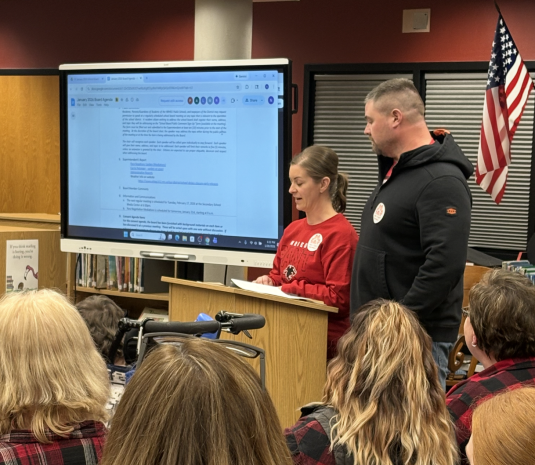
SUPPORTIVE - Parents Nikki and Dave Chicos shared their appreciation and support for NRHEG paraprofessionals in front of an unusually full house during the Jan. 20 school board meeting.
NRHEG Mediation
Thu, 01/29/2026 - 1:00am
Results are not being shared yet from a five-hour “mediation” session meant to resolve contract negotiations between the NRHEG school district and the 26 paraprofessionals who work there.
The district has contracts in place with the other bargaining units employed by the school; these include building maintenance, record-keeping and office positions, and the licensed staff. Paraprofessionals have been working under the wages and terms of employment provided in the now-expired contract covering school years 2023 to ‘24 and 2024 to ‘25 since last fall while negotiations have been underway.
According to information shared by district superintendent Michael Meihak during the Jan. 20 school board meeting, prior to the mediation session the paraprofessionals had presented two separate proposals while the district had presented only one, which he presented as its “top” and “firm” offer. Meihak stated the “financial impact” of the district’s terms would be $50,000 across two years; the figure includes the cost of both wages and benefits.
Meihak’s summary showed that, under the district’s offer, paraprofessionals would have a starting wage of $17.70 an hour, with the longest-employed earning up to $22.95 an hour. Overall, he summarized, the district’s offer led to a 75-cent-per-hour increase each year for each paraprofessional on staff.
The less costly of the paraprofessionals’ two proposals, he stated, called for a $1.20 per-hour increase each year, and would have had a financial impact of $81,000.
The expected outcome of a mediation session is a mutually agreed upon tentative agreement falling somewhere between those two sets of figures.
Individuals present at the Jan. 21 session reported that such terms had been reached, but details will not be available publicly until both the paraprofessionals’ union and the school district have voted to affirm them.
Nearly 30 visitors arrived at the Jan. 20 school board meeting; the number included paraprofessionals and others who were there to support their cause, including members of the public and licensed staff.
Among the information shared during the meeting by paraprofessional Maryann Schlaak was the fact that some paras in the district work additional jobs to help make ends meet. Some, she reported, qualify for public assistance.
She named many demanding elements of the paras’ work days. “We help students arrive safely, regulate emotions, and prepare for learning,” she said. “Throughout the day, we work one-on-one and in small groups with students who have disabilities, learning differences, behavioral challenges, and medical needs.
“We de-escalate crises and help when students feel overwhelmed, frustrated, or afraid.”
Schlaak went on to say, “We do this work because we care deeply about students, but caring does not pay the rent.” Some paraprofessionals, she said, “leave the profession altogether, not because they want to, but because they cannot afford to stay.
“When paraprofessionals leave, students lose trusted adults. Teachers lose critical support.
“High turnover hurts the very children our district is committed to serving, especially students with disabilities.”
Dave and Nikki Chicos, parents of two children in the district, also took the podium to speak in support of paraprofessionals. Their older son Owen is in second grade, and “has significant medical, developmental, and physical complexities.”
The parents praised the support and caring approach they have seen paraprofessionals extend to their children, and pointed out the “sense of community” built at school has been a significant element of their sons’ progress.
Fourth-grade teacher Jennie Bunn also spoke regarding the many roles filled by paraprofessionals and the importance of maintaining consistency.
She stated, “Paraprofessionals are underpaid and undervalued by our district despite their training, specialized skills, and critical role in student success.
“Higher pay is not just about recognition, it is about retention, sustainability, and fairness.”