
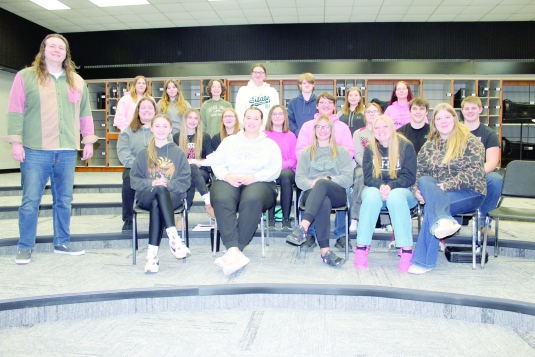
NRHEG Band director Seth Schaefer and members of the 2025 band were able to set up shop in their refurbished space for the first time on Friday, Jan. 18. Construction delays had the room "in progress" for upgrades since before the school year began last September. The room now has reconstructed support structures under the tiered floor, new wooden floors and carpeting and upgraded electrical outlets. Perhaps the most visible change are the newly installed specialty cabinets spanning the back of the room. Star Eagle photo by Deb Bently
NRHEG Band is finally “home”
Thu, 02/06/2025 - 11:47pm
“I can’t say enough about Mr. Schaeffer’s professionalism and composure,” stated NRHEG Superintendent Michael Meihak regarding district band director Seth Schaefer’s response to a string of “construction woes” which began in June of 2024.
Until Friday, Jan. 17, those “woes” called upon Schaefer and the members of the high school band to show daily flexibility as their instruction and operations were moved to other locations in the secondary building.
That difficult journey ended as the band reclaimed its space–although Schaefer says it will take a while before all the band's properties–including sheet music and other small items–are truly organized. He expresses gratitude for specifically designed storage cabinets which now grace the back of the room.
Throughout the first half of the school year, as covered in prior editions of the Star Eagle, school vocal music instructor Krista Reeder and band director Schaefer devised workarounds which allowed them to continue their programs of instruction despite the band room being closed. Through the fall, Schaefer would frequently take the band outdoors to practice its marching and field performance routines. Large instruments and many other band supplies were stored on the high school stage. Even when the band would be going outdoors, this led to extra activity at the beginning and end of the class hour when band members assembled in the gym. Physical education teachers also had to show flexibility by moving their instruction elsewhere when possible to allow for occasional indoor practices.
Once cold weather arrived, the band students’ chairs and music stands were set up in the choral music classroom. Though vocal and instrumental music classes are not held at the same time, the large amount of furniture imposed many changes to typical procedures for Reeder; the smaller size of the classroom led to cramped space for the instrumental department.
“It’s a system that let us keep moving forward,” Schaefer observed, “but it’s far from ideal.”
Superintendent Meihak explains that, as part of the upgrades included in last summer’s numerous projects completed both in Ellendale and New Richland, some linoleum flooring tile dating back to the 1950s was scheduled to be removed from the high school band room. As did many construction items from that time, the linoleum contained asbestos. It had not posed a danger to students because it was in a solid form and would not become airborne. The tile had also long ago been covered over by carpeting.
Still, Meihak points out, it was asbestos, and so the plan was to remove the worn carpeting, remove the linoleum tiles, and then not only lay new carpeting, but replace the battered shelving which spanned the back of the room and was used for storage, most visibly of school- and student-owned instruments.
Asbestos removal is a specialized process requiring numerous safety protocols; laying floor covering is a less technology intensive task, so a number of different companies were contracted to perform the various stages of the work, Meihak explains. Which is why, when a complication arose, there was considerable uncertainty about which company was responsible for addressing the problem.
The “complication” was that, during the asbestos removal process, some of the planking of the band room’s tiered floor ended up being removed, exposing the wooden framework which supported the three raised levels of flooring. With the planking removed, it became evident the original wooden framework was not in alignment with current structural code–and would have to be replaced.
To meet code, the new framing would have to be metal. Building that new framework would require a set of materials and skills not planned for as part of last summer’s projects. Regrettably, arrangements for construction were difficult to make, and even harder, it seemed, to get scheduled. Preliminary plans were proposed then repeatedly delayed.
To everyone’s relief, construction on the metal framework began prior to the December holiday break. New planking and carpet were installed during the break, and the final step, installation of the new storage cabinets was expected to take place either during the break or within the first few days of January. Because of supply chain difficulties, the installation actually occurred on Wednesday and Thursday, Jan. 15 and 16, making Friday’s “return home” possible.
“It’s been a long haul,” Schaeffer commented, “but we’re here at last.”