
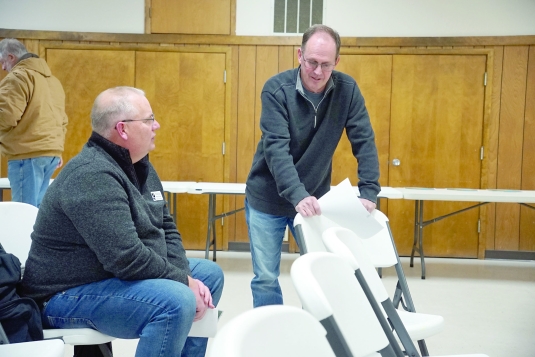
Waseca County Commissioner Doug Christopherson speaks with Wayne Cords during a New Richland flood mitigation talk at city hall on December 5, 2024. Star Eagle photo by Eli Lutgens
New Richland hosts flood presentation
Houston Engineering discusses results of study, talks next steps
Houston Engineering discusses results of study, talks next steps
Wed, 01/08/2025 - 7:25pm
About three dozen New Richland area residents attended a community flood presentation at city hall the evening of Thursday, Dec. 5, 2024.
“(Tonight) will give you a chance to see where we are and, maybe, where we’re intending to go,” New Richland City Administrator Tony Martens began.
Joe Lewis of Mankato’s Houston Engineering, the main speaker for the evening, shared details of the city’s recent flooding mitigation analysis.
Also present to participate in the conversation were Waseca County’s Land and Water Resources Director Chris Howard, County Commissioner Doug Christopherson, city maintenance supervisor Erik Hendrickson, and Shell Johnson from People Service.
Lewis’s 20-minute presentation introduced existing conditions, alternative plans for action, the costs for said plans and what the city’s potential next steps might be. A video of his presentation, and a question and answer session, was more than an hour in length and is available on the city’s website and YouTube page.
The study commissioned by the city analyzed 10 square miles of land, with the majority of the drainage coming through two different systems. County Ditch (CD) 6, runs east, crosses Highway 13 through culverts and intersects CD 47 in the center of town. The combined water flow then goes south and west toward Highway 30.
The current system can handle about 400 to 600 cubic feet per second (CFPS) of water, the equivalent of 3.5 to 4.5 inches of rainfall over a 24-hour period.
A “100-year rain” is classified as rainfall totaling 7.7 inches or more in a 24-hour period and delivers water at approximately 1,200 CFPS.
The challenge facing the city and area residents is how extraordinary levels of water can be safely moved to avoid flooding during high-capacity events which appear to be growing more and more common.
"When we look at a 100-year event today, it’s more water than it was 10 years ago,” Lewis stated.
Ten years ago a “100-year rain” event was measured at 6.25 inches in a 24-hour period. By 2040 or ‘50, this number is expected to be around eight or nine inches.
Lewis listed four project alternatives and explained that no one option alone will move enough water through the city to avoid flooding during future 100-year events. Different approaches must be used together to help offer a long-term solution.
The alternatives he offered include increased culvert and channel capacity; diversion; property buy-outs; and structural protections, levees or floodwalls.
The strengths and weaknesses of each alternative were discussed.
Widening channels and enlarging culverts could result in buildings like Neighbor’s Meats or the funeral home having to relocate because the expanded waterways would impede on their structures.
Property buy-outs were not seriously considered because the cost came to more than $20 million.
The early and not final consensus between Houston Engineering and the city of New Richland thus far is that a diversion plan along with increased culvert and channel sizes, and possibly levees will reduce the flooding risk to the highest extent.
The “Northern Diversion” alignment, the most viable according to Houston Engineering, will take water north, around New Richland and back out on the west side. This option can capture 60 to 70 percent of the drainage area.
“The city and the county are putting our heads together to see how we can collaborate to see what works best,” Martens stated. “Who leads and how does it put the community in the best position to be ready to go after that external funding.”
In order to pay for this project, which will cost anywhere from $2 million to $5 million, if not more, the city and county are going to apply for a grant through the State of Minnesota Flood Hazard Mitigation program.
Since 1987 this program, run through the Minnesota Department of Natural Resources, has awarded $590 million. A local contribution of money is required, but is capped. The maximum amount contributed by local city taxpayers is estimated to be at about 10 percent of the total cost of the project.
Plans regarding which plan to submit and who will do the “technical work” will be done before a final grant application is submitted. In the meantime Martens has applied for a “planning grant” to help cover the costs associated with the necessary technical work.
During the question and answer session following the presentation, many frustrations, clarifications and alternative ideas were heard.
Residents asked whether the intended steps will actually be followed through, and how long it will likely take to do so.
“That’s why we are taking this to the community,” Martens answered. “We have to narrow down which options we have to choose to make the grant application.”
No timeline was given due to the infancy of this project.
The first step to do something, however, was the flood mitigation study commissioned by the city through Houston Engineering.
After conversations with Senator Tina Smith, Congressman Brad Finstad, local state representative Peggy Bennett, and commissioner Christopherson, Martens said there is support for this project at every level of government.
“Local legislators are very aware…wanting to help,” Martens shared. “Having this step ready to go is on their radar. We’re making the progress we need to make.”
Martens assured that the city is trying to do this project with "as little cost to taxpayers as possible.”
The topic was on the agenda for the Dec. 9 meeting of the council.