
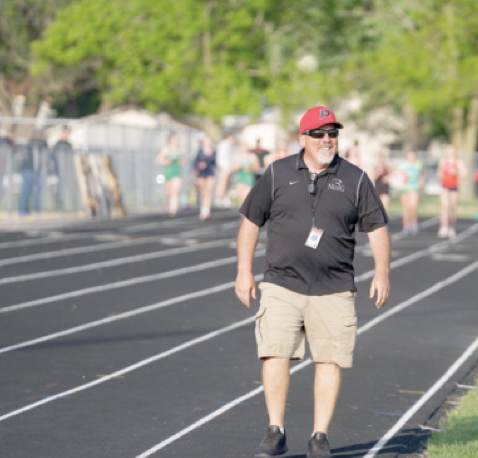
NRHEG Head Track and Field coach, Duey Ferber, walks the track during the final home meet of his 34-year career.
Longest tenured coach in NRHEG history to retire
Thu, 05/30/2024 - 2:00am
It may come as a surprise to some, but the longest tenured coach in NRHEG school history, head track coach Duey Ferber, is hanging up his whistle at the end of this year, his 34th season.
“The thing I loved most about Duey coaching was it didn’t matter how good you were, he always found something for every kid to do, something for every kid to be good at,” Amy Ferber, Duey’s wife, told the Star Eagle. “We heard this from athletes all night (during his final home meet): ‘I didn’t realize how much I missed this. I didn’t realize how much I missed track.' He talked kids into it,” Amy continued. “‘Just try it,’ he would tell them. Then they found out they were good at it. He’s always encouraging and motivating. Everybody had a job, an event. And they knew where they were good.”
During his career, Ferber was named the Minnesota State Track Coach of the Year, earned three state True Team Appearances, two section championship teams, 11 girls' conference titles, including six straight, and two boys' titles. He qualified individual athletes for the state meet 29 out of 34 years, and coached a two-time state champion high jumper, Carlie Wagner.
“The conference has always been my Super Bowl,” Ferber explained. “That’s your last team event. To walk off the track 13 times holding the trophy over your head, those were special memories.
“I always tell the kids. I want us to be the team that, when our bus pulls up, I want the teams to say, ‘Oh crap, NRHEG is here. We’re all fighting for second place.’ When we won six straight conference championships with the girls, that was the way teams would react.”
But if you ask Ferber the meaning behind everything, he says it's the relationships.
“My No. 1 goal for the kids hasn’t changed in 34 years,” Ferber said. “Number one: Have fun. Goal number two: Work hard to get as far as you can. And number three: Win everything you can. But notice that’s number three.
“Some kids are out for social reasons and that’s fine," said Ferber. "And some are out for state championships. And you see a definite difference in work ethic.”
What’s next for NRHEG track and field?
“I want it to continue to be a strong program,” Ferber said. “Where everybody finds something to do. Everybody has an event."
This season, however, isn’t quite over.
Sub-sections were Thursday, May 23. Sections will be June 1 at Mankato East and finally the state meet at St. Michael-Albertville on June 6 and 7.
“I’d like to see three get to state,” Ferber said. “I think that’s realistic. I say it to my seniors, everybody leaves me. It’s me this time. That’s the way I feel. It’s time to hand the baton to someone else.”
What’s next for Ferber?
Ferber will continue to do what he’s done since 1989, teach fifth or sixth grade. He’ll continue as the only driver’s ed instructor, and intends to fully retire from teaching in three to four years. If you ask him, he’ll remind you, he missed out on the “rule of 90” by only a couple weeks.
1989
The superintendent when Ferber was hired was Rich Lorenz, the principal, Tony Boyer. It was always Ferber’s intention to coach and in 1990, he was offered the position from athletic director Ted Pelzl.
“Pelzl walked by me in the hallway, it was right after Christmas in 1991,” Ferber recalled. “He said, ‘Hey Duey, you used to run track in Byron. You wanna be the track coach?’ I said sure. And that was my interview. I thought, why not? Let’s do it.”
To the next guy or gal
What’s Ferber’s message to his successor? “Don’t put too much pressure on yourself, because I think most of my pressure, I put on myself. To reach certain goals… Just enjoy it. Have fun with it. I used to feel so much pressure. Especially when we were winning. I felt like we had that expectation to win the conference and that’s not realistic. Make relationships. Have fun. The kids that come out for track, they have self-discipline and they’re not afraid to work hard. I’ve said it before. Our sport is your sport's punishment. It takes a special kid to come out for track. The kids that come out, they’re my pride and joy. I love them.”
What will Ferber remember most?
“A gazillion memories," he said. "I can stand and look at the record board and I can see the meet and the individual effort of everyone on the team. Where they set the record. I don’t always remember the times, but I remember where we were.”
Why hang it up now?
“You always have a group, I’m just gonna get through them and then another group comes. And then I’ll get through them," said Ferber. "It just got to be, it was my baby, but I don’t want to give it up. Why am I getting out now? It’s energy. I was always told, ‘When you know, you know.’ And I know. There was no doubt in me that this year was going to be my final one.
“I thank my family for allowing me to do it this long. It’s taken me away from a lot of family time. A lot of family time has been spent at track meets. I’m just fortunate that I’ve had a family that’s supported me for doing this all these years.”
Coaching styles
“Some kids need the hug, and (they just wanna belong to something) where other kids, I think about Carlie Wagner. I could tell her something once and she would say, ‘I got it.’ And that started from seventh grade. Where other kids need more repetition. I think kindness goes a long way. There's kids that just want to belong to something. And once you’re in track, you're part of the track family. There are 18 events. We’re a team, but entirely individual. I think Carlie said it best. When people wanted her to go out for softball. she used to say, ‘This is the one sport where you have no excuses. It’s you and the bar. Or it’s you and the stopwatch. You can’t hide.’”
How do you identify the gifts of particular athletes?
“Trial and error," answered Ferber. "Knowing their personalities. Starting in fifth grade, I’d have them sign a letter of intent. If I recognized they’re going to be a good sprinter or jumper, I’d have them sign a letter of intent. I still have a bunch in the folder.”
Who's on your Mount Rushmore of tracksters?
Ferber coached more than 500 athletes during his 34 years.
“Carlie Wagner," he said. "But that’s the thing, there’s so many.”
“That record board. I can stand and look at that for hours. It’s so beautiful. I see the seventh-graders staring at it and I hope they’re looking at their events hoping they’re going to be there one day. That's my Mount Rushmore.”
Who have you coached with?
Ferber stated emphatically, it’s impossible for him to list everyone. We tried anyway.
Brad Root, one year; Mark Rud, one year; Julie Schley; Dave Ware; Mike Weber; Chuck Crabtree, 30 years “I leaned on him more than anybody;" Corrine Schuller; Gabe Kofstad; Jay Crabtree; Kim Schlaak; Geoff Stieglbauer; Larry Nydegger; Marc Krueger; Miles Otstot; Nic Seiler; Xan Johnson; Ellen Johnson; Bryan Belcourt; Bailey Thom; Tyler Schlaak; T.J. Schiltz.
“I know I’m going to forget someone,” Ferber said. “I know I’m missing someone. A lot of those were volunteer helpers."
Ferber concluded, "Kim gives me a hard time. She tells me I used to push the sprinters a lot harder when she was in high school. I’ve gotten soft since I’ve become a grandpa.”
In the end
Officially, we won't be able to call him "Coach" much longer.
But, for hundreds of athletes, he'll always be Coach.