
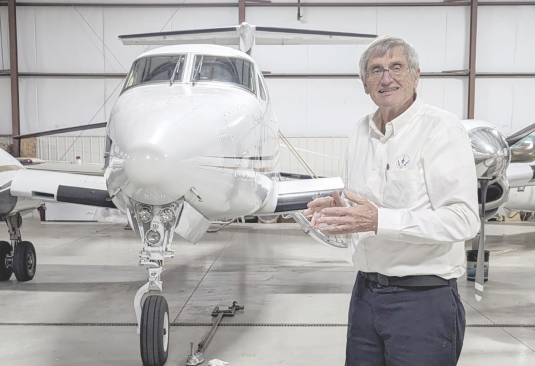
Jim Hanson in front of the Beechkraft King Air 200.
A king in the air
Thu, 06/06/2024 - 3:30am
Jim Hanson of Clarks Grove didn't exactly jump at the chance to buzz the Washington DC Capitol Mall in a 1974 Beechcraft King Air 200 for the historic Aircraft Owners and Pilots Association (AOPA) DC Flyover on Saturday, May 11.
It was months ago that Doug Rozendaal of Clear Lake called Hanson to ask him to participate in the AOPA's plan to fly more than 60 antique and modern aircraft over Washington D.C. Hanson initially thought the whole plan was crazy: to fly 800 miles to Washington D.C., another 20 miles to the Potomac River, turn to fly over the Capitol Mall with thousands of spectators below, and then return to base, while somehow managing not to crash into one another. Hanson asked Rozendaal, “You've got some airplanes that can do 300 miles an hour, and you've got some that'll barely do 80. How are we going to do this thing?”
Rozendaal said, “We'll do it all by time.”
Hanson replied, “There's not a chance in the world that's going to happen.”
When Rozendaal told him that this plan had been initiated by none other than Mike Ginter, Hanson was nonplussed; he'd never heard of him. Rozendaal said, “If you had to bet your life on one person, this is it.”
Mike Ginter is a retired Navy captain and current Vice President of the AOPA. His plan was to show the general public the history and evolution of general aviation – meaning any aircraft not military or airline affiliated - from 1939 to the present in a grand air parade over Washington D.C.
It took an entire year of planning.
First, the AOPA had to convince the Federal Aviation Administration (FAA) that it was a good idea. Problematically, Washington DC is the most restricted air space in the United States. It's also the most complicated air space in the world. As if that weren't problematic enough, that airspace has been prohibited since the attacks of Sept. 11, 2001. When the AOPA approached the FAA with their plan, the negative was emphatic.
But Mark Baker, president of the AOPA, is, according to Hanson, a force to be reckoned with; he had another card up his sleeve. When the FAA declined to allow the Flyover, Baker went straight to Congress. The AOPA contacted everyone in Congress who had ever been interested in aviation or had been in the Air Force, and told them of their plan. One Congressman had the solution: to write a narrowly drafted bill, and put it through the House and the Senate, that would direct the FAA to cooperate. The bill never got that far. After it had already been signed by a number of Congress members, Congress told the FAA of the bill. The FAA folded. Their reply was: “Don't bother. We'll cooperate.”
“[The FAA] not only did it,” said Hanson, “they did it very willingly. I mean, it was a complete sea change!”
The AOPA also had to convince the pilots it was a good idea.
The AOPA contacted Hanson because they wanted pilots who could fly formation, were reliable, and had a reputation for getting things done. And they wanted someone with a Beechcraft King Air 200.
Hanson explained to Rozendaal that he no longer owned the King Air at the Albert Lea Municipal Airport. He'd owned it three times and sold it four. The King Air is currently owned by Crossroads Trailer. Fortunately, Hanson sold it to them under the caveat that he would still be able to fly it for the cost of fuel.
Rozendaal got his way in convincing Hanson to join the fleet.
“It was a huge amount of work,” said Hanson, “bigger than any other government project that I've been involved with.”
The next step was to get the FAA Air Traffic Controller (ATC) to sign off on the plan. The AOPA asked Air Traffic Control what it would take to make them comfortable with the plan. The answer was that everyone involved receive special training to fly over Prohibited Area P-56, which includes the White House and the Capitol. Jim Hanson and the rest of the pilots sat through a 10-hour course on the subject, tested on it, and then presented the results to the FAA, to the Transportation Security Administration, and finally to the Secret Service. The group coordinated with FAA Air Traffic Control to simplify the various Prohibitive Areas for the flight.
Next, the pilots had to prove that each aircraft was airworthy. These aircraft are regularly inspected anyway, but Hanson moved the inspection of the King Air up three months and told the maintenance inspectors in St. Cloud, “I want this thing woodshedded, ” a colloquialism for precision. The documentation on every aspect of the craft was inspected: from the radios to the pitot-static transponder system, and every upgrade and recall, including the coffee maker. Only then was a certificate of inspection issued. The FAA allowed the pilots to forward the inspection package for FAA review prior to the inspection—over 200 pages of documentation.
“There's nothing like overkill,” said Hanson. When the FAA inspected the King Air, what could potentially have taken hours was over in five minutes.
The pilots, too, had to prove they were airworthy. Hanson had to present his licences, log book, his last training certificate, his biennial flight review, insurance card, and proof of insurance coverage. Many of the other pilots had compiled all the same materials beforehand, so that, although the FAA had planned a two- to three-day inspection of the pilots, the actual inspection “didn't last half a day,” according to Hanson.
One FAA member thought he'd cornered a pilot on an infraction regarding the compass correction card that told how many degrees a pilot needs to adjust for discrepancies in the kerosene compass caused by metal in the aircraft. “That used to be a big thing in a lot of older airplanes and small airplanes,” said Hanson, “and we did have some older airplanes [at the event].” Over the last 30 or 40 years, however, most pilots have switched to gyro compasses even in their older airplanes. “Nobody looks at this whiskey compass,” said Hanson with emphasis, using a term referencing the fact that the compass floats in alcohol. “The government standards are hopelessly behind the times.” The FAA still mandates the compass correction card, which is usually a paper card. When the FAA asked to see the pilot's compass correction card for his 1978 airplane, the pilot showed him the card etched in metal on the airplane.
Hanson praised both the FAA and the AOPA for how well they worked together to make the air show happen. Both entities were aware of the laws and regulations, and both took steps to ensure that they were met. “I've been flying for 61 years,” said Hanson, “and I've never seen people that were that good at compliance.”
On the day of the event, the FAA did a ramp check, and then the Transportation Security Administration inspected the aircraft. “They usually do airlines,” says Hanson. “They're the people that go back and do the pre-boarding check.” Hanson opened the airplane door for them, and their inspection took no time at all. Then the Secret Service inspected each aircraft for weapons and bombs with a bomb-sniffing dog. “I have to give both AOPA and the regulatory agencies credit for the huge changes they were able to create, resulting in big changes in security procedures,” said Hanson. “Once all of the needs were identified, it made it much easier to fly in the last remaining special-use airspace in the U.S.”
Hanson had to have an insurance waiver as well as an insurance binder from his insurance company, both to indemnify the AOPA, and to cover anything that might happen on the Capitol Mall. Hanson explained the huge possible risks involved with an air show and a large crowd of people. The insurance company, to their credit, had no problem with the scenario; all the pilots were professionals. “It didn't cost much at all to add that [coverage],” said Hanson.
“But that's how thorough the investigation was,” Hanson continued, “and how good [the AOPA] was, and how for the first time that I can think of in decades that industry and the regulators could come to a common ground.”
Meticulous planning was involved in calculating where each aircraft needed to be in the progression based on the start-up time needed, which might vary from three to 20 minutes, the take-off time, and the speed and weight of each aircraft, with the faster airplanes starting out the procession, followed by the slower airplanes. Each formation group was given three minutes over the television crews and the Capitol Mall.
Ginter pre-planned where each aircraft would park prior to flight, factoring in engine start time and taxi time. Mere seconds were allocated between take-off times for each formation group. The FAA protested that there wouldn't be enough time between planes; they required miles between aircraft. But Ginter had already planned for that: the AOPA took over the Frederick, Md. control tower for the day; all other airlines were grounded. Ginter told the FAA air traffic controllers they could take the afternoon off. He reasoned that, if a problem should arise, the AOPA had retired air traffic controllers among its members who could handle those situations. It also took the FAA off the hook for traffic separation. The FAA controllers issued a final clearance: “Aircraft in your group are cleared for takeoff at their appointed time.” It was another example of government and private cooperation to get the job done.
“It absolutely worked,” said Hanson. The King Air had a take-off time of 12:38:15, an assignment Hanson had received weeks before. “We had to hit a place on the Capitol Mall – a place that nobody had ever flown over before – and navigate to it […] within ten to 15 seconds of the time we said we would be there.”
With only an estimate of what the winds were that day, each pilot took off and flew in formation over the Capitol Mall, mostly in groups of three aircraft.
“I didn't think there was a chance in the world that it would ever happen,” Hanson continued, “and it was absolute precision. At 200 miles an hour, you're doing three and a third miles a minute. My gosh, that window is very, very narrow.” It is a testament not only to the planning involved, but to the expertise and professionalism of the pilots who undertook the plan to fly with only a ten to 15-second margin of error.
“At ten miles, you can't see preceding traffic to maintain the separation,” said Hanson. “I mean, you can't see ten miles, especially in the Washington smog.” Hanson didn't use the Automatic Dependent Surveillance-Broadcast on the King Air, a device that sends a signal to a radar site, which then tracks surrounding aircraft. “We could have used that, but there wouldn't have been time. It was all done with a compass and a clock,” said Hanson, comparing it to the old days of sailing ship navigation.
When Hanson agreed to fly formation, he wanted to know what type of airplanes he would be flying with. He was flying formation near a Learjet Model 35 and a Citation CJ3. Hanson didn't like the idea of flying a light aircraft behind two heavier airplanes; he was worried about dangerous wake turbulence at a low altitude. “That's something we hadn't considered,” said Ginter. Most of the other aircraft flying formation were of similar weights. Ginter suggested that the King Air lead the formation instead of following. “Can you maintain the required airspeed?” asked Ginter. Hanson could and did.
Hanson's co-pilot was Rozendaal. “I wanted somebody I could absolutely depend on and trust,” said Hanson. “And besides that, he's done enough air shows. He knows procedure.” Rozendaal manned the radios and Hanson flew the plane.
The pilots took off from the airport at Frederick, Md. They climbed to 800' above ground, stayed low, and headed south to the Potomac River. They followed the river between foothills of between 1,000' and 1,500'. “It's very scenic,” said Hanson. “They don't have the squared layout of fields like we have here. It's pastureland.”
Ginter told the pilots: “When you see this big, square building, that's the Lincoln Memorial. Do not overfly the top of it. You can come as close as you like on your left side, as long as it's not directly below you.” Further, the pilots were told to stay on the south side of the reflecting pool over Independence Ave. They were permitted then to fly beside, but not over the Washington Monument, but not on the opposite side of it, because it's too near the White House area. Then they were told to make a right turn and head south when they reached the Smithsonian.
With two heavy airplanes following him, Hanson didn't want to make a tight 60⁰ turn that would be difficult for the heavier airplanes to follow. Hanson decided to start the turn early; he wanted to make a 30⁰ turn. He briefed the pilots behind him on his plan, so they would know what to expect.
Once they'd cleared the Capitol Mall and Prohibited Area P-56, the pilots were in the jurisdiction of Potomac Control. They climbed to 2,000' above ground. “The FAA had laid out a series of GPS waypoints,” said Hanson. “You could navigate visually on them if you had to, but frankly, things were too busy to be doing visual at those speeds and that much air traffic.” The pilots used GPS to fly through eight waypoints and then returned to base in Frederick.
Hanson had one other adjustment to make in the plan. “We'd never flown together before,” said Hanson. “You can't practice fly this thing, because you only get one bite at the apple.” He'd flown and was rated for Learjets and Citations, so he knew how those planes flew. At 128 knots, the two other pilots would need more runway to land than the King Air. “With a King Air, I can stop fast,” Hanson said. “I can slow down almost enough to lurch you forward in your seat. Not so much though with a jet.” The three pilots would maintain speed until they reached the airport boundary. Hanson would wait until the last half of the runway to land, while the other two aircraft would land at the beginning of the runway, so they would have the time they needed to slow down. As a fail-safe, Hanson planned to stay on the right side of the runway in case the two heavier aircraft should overtake him; they could pass him on the left.
In spite of Hanson's initial misgivings, the end result was all positive. “It worked out really, really well,” said Hanson.
The AOPA projected that the parade of aircraft might draw 15,000 – 20,000 spectators. In reality, there were over three times that number of spectators in the Washington area alone. The AOPA also considered that, if the event could be televised, that might draw another 200,000 spectators. The real number of spectators of TV stations located within a 75-mile radius of DC was closer to 250,000. Due to YouTube exposure, that number is steadily increasing world-wide. The AOPA estimates that in four to five years, up to 15 million viewers may have watched the DC Flyover.
Hanson's wife, Maryalice said the flight experience was, “Beyond words. There's something about looking down at the Lincoln Memorial and down at the Washington Monument.”
To watch the DC Flyover on YouTube, visit: LIVE DC Flyover - AOPA's National Celebration of General Aviation (youtube.com).