
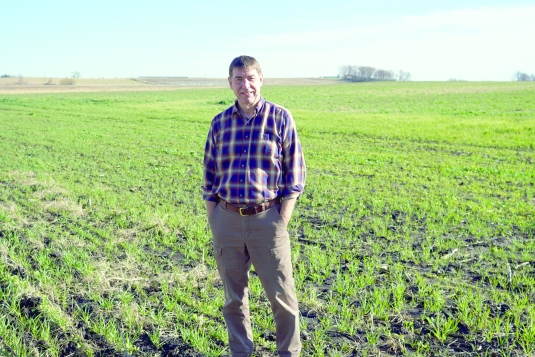
Karl Swenson of Otisco was selected as the 2024 Outstanding Conservationist for Waseca County by Waseca Soil and Water Conservation District.
Karl Swenson, 2024 Outstanding Conservationist
Wed, 11/20/2024 - 11:30pm
The Waseca County Soil and Water Conservation District (SWCD) has selected Otisco farmer Karl Swenson as its conservation farmer of 2024.
Swenson was the youngest of four children raised on the farm his parents, lifelong area residents Rolland and Carol, acquired in 1964. He, his two brothers and their sister helped with tasks and chores; Swenson graduated high school in 1979, attended college, and soon thereafter moved to Anchorage, Alaska, where he worked for 27 years as an accountant and bookkeeper.
Tired of being so far from family, he moved back in 2014 and took over the farming operation as his parents retired and moved into Waseca. He grew his first crop that year and continues to farm 210 acres annually–90 of soybeans and 120 of sweet corn. He points out this means 30 acres each year are “corn on corn.”
In 2014 he was one of the first in Waseca County to start using cover crops, on his land following sweet corn. He says his motive was to reduce compaction caused by large-scale equipment used to harvest the corn. In 2019 he began using strip till on the sweet corn acres, tilling only the space needed to plant the seeds.
He says the techniques work well for his operation, giving his fields “better infiltration, tilth and structure since starting these healthy soil practices.”
He goes on to say, “I don't think what I am doing is that special or radical. I do these things as, yes, I want to be a good steward of the farm, but I also need to make a profit. I think these practices, in the long term, allow me to produce a better crop with fewer inputs. If I can do things that benefit my soil, make it more productive, that should make me more money.”
While appreciating being recognized, Swenson describes his focus as being “practical” more than on conservation for conservation’s sake. “Every season is an opportunity to improve the soil and it’s a challenge to see if I can do just that.”
Emphasizing the “practical” side, he observes, “I don't think the strip-till costs me any more than conventional tillage. It may even cost me less. Strip-till is only one pass over the ground prior to planting and allows the banding of fertilizer rather than broadcasting. This means the fertilizer is much closer to the row and in higher concentration than general broadcast. Spring strip-till also allows me to leave the ground undisturbed during the winter, which helps keep the soil in place rather than suffer from wind erosion.”
Typical costs for his cover crops are between $20 and $25 an acre. “It is hard to quantify whether those pay for themselves or not,” he comments. “The benefits I receive from the cover crops are subjective: better rainwater infiltration, better soil tilth and better soil structure.”
For anyone considering some of the techniques he uses, he offers, “I would encourage someone to plant cover crops on some acres: Do a test. Try some and see what you think. A suggestion would be to note objective measurements before you experiment. Take soil samples. Write down what gear you normally pull an implement with. Do you have compaction? If so, at what depth? Collect any information you can to quantify three to five years from now what changes you have accomplished.
“Cover crops and reduced tillage, (strip-till) are a long term process. You most likely will not see any large changes, but subtle observations over time.”