
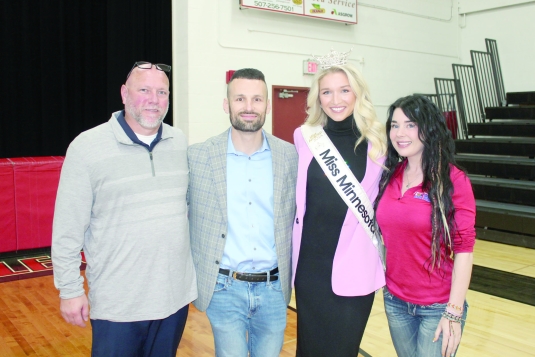
NRHEG Secondary school principal Grant Berg with guest speakers Jason Lennox, Miss Minnesota Emily Schumacher, and American Heart Association youth market director Allana Lippman.
Jason Lennox raises awareness of mental health
Thu, 11/21/2024 - 2:30am
“There are people walking around in this building who are in a lot of pain,” Jason Lennox told NRHEG secondary students during a building-wide assembly on Nov. 14.
Lennox, a 2010 graduate of NRHEG, who is now a national consultant and public speaker, spent about 30 minutes with secondary students addressing the topic of mental health.
Lennox told students he had three goals: to help them recognize how universal the problem of mental illness is, to change or enrich their perspectives on the topic, and to raise the level of compassion they feel for those who experience it.
“I’ve been someone who listened to a speech like this, and it changed my life,” said Lennox as he asked students to avoid being disruptive. “There are people here who will benefit from hearing what’s going to be said.”
Lennox asked everyone in the room to close their eyes and listen as he read an excerpt from his book, “A Perfect Tragedy.” The book tells of his path through loneliness, addiction, feelings of worthlessness and his eventual journey to recovery. The excerpt regarded a moment when he considered veering off a road at high speed as a way to end his life.
“I lived moments like this over and over,” he said of his desire to die during his teens and early twenties. “Untreated mental illness ran rampant in my life.” Lennox used visual elements to illustrate statistics. After asking everyone whose last name began with letters “d” through “z” to stand up, he told everyone to look around. Statistically, he said, the large majority of people standing represent the 83 percent of young people who have experienced a traumatic event severe enough to trigger thoughts of self-harm or suicide. He used the same method to help students visualize the 40 percent of teens who experience persistent feelings of sadness or hopelessness, the 23 percent who have seriously considered suicide, and the 9 percent who have attempted to kill themselves.
Lennox then asked students why people might not mention their feelings of sadness to others.
“Pride, fear, stubbornness,” he said, repeating their responses. “Those are all based on what other people think about us.
“That, my friends, is called ‘stigma.’
“That’s what we’re here to break through.
“We need to talk about it; that’s the only way it’s going to get better.” Lennox went on to observe that people who listen to others without judging, people who act compassionately, are “making it better.
“While some of you are making it worse.”
The first step in helping those with persistent feelings of sadness and worthlessness, Lennox said, is “Do no harm.”
The next, he said, is to invite others to share their thoughts and feelings, and then genuinely listen to their answers without responding judgmentally. He asked all students in the room who had their cell phones with them to choose a friend or acquaintance, then create a text which said simply, “How’re you doing?” He then asked everyone to hold their smartphones in the air and press “send” at the same time.
Lennox told students of two friends of his who had died by suicide–one five years ago, another only this October.
“If you would have looked at Brandon two months ago, you would not have imagined that’s how it was going to go,” he said of the recent death.
He said he wishes he had checked in with Brandon, just as he had asked students to check in with someone via text message moments before.
“There are a lot of opportunities for second chances,” Lennox said, using his own experiences as an example. “I dropped out of school, but I got the chance to go back and graduate. I blew the chance to go to college on a scholarship, but I found a way to go to college later. I hurt my knee. With therapy it can get better. I missed a lot of opportunities on the first go-round, but I’m finding my way and my life is better than ever. Sometimes there’s another scar, but we can recover.
“But these guys closed the book. With this, there’s no resetting. There are no second chances.
“I know what happened when I didn’t,” said Lennox of his wish that he had checked in with his friend. “I can’t know what would have happened if I had.”
As he finished his presentation, Lennox asked students to make a personal commitment to, “Do something different, even if it’s only to think about this a little differently.”
After finishing his presentation, Lennox gave away signed copies of his book to a long line of students.