
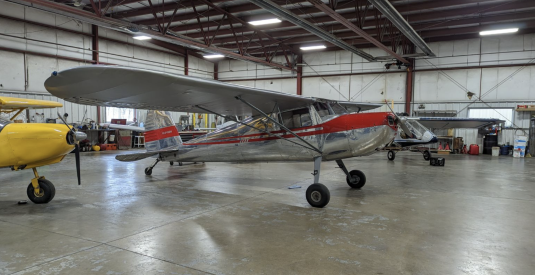
Cessna 120
It all started with the Cessna 120
Thu, 05/09/2024 - 12:30am
One might call Jim Hanson, currently of Clarks Grove, an adventurous person. At the age of 77, he has flown to 87 different countries, as well as Antarctica, and the walls of the Albert Lea Municipal Airport offices and hangar are filled with his awards, recognitions, and certificates.
And it all started with a question his father asked him. Jim had just returned home to Ellendale at the age of 15 from a trip to Mexico as a foreign exchange student. Jim's father, Paul Hanson, was impressed. He asked his son, “What are you going to do to top that?”
Without skipping a beat, the teenager replied, “I'm going to learn to fly!”
And he did.
Jim didn't have a driver's license yet, so his father drove him to the Albert Lea Municipal Airport for lessons. On his 16th birthday, Jim took his solo flight.
Coincidentally, Paul and Jim learned that a local farmer named Dave Behrend wanted to sell his airplane. Behrend had explained to the airport operator: “I'm getting married, and she wants a couch – NOT an airplane.” The airplane in question was a Cessna 120, a two-seater manufactured in 1947, the same year Jim was born. “Unlike people, airplanes don't get old,” Jim explains today. “It cruises just as fast as today's airplanes – because they are certified to the same standard.”
Thus far, Jim's father had shown no interest in learning to fly, but it seems he caught the flying bug from his son. The Cessna 120 piqued his interest. “Could I learn to fly in that airplane?” Paul asked. Jim was sure his father could learn to fly in the Cessna 120, because it had already been used for training. “Could you get me a demo?” Paul asked.
Jim arranged for his father to get a demo flight in the Cessna 120. Jim, still in high school, was in study hall when he saw the airplane flying overhead through the big windows at school. “I could see the airplane going base to final and landing out here,” says Jim, who didn't say anything to his father about it.
About three days later, Jim's father came to him to ask, “Do you have $900?” Jim did; he'd been laying grain tile in the swamps near Hollandale all summer to earn money. Paul said, “Then you own half of the airplane! And I'm going to buy the other half.”
Jim had a pilot's license before he had a driver's license, and owned an airplane before he owned a car. “It launched a career that has taken me all over the world,” Jim says, “- to every state in the Union, every Province in Canada, across the Atlantic to Greenland, Iceland, Europe, Africa, every nation in the Caribbean, South and Central America, and even Antarctica.” In addition, Jim holds 46 US and world records for aircraft class and category for “speeds over recognized courses.”
Jim and his father owned the Cessna 120 for a number of years – until Jim returned from the army in 1968. Paul encouraged Jim to sell the airplane. “The two of us are getting too big for this airplane,” said Paul. It was true. Jim sold the airplane.
“And I will never make that mistake again,” says Jim.
For years the Cessna 120 lay derelict in Baudette, Minn. on the Canadian border. “Every time I would come back from flying a Canadian trip or something with the jet or the turbo prop […], I'd land there for customs,” says Jim. “I'd go back and take a look at my old 120 over there, and I'd always leave a card in it that said, 'If you're ever going to sell the airplane, let me know.'”
One day, the phone rang. The owner of the Cessna 120 said, “Well, I'm going to sell you that airplane. I'm going to charge too much for it, because I know you'll pay it. But on the other hand, you can charge me too much for that Piper Cherokee that you're going to sell me. I'm 84 years old; it takes me too long to get out to Denver to ski with my grandkids.”
Jim bought the Cessna 120 back. The old, deteriorated plane could barely make it back to Albert Lea. Jim flew it twice and decided he had to restore his old friend. “That airplane taught me how to fly,” says Jim, “and it taught me that I could do anything I set out to do, as long as I set my mind to it. I learned more about myself and more about the world than I ever would in college. It opened doors to the rest of the world!”
It took Jim about a year to restore the Cessna 120. Some of the work was cosmetic, like the interior, and some was more labor intensive than expensive, like stripping the paint down to restore the highly polished aluminum. Some of the work was both highly technical and expensive. The engine needed a complete overhaul, and in that Jim got lucky. The interim owner told him, “You treated me well on the airplane I bought from you. I have a spare engine stored in an oil drum that I'll GIVE you!” Just by chance, it was the original engine that had been installed at the factory. The Cessna's engine had been changed in the 1950s. “So we had it overhauled to new standards!” Jim enthuses. “When it was done it was BETTER THAN FACTORY NEW!”
Jim was offered a lot of money for the newly restored Cessna 120, but the old airplane had come home for good. Jim says, “It not only made a pilot out of me, but we both learned a lot about flying – and doing it safely – practical lessons that you don't learn in the classroom.”
Jim's wife, Maryalice, likes to joke, “I never have to worry about being divorced, because Jim never throws away old things.”
Jim currently has more “serious” airplanes that are more suited to long trips and inclement weather, but he still flies the Cessna 120 for fun. It cruises at about 100 miles per hour, and can even run on automobile gas. “It burns about five gallons an hour at full cruise,” Jim says, “so it's very economical to fly.
“I value my old friend and would never put it at risk,” Jim continues. “Its flight characteristics keep a pilot on their toes. The Cessna and I are both survivors of an age when things were different. Flying – and life itself – was more difficult, and pilot and plane faced challenges rarely experienced today.” Jim explains that the Cessna 120 is just as capable and safe as any modern airplane. “Pilot and airplane both take care not to hurt each other,” he says. “While the pilot has a finite life, the aircraft can last virtually forever if we cared for it – and I take care of my old friend and mentor!”
The Cessna 120 now has its well-deserved and honored home at the Albert Lea Municipal Airport.
“I've owned over 500 airplanes over the years, and I think I've brokered about twice that many. I will never sell that airplane,” says Jim with emphasis.
Jim is a flight and ground instructor in every category and class of aircraft, who also writes for four aviation magazines. He says his writing credentials open a lot of doors for him. As an inductee into the Minnesota Aviation Hall of Fame, Jim is one of only three people to be both an inductee and also hold a Writer's Award. He covers not only modern aircraft in his writing, but antiques and military aircraft as well. He has flown NASA's Orbital Trainer and Space Shuttle Trainer – the same realistic trainers used by astronauts. He was invited by NASA to land the first civil aircraft on the 15,000-foot runway at Cape Canaveral, and was approved to land a King Air aircraft there to duplicate a shuttle landing.
“Through it all, I've never had an accident or violation,” says Jim, who has received the FAA Master Pilot Award for more than 50 years of accident and violation free flight – one of only about 3,000 people to do so in 121 years of powered flight.
“On January 29 of next year,” says Jim, “I will have been flying for more than half the time of powered flight since the Wright Brothers' first flight on December 17, 1903.” Jim is one of the last people who will be able to make that claim.


