
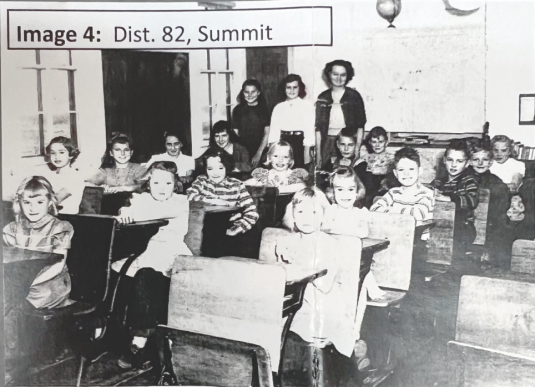
School year 1950-1951 Steele County District 82Standing: Sonja Underland, Sherry Thompson & teacher Miss Betty Winzenberg. Starting at window side, Desk Row 1: Betty Jirousek, Donna Thompson, Pat Moore, Carol Underland; Desk Row 2: Allie Crabtree, Roxanne Anderson, Helen Conklin, Janice Calverley, Jerry Calverley; Paul Underland. Desk Row 3: Judy Calverley, Janice Jirousek, Gene Thompson, Donald Calverley, Gary Calverley, Millie Crabtree.
History in the air
Group works to preserve local heritage
Group works to preserve local heritage
Thu, 09/05/2024 - 5:30am
History is in the air at the Ellendale Community Center the first Saturday of each month at 9 a.m. That’s when the members of the Ellendale Area Heritage Society hold their regular meetings, transact society business, and then reminisce. They invite anyone interested to join them.
“There’s so much interesting history in this area,” comments long-time president Barb Mrotz, 85. “We’re just doing what we can to record some of it.” “For those who lived part of it, they really enjoy having something to spark their memory,” comments fellow society member Brenda Dokken, 69. “Having this information helps people understand where they came from.” Mrotz graduated from Ellendale High School in 1956, Dokken in 1972.
While society members emphasize they are always keeping in mind what projects they can do to preserve history, their most recent accomplishment has been recording the timeline of area rural schools. In addition to Mrotz and Dokken, Heritage Society members are Jo Lerberg, Lloyd Kaplan, Andy Lerberg, Jim Deml, Dan Nelson, and John White.
According to the Steele County website, the county was organized in 1855, even though Minnesota did not officially become a state until 1858. One of the county’s first rural schools was established in 1862, and was located a couple miles west of Ellendale’s current location along what is now State Highway 30.
Ellendale, Mrotz mentions, was not incorporated until 1900, when the railroad determined its planned route and took steps to ensure people would use its services by encouraging the creation of new towns. Just under a mile east of the current city center was a small town named Cooleyville. It, too, had a school building; its district had formed in 1891.
As time went on, “There was a school every couple miles or so,” says Mrotz. “Usually there was a small store and a creamery right there, too. That way farmers could bring their milk to the creamery and deliver their kids to school at the same time.”
Single-sheet, glossy documents compiled by the heritage society include lists of the rural school districts, maps showing their locations, and photos of buildings, students, or both. In many, the boys are dressed in coveralls holding their hats in their hands. All girls are wearing dresses.
Photos are of highly varied quality since many were taken early in the history of photography; many of the buildings were moved, repurposed, or both in the first half of the 1900s.
“Roads improved. Transportation improved. The districts began to consolidate in 1910,” summarizes Mrotz. She points out, however, that some regions valued their local districts very highly. About 12 rural schools still existed in the Ellendale and Geneva area in the 1950s. “Some had nearly new buildings when they closed,” she observes.
Mrotz and Dokken are both pleased with and proud of the society’s accomplishment in putting together the information about the rural districts. Given the time and effort it took to collect the needed information and materials, they feel they may have accomplished the task just in time–before it might have become altogether impossible.
There have been other triumphs. For Ellendale’s centennial in 2000, the society put together a comprehensive publication summarizing elements of the city’s history and development. Now more than 20 years old, the publication is also a snapshot of the community at that time and something of an artifact on its own.
Society members were also very pleased to be able to trace the whereabouts of the collected newspapers printed during Ellendale’s earliest years. Newspapers have long had a system for binding each year’s worth of editions into a large book. The collection of books had passed through a number of hands as ownership of the paper changed.
When the books were found, the society sent them to the state historical society to be scanned and recorded, making them available for future researchers. The books themselves, many of them quite brittle due to their age, are now owned by the society.
Also an important historical resource is the society’s full set of yearbooks for the Geneva and Ellendale school districts.
Mrotz remembers back to when the society formed. Area residents were invited to a local meeting arranged by an instructor from the University of Minnesota. They were advised that, if no one began collecting some of the area’s history, it might be lost forever.
“He told us not to use up our energy putting together a museum,” remembers Mrotz. “We were supposed to collect information and people’s accounts, and do what we could to keep track of those.”
That advice, she mentions, has been difficult to follow. Community members have come across fascinating artifacts including a buffalo hide coat and gloves, a replica of the “sleds” once used on an elevated rail slide leading down into Beaver Lake, and a four-foot-tall manually wound wall clock which supported the bell system used at the Ellendale school.
These items and others are in display cases built at society expense in the Ellendale Community Center building. “There are some things we just couldn’t turn away,” Mrotz mentions.
Mrotz and Dokken explain the society holds fundraisers to support its projects. Most recently, group members sold ice cream sundaes during Ellendale Days. “We’re always discussing ideas for ways to raise money,” says Dokken. “Without it, we wouldn’t get far.”
As members of the society grow older, they fervently hope there will be others with sufficient interest to join the group and continue preserving history. “This is important work,” comments Dokken. “It’s also fun.” She mentions that it feels good to complete a project which will help others recognize and appreciate what has come before.
“The stories and the experiences are fascinating,” she says. “We have to do what we can to keep them coming.”