
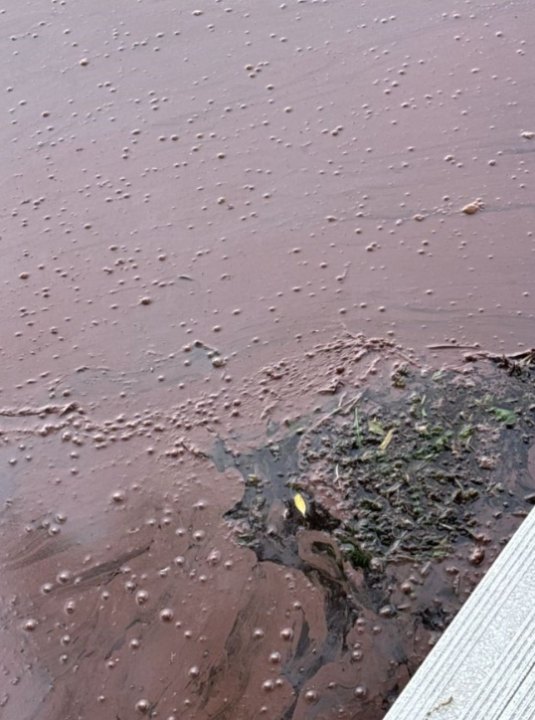
St. Olaf Lake
Harmful bloom reported at St. Olaf
Thu, 06/13/2024 - 1:00am
Have you ever observed what appeared to be pink lemonade colored water under the ice in your local lake? Have you observed a brown/pink layer of 'scum' on the surface of a lake? This may indicate a harmful bloom of Cyanobacterium Planktothrix rubescens. A couple reports of this have been documented in the past couple winters around Waterville and Windom, so it is worth discussion, albeit I am admittedly by no means an expert on this topic!
An example is shown in the included photos in winter 2024. One photo was taken at St. Olaf Lake (Waseca County). The Waterville Fisheries Office had reports of a reddish color/hue to the water under the ice. Upon inspection it was confirmed to be Planktothrix rubescens. These Cynaobacteria, which are likely present in all lakes naturally, but only proliferate under favorable environmental conditions, seem to thrive in cold water and with limited snow cover, and in 2024 really took off. Typically, when the ice comes out the signs of P. rubescens disappear from the upper water column. But remnants of a large bloom can persist!
This weekend I was sent the following photos taken by a 'rightfully' concerned lakeshore owner on St. Olaf Lake. Pictured is apparently the remnants of this winter’s P. rubescens bloom.
The following statement was from a knowledgeable staff at the Science Museum of Minnesota.
"WOW! That looks horrific.” It is clearly the end product of a Planktothrix bloom that has persisted into spring and is now breaking down. That's the smell, that's the gunky look of the water, and it also is probably a huge oxygen demand on the lake (=sad fish). We had an unprecedented winter that was characterized by thin ice, low snow, and short ice-on. All of this contributed to perfect conditions for the Planktothrix bloom. Algae are like people; they love light and food (nutrients). Planktothrix is a winter form and this winter hit all its buttons just right. Thin ice=good light. No snow=good light. Short ice on=got the lake kicking in spring very early. Perfect Planktothrix storm. I'm not sure what the prognosis of this lake will be this season. A big concern is that with such low light levels [due to the turbid water now], the macrophytes will not come in as before and open up the lake to increased internal nutrient cycling and/or sediment resuspension. Welcome to climate change, folks. And St Olaf Lake is definitely a nutrient-rich lake already poised to kick it given the right conditions."
In looking into this more, I have found the dynamics that allow Planktothrix rubescens to proliferate are very complex, but that it most commonly occurs in what are typically 'better quality lakes' that are moderately deep and mesotrophic to oligotrophic lakes (clearer water with stratification), but in watersheds with high nutrient history. Large blooms of Planktothrix rubescens are not as common in most eutrophic to hyper-eutrophic lakes of Southern MN lakes that are dominated by other forms of algal blooms., or that do not stratify. No lake is immune. We have even documented this on Fish Lake (LeSueur County), which is one of our best water quality lakes in the entire nine County management area.
The bottom line is there is little that can be done to prevent this type of situation, or to treat it. We need to clean up our watersheds and stop nutrients from entering our waters. This is yet another natural cycle we will have to deal with in the meantime.
Importantly, since Planktothrix rubescens can contain toxins, here are some tips to reduce your risk of illness from ingesting toxins:
-Don’t drink the lake water, and if you brought your dog out to the lake with you, don’t let your dog drink the water either. Always bring clean, fresh drinking water.
-Clean off your hands after handling fish or wetting hands with lake water, and before eating. Use clean, fresh water that you brought with you, or wipes.
-Toxins are more likely to accumulate in organs, so only eat fillets.
-Rinse fillets well with clean water before cooking or freezing.
-Blue-green algae can produce “taste and odor” compounds that may give earthy or musty off flavors to fish living in waters with high blue-green algae levels. These off flavors are not toxins.
Craig Soupir, DNR Waterville Area Fisheries Office and State Fish Hatchery Supervisor. Craig.soupir@state.mn.us; call/text 507-461-9377.