
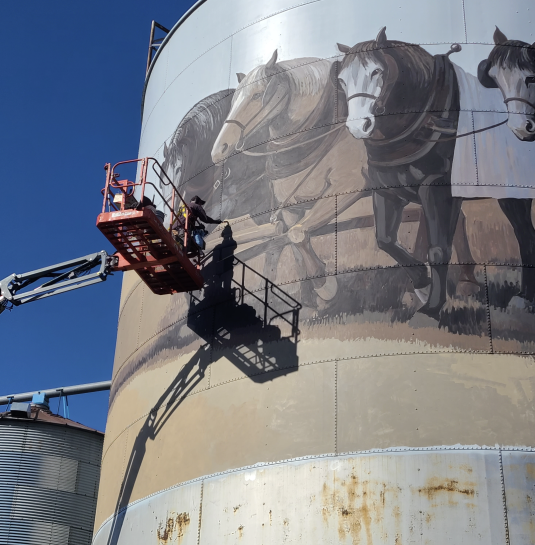
OVERWHELMING ART - Artist Steve DeLaitsch at work on the mural underway north of Ace Hardware along Waseca's Second Street Northwest.
Grain bin mural demands talent, effort and skill
Thu, 01/15/2026 - 12:00am
In his time, Waseca artist Steven DeLaitsch has painted more than 15 murals. So when his brother-in-law Mike Denn asked Steve whether he could paint a mural that would extend across two large steel bins, he said his answer was a confident, "Of course." The two of them had a 3-year dialogue before the decision was truly made to begin the project. Mike and his brother, Mark, are the owners of the land and remaining structures of the EACO Flour Mill once located along the eastern shore of Loon Lake. The large steel bins are located at this site.
When Steve found himself looking at the prepared surfaces with paint in hand this past fall, he says his reaction was a momentarily overwhelmed “Gulp.”
Work on the mural began Sept. 10 and was stopped by the weather in mid-November. It is now more than half finished. When it is complete, the mural will be 35 feet tall and 155 feet long.
In honor of the site’s history, the mural depicts a wheat harvest in process as it would have looked in the late 1800s. Four horses draw a reaper through a golden field while the machine behind them cuts the plants and draws them up to be baled.
The scale of the painting is such, Steve points out, that each horse’s head from forehead to nose is as tall as he is.
“It was a challenge I wanted to undertake, and Mike had kind of always wanted a mural on the bins,” Steve recalls. “It all took a while to come together, but now it is well on its way.”
Owners Mike Denn and Mark Denn are brothers to Steve's wife, Mary Jo.
It is believed the two large bins were built in the 1870s. Each is more than 60 feet tall and is constructed of riveted together panels, each of which is 5 feet tall by 15 feet wide. Steve says the identically sized panels provide a helpful grid as he adapts the scale of his concept sketches to the gigantic steel surface.
The first step in preparing the bins, Mike Denn describes, was to power wash the exterior; the next was to paint on primer over the area meant for the mural. Also a major element of preparations, Mike says, was the purchase of an aerial boom lift specifically for use on the project, with the intent it will be used for more everyday tasks in the future, including tuck pointing on the brick building, once part of the EACO complex, which stands west of the 14 bins.
Steve says he will resume work in the spring when the weather is amenable. He hopes for something less variable than he experienced this fall; conditions ranged from several days when temperatures were in the 90s with the sun beating down so powerfully that “the paint was drying on the brush before I could even stroke it on,” to windy days when the boom lift rattled, making it hard to work up to his personal standards.
“It was like a wind tunnel,” Steve observes regarding the curved surfaces of the two neighboring bins.
He says he finds his work so far satisfactory, despite the range of challenges. He has already used 20 gallons of paint.
Steve says he has been drawn to art since childhood. After graduating from Owatonna High School in the 1970s, he attended the Chicago School of Art. “I wanted to learn to draw like the masters,” he recalls. Throughout his life, he has supported his work as an artist by using additional skills, including acquiring the credentials to be a construction contractor. He moved to Waseca in the 1990s to serve as director of the regional art center; he met Mary Jo, decided he liked the atmosphere and cooperative spirit of the community, and elected to stay–mostly.
“I love to travel and expand my skill as an artist,” he mentions.
Steve met New Richland’s Bernie Anderson in the 1980s. The two have traveled together to numerous locations around the country where they have gleaned artistic inspiration from the landscape around them.
Steve has set up his easel all around the planet, having been to Napa Valley in California, Alaska, and the American Southwest, as well as Norway, Australia, Italy, China, the Great Barrier Reef, and more. He says the majority of his paintings are landscapes, ranging from closeups of details to mountain ranges and cityscapes. He works in various media, including watercolor, oils, and–specifically when painting murals–exterior house paint. He also enjoys sketching both in black and white and in color.
Whatever his subject or media, he says a main objective of his art is to inspire people “to look inward by looking outward.”
Since 2003, Steve has kept a studio in a classic brick building along New Richland’s Broadway Avenue. Built in 1917, a time when the chief need for electricity was to power electric lights, it was referred to as a “light plant” rather than a “power plant.” He says he admires the classic elements of the building’s construction, and especially enjoys the many large windows. He points out that, with a coal-fired generator burning night and day, the windows helped keep the space cool. Now they offer him plentiful natural light. Steve continues working on improvements to make his studio a comfortable place to work; he can frequently be found there creating artwork throughout the week.