
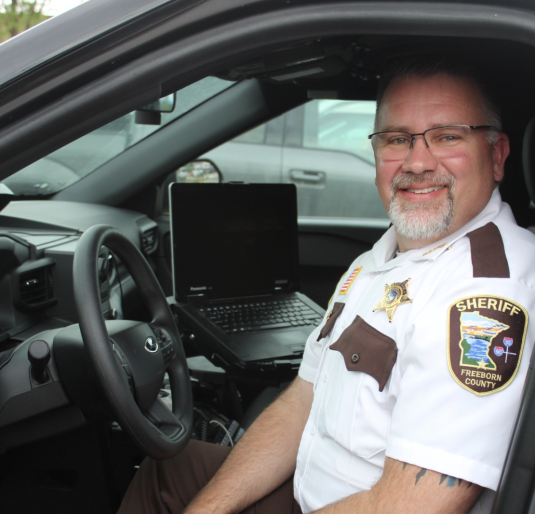
Freeborn County Sheriff Ryan Shea.
Freeborn County offers paid training program
Thu, 06/27/2024 - 1:30am
Freeborn County Sheriff Ryan Shea, 48, began his training to become a law enforcement officer back in the mid-1990s for a crowded profession.
“There was a time when there would be more than 100 applications for a single position,” Shea describes.
Those days, however, are gone.
The online job connection site “Linked In” lists nearly 600 open law enforcement positions statewide. Shea says his department has consistently been short by two or three patrol deputies for the past year. There are currently 16 on staff: An optimal number of 18 would make it possible to have four sheriff vehicles out on patrol at any given time, while also maintaining a presence at large-scale events such as concerts and major sports competitions.
Not being able to keep a full roster of staff has been a source of frustration for many agencies, according to Shea. Individuals with law enforcement training can go on to work for sheriffs’ offices, police departments, the state highway patrol and the Department of Natural Resources.
Shea describes having mentioned his frustration to state public safety commissioner Bob Jacobson last fall. “He told me the state had something in mind, and to keep my eyes open for it,” he recalls.
This spring, the state of Minnesota offered grants of $50,000 to law enforcement agencies for a new program. The Freeborn County Sheriff’s department was allotted two of them, for a total of $100,000.
The grant stipulates that agencies can recruit individuals who have completed either a two- or four-year post-secondary education in any field, then pay them a peace officer’s salary as they attend an intense five-month training program covering all the topics which apply specifically to the field of law enforcement.
Shea is excited as the recruitment process is about to begin.
“Research shows long-term trends in employment have changed,” he explains. “These days, statistics indicate people have a tendency to change jobs about every seven years.”
Shea says his department is looking for two people who have perhaps gradually come to the understanding they would like to be peace officers.
“We expect to receive applications from people probably in their twenties or thirties,” Shea anticipates. “Someone who has completed a training program and begun their career, but has realized it doesn’t satisfy them.
“Someone homegrown, who has roots in the area,” he describes.
“Maybe they kind of wish they had taken the training to be police officers, but now they have a family, maybe a mortgage and monthly bills, so they figure there’s no way they can make the change.
“This program would make it possible; they wouldn’t have to pay for the training, and they would be being paid while they learned.”
The major sacrifice for the two selected individuals, Shea notes, is the expectation they be in Alexandria five days a week for five months to attend the specially-designed training program, earning a total of 38 college credits during the upcoming fall and spring semesters. They would, however, have weekends free to come home–and could even have mileage costs reimbursed for doing so.
Once the candidates have completed all the requirements and met the necessary qualifications, they would be expected to sign a three-year contract with the Freeborn County Sheriff’s Department.
From there, Shea anticipates the general job satisfaction within his department and the individuals’ local roots will keep them on staff.
He names some of the positive features of working as a sheriff’s deputy. First, he says, is the sense of satisfaction which comes from helping others–being there to respond when people are in need. “You get to make a difference,” he comments, “to help make your community a better place.”
When not responding to “calls,” Shea observes, patrol deputies have tremendous flexibility–anything from traffic control to stopping by a park or coffee shop to make positive connections with community members. Patrol deputies are assigned a sheriff’s department vehicle and not only use it throughout their shifts, but drive it to and from home. Shea explains the practice is fairly universal in sheriff departments, and allows for faster response times in emergencies.
Shea also says he believes the pay scales in his department are strong enough to keep officers from being lured away.
The recruitment process to find the two candidates for the program is getting a good start now, with post cards being sent to nearly every Freeborn County address and advertisements being posted at roadside signs.
Interviews and selection will take place over the next several weeks, with the intent of having candidates in place as the fall semester begins at Alexandria Technical College. About 35 grants for intensive train-while-employed programs of this type have been granted across the state: Albert Lea’s candidates will be attending classes side by side with those from other agencies. Topics for the courses they will be taking include criminal and juvenile justice, investigation, emergency medical response, and even “human behavior.” Training will also be ongoing for firearm and driving skills.
Even once the five-month program is complete, Shea says the new officers will receive further training regarding procedures and expectations at Freeborn County.
“I think this will work,” observes Shea. “I’m looking forward to the day when we have a full roster of deputies on staff.”