
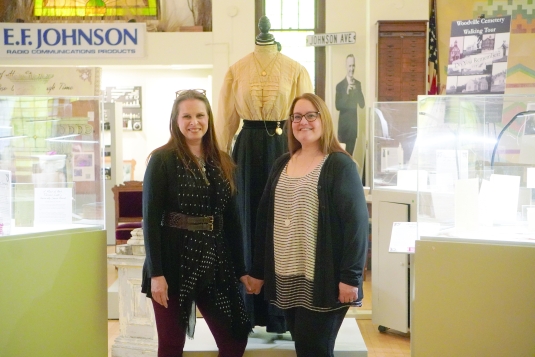
PORTRAIT OF A LADY - An exhibit featuring Florence Rose Castor, 1884-1957, will be at the Waseca Historical Society until Oct. 23. Pictured from left: Executive Director of the museum Amy sform of dress worn during the period of Florence's life. Star Eagle photo by Ben Revermann
Florence Rose Castor's life on display
Waseca County Historical museum presents a new exhibit: Portrait of a Lady
Waseca County Historical museum presents a new exhibit: Portrait of a Lady
Tue, 09/02/2025 - 12:00am
The Waseca County Historical Society (WCHS) is presenting a new exhibit, Portrait of a Lady, from now until October 24. The exhibit highlights the life and times of Florence Rose Castor, 1884-1957. WCHS invites visitors to imagine Florence as a student, a traveler, a friend, a sister and a woman shaped by the world around her.
Born in Waseca to local jeweler Ed Castor, Florence graduated from Waseca High School in 1902, earned a Bachelor’s degree from the University of Minnesota, and later received a Master’s degree from the University of Wisconsin. She went on to work as a teacher and librarian, eventually serving as head librarian at the College of St. Teresa in Winona.
Florence grew up during an era of great transition, when trains remained the dominant mode of travel, automobiles were just beginning to appear, and horse-drawn carriages were still a common sight on downtown streets. One of the first displays features “calling cards”—small, business-card-sized tokens once left at a neighbor’s home to signify a visit. Alongside the cards sits an old-fashioned quill and ink bottle, allowing museum guests to try their hand at writing with the type of equipment Florence used. These calling cards served as an early precursor to the modern-day business card.
The exhibit blends artifacts Florence owned with objects typical from her time. Visitors can see her 1910 transatlantic cruise memorabilia, including ship tickets and a preserved menu from the R.M.S. Mauretania. The menu included delicacies such as consommé julienne, roast beef in Yorkshire pudding, rhubarb tart, and plum pudding with brandy sauce.
In 1918, while in her mid-thirties, Florence began the discernment process, taking her first step toward becoming a Catholic nun. She received her black veil with the Sisters of St. Francis in Rochester in 1920.
The museum staff members were recently able to pay their respects to Florence, leaving flowers at her gravesite in Calvary Cemetery in Rochester. Many of her sisters from the convent are also buried in this beautiful cemetery. There is a QR code in the exhibit which will allow visitors to leave “virtual” flowers for Florence through FindAGrave.com.
Though her life ended quietly, Florence Rose Castor’s legacy endures through her service as an educator, a librarian, and a woman of faith. The Portrait of a Lady exhibit offers a poignant glimpse into her world and the times in which she lived—an invitation to reflect not only on one woman’s journey, but also on a bygone era of American history.