
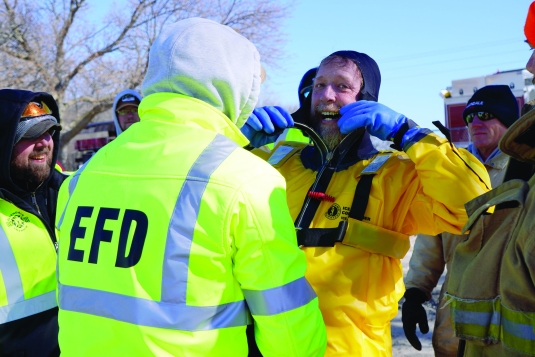
Pat Kruger suits up to simulate someone who has fallen through the ice and needs to be rescued. The Ellendale Fire Department practiced three types of extrication during their training session at Beaver Lake on Saturday, March 1, 2025.
Ellendale firefighters complete ice rescue training
Wed, 03/26/2025 - 8:05pm
On Saturday, March 1, 22 firefighters from Ellendale, Medford and Blooming Prairie completed about 12 hours of training to learn the best techniques for rescuing someone who has gone through ice into icy waters.
After about three hours of classroom instruction, the group moved to Beaver Lake where a hole had been prepared in advance for the practice. Trainees made use of the Ellendale Fire Department’s ice rescue equipment, acquired with grant funding over the past couple of years. Busho credits department members Nolan and Tyler McGowan for being vigilant about finding and following up on grant opportunities.
The most visible piece of equipment was the inflatable raft, about 12 feet long, with strategically placed openings meant to make it easier to lift victims out of the water and into the specially-shaped boat.
Also used in the water rescues were the department’s three “mustang suits,” waterproof, insulated outfits which allow rescuers to enter the water without becoming hypothermic while extricating a victim.
“We ran different scenarios,” explains Ellendale fire chief Logan Busho. “The idea was to get practice that felt almost like a real-life emergency, where we rush to the location and start preparing all kinds of equipment that we’re not sure we’re going to use, but know we might need.”
Busho describes the most typical ice rescue involving one or more people who have fallen through thin ice or accidentally stepped on snow covering a hidden breach in ice.
“The idea is to get both the victim and the rescue team off the ice safely,” Busho says. “Techniques to do that include sending someone in next to them in the mustang suit to attach a rope to them, then have a crew haul both the victim and the rescuer out across the ice,” explained Busho. “Or there might be cases where we shuffle out using our raft to physically load them up and slide them out.” Trainees also learned techniques for getting themselves out of a hole in the ice.
Crews were grateful for the new equipment during the training, Busho observes, since without it, the rescue technique was to walk out using an extension ladder to distribute weight. “But if that went through,” he commented, “the rescuers could end up in the water.”
Busho explains firefighters are required to take part in a fair number of training events, some of which cover specialized situations. Along with water rescue are topics such as vehicle extrication, confined spaces, hazardous materials, and more. Busho mentioned local firefighters have been wanting to cover water rescue for the past five years or so; with the newly acquired equipment, with other department goals managed, and with fairly predictable conditions on Beaver Lake, this was the right time to schedule it.
“We have a group that doesn’t mind working hard,” Busho said of his team. “They know it’s important to be as prepared as possible for whatever happens, so they were glad to go out and do this, even with all the physical challenges.”
Instructor for the day was veteran Inver Grove Heights firefighter Daniel Bernardy, who now operates his own rescue training company, working through Safety and Security Consultants out of Minnesota Lake.