
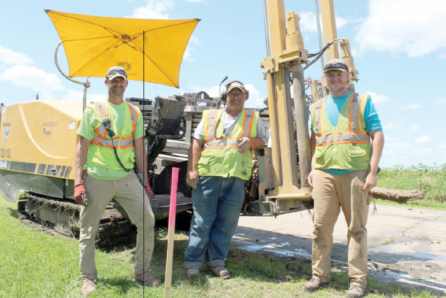
Above: Experienced operators of the directional borer say it can dig a channel up to a mile long. Below: Operator Scott Kroenke at the controls of the borer.
Early phases of internet installation underway in southwest part of county
Wed, 07/31/2024 - 11:00pm
The process of installing about 200 miles of fiber internet cable has begun in the southwest portion of the county. Under the terms of a $4,385,000 grant from the Minnesota Office of Broadband Development, fiber internet cable is due to be installed in Vivian, Byron, Freedom and Wilton townships; installation will continue next year, with internet service in those townships probably being fully connected and operational late next summer.
The grant was applied for by Waseca County in partnership with Blue Earth based television, phone, and internet provider, Bevcomm. Under the terms of the grant, all residences within the designated areas are eligible to be connected to the system at no cost to themselves, provided they request that connection during the installation process. New connections will be possible after the system is in place, but at a significant fee. Those who wish to use the fiber network to acquire services will have to contract for them through Bevcomm.
Anyone with questions about arranging connections for homes or businesses within the designated area can contact the Bevcomm office, located at 123 W. Seventh Street in Blue Earth. The phone number there is (507) 526-2822.
Those moving through the four townships at this time will see small white and orange flags, and if their timing is right, a crew of three or four workers with about the same number of vehicles working along roadsides. The crew and vehicles are owned by Midwest Utility Services, a Mankato company engaged by Bevcomm to bury the needed casings and cables.
According to Midwest team supervisor Cody Elias, the white flags indicate the path the buried cable should follow. Orange flags indicate locations where the team should be cautious of underground lines.
Elias explains there are about five steps to getting the internet cable distributed throughout the planned network. The first, determining the route, was done by engineers at Bevcomm; their objective was to devise a network which could meet system demands while making efficient use of resources. Bevcomm staff placed the flags and advised Midwest of the route.
The second step is now in progress. A crew of three has been working about a month so far using a specialized piece of big equipment known as a “directional bore.” Mounted on tracks and at least 15 feet long, the bore drives a shaft underground and creates a channel about five inches in diameter.
Operators say the machine is capable of digging hundreds of feet down and of creating a continuous opening about a mile in length. When necessary, it can drill through solid rock, but those extremes are not called for on this project.
Elias says the pipe being placed to serve as a casing for the fiber is between 3 and 3.5 feet below the ground in ditches, at least five feet beneath roadways, 10 feet below culverts and a minimum of 15 feet below water channels. He says the path of the channel and the mechanics used to create it follow rules set by a number of state agencies, including the Department of Natural Resources.
Once the directional bore has created the needed underground opening, the machine pulls an orange pipe about 1.25 inches in diameter through to line the channel. For those who come across the crew and their vehicles, the giant reel of what looks like oversized orange hose is the “pipe” in question.
Depending on the number of specialized digs–waterways, culverts, and passages under roads–Elias says the vertical borer team completes about two miles of underground channel a day. He also clarifies that the equipment will no longer be able to operate once the ground freezes, and so the work will need to be continued next summer. The laying of the orange pipe is the second of five phases Elias named.
Elias invites farmers to contact Midwest with information about any underground tiles which extend into ditches. The company’s number is (952) 884-3661.
The next step will be to actually insert the cable into the pipe and set what Elias called “pedestals” at each location where a connection is arranged for. Crews from Midwest will also be doing the work for that phase, and are likely to begin later this summer.
The cable’s diameter is about the same as a dime or a nickel, Elias says, but it encloses 100 glass fibers. Each connection on the network–home or business–will have its service delivered by one of those fibers, which are capable of sending or delivering a gigabyte’s worth of information in a second.
The fourth installation phase, also scheduled to be performed by Midwest crews, is to run the needed connecting cable from the “pedestal” to the outside of the customers’ home or office.
A fifth crew will install the service inside the structures.
The current timeline has the system up and running sometime near the end of summer 2025.
A couple of elements are still in the “to be determined” phase.
For one, Waseca County and Bevcomm applied for an additional grant which would add St. Mary’s township to the planned network. The list of successful applications has not yet been released by the Office of Broadband development, but if the grant is received, some elements of the plan may be expanded.
One other detail, according to Elias, is that there must be a small building located somewhere fairly central within the system. The building will act as a hub for the wiring and connections, allowing the services customers request to be delivered. The location for that structure is still being finalized.