
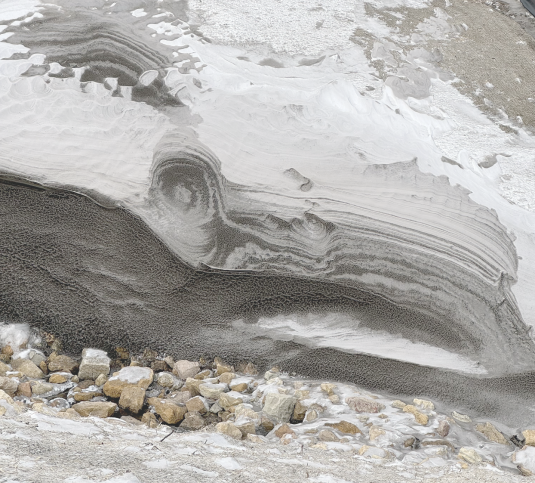
ARTFUL - Winds as high as 33 mph over the weekend changed the snow countywide from white to gray. Businesses and schools spent Monday cleaning up muddy footprints. Star Eagle photo by Deb Bently
Drifting soil turns snow gray
Thu, 01/29/2026 - 12:15am
Research done by the Universities of Minnesota and North Dakota indicates that a typical acre of farmland in our states loses a bit over five tons of soil to wind erosion each year–about the capacity of a single axle dump truck.
Mark Schaetzke, district manager, and Cammi Phelps, resource technician with the county Soil and Water Conservation District (SWCD) shared numerous observations inspired by recent high winds which sent soil airborne across Waseca County, turning snow cover gray.
According to Kyle Holling at the U of M Southern Research and Outreach Center (SROC) in Waseca, the county experienced a number of days with winds exceeding 30 m.p.h. between Jan. 14 and 18.
Schaetzke speculated, “It seems the faster the wind, the more susceptible the soil is to becoming windborne. We’ve had some high winds lately.” He also mentioned, “The wind is always moving soil around. It’s because we have a white canvas at this time of year that we really notice it.”
Phelps points out the level of tillage, field topography, the presence of natural or planned windbreaks, and the amount of material on the field–including the amount of snow cover– will affect how much soil is set in motion. She says the soil is best protected when plants in the field are at canopy, creating the most effective windbreak of the year.
The flip side of that, she mentions, is that, in fields using traditional tillage methods, the soil is exposed from the time crops are harvested in the fall to the time they reach canopy the next summer–a total of at least six and sometimes up to nine months.
Taken over the size of an acre, 5.2 tons of soil is only about a dime’s width, Phelps reveals.
“But the effect is cumulative,” she points out. “Over decades of erosion, farmers are losing inches of depth.
“Soil is a finite resource, and it’s being blown away.”
Perhaps even more significantly, she goes on, wind tends to take the topsoil, the most productive layer. Along with that are naturally occurring and manually distributed nutrients including phosphorous, nitrogen and potassium.
Research by the U of M in 2014 indicated wind erosion was taking more than $55 worth of nutrients per acre–a value which will have grown since then due to inflation.
Schaetzke and Phelps want area farmers to know the SWCD offers information, advice and even financial support for land owners who want to take steps to reduce erosion to their fields. They encourage land owners to stop by their office at 300 N. State Street in Waseca, or to call 507-835-0603.
The different measures have to do with reducing tillage, leaving more residue on the field, planting cover crops or even–for land with a poor production record–putting it in an easement program.
Phelps mentions ongoing research and advancing technology have created new possibilities when it comes to many of these preservation techniques. “For example, drones make it possible to plant a cover crop while the cash crop is still in place,” she offers. “People who may have looked at these options years ago will find they are worth looking at again, thanks to these new possibilities.”
Article “Reduce Wind Erosion for Long-Term Productivity,” by Jodi DeJong-Hughes, UMN Extension, David Franzen and Abbey Wick, NDSU Extension. 2011.