
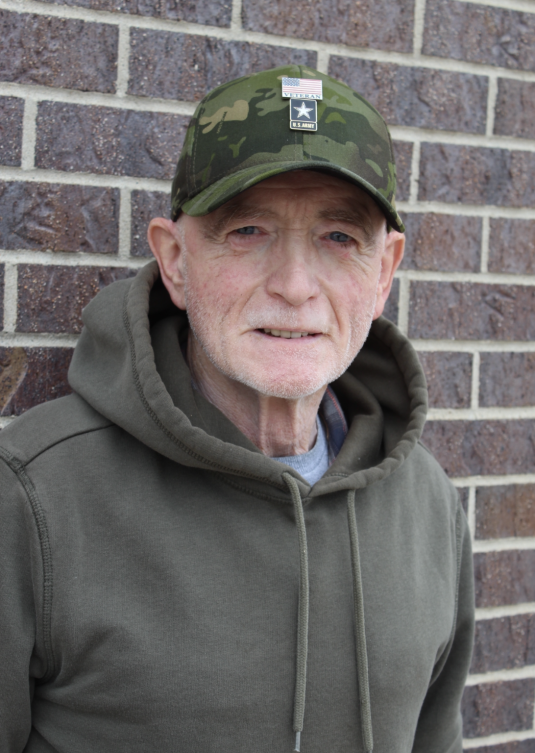
CONNECTIONS - New Richland area veteran Dale Baker discovered rich connections to history when he began studying the genealogy of his family. Star Eagle photo by Deb Bently
Dale Baker finds connection to history through military service
Wed, 11/05/2025 - 11:45pm
A veteran who served in Korea and the son of a veteran who fought in World War II, New Richland area resident Dale Baker, 71, discovered in 2007 that his family is even more richly connected to the military than he had realized.
As he was helping sort through his mother’s papers after her death, he came across some materials mentioning four men–his great-grandfather and three of his brothers–some of whom marched more than 9,500 miles and took part in as many as 15 decisive battles of the Civil War.
“I saw that,” he remembers, “and right away I wanted to know more.
“After a while, I got in pretty deep. History’s really interesting, and I was learning about history that involved my ancestors.”
Regarding their decision to volunteer for the Civil War, Dale comments, “I’m proud of them for their service and their bravery in action, and how they wanted to help free the slaves.”
Brothers John, Henry, Andrew Jr. and Daniel, born in the 1830s and ‘40s, were among eight children, only one of whom was a daughter, born to Andrew and Barbary Baker, whose home was in Ohio. When John, Andrew Jr., and Daniel reached adulthood, they moved to Wisconsin.
The Civil War began in 1861 and the four volunteered within a year. Dale’s research discovered that Daniel and Andrew landed in Wisconsin regiment 23, which was led for at least part of its deployment in turn by both Ulysses S. Grant and William Sherman. The regiment marched southward along most of the length of the Mississippi River and proceeded to engage in battle throughout the south. Henry, Dale’s great-grandfather, had enlisted with the Sixteenth Ohio regiment, and also marched down the length of the Mississippi. John joined the Sixth Wisconsin, a unit which represented itself well at Gettysburg, as well as in many other battles.
Dale came across a painting from the Siege of Vicksburg in which Confederate General John C. Pemberton is shown arriving at the Union encampment carrying a white flag. In the painting, two soldiers are standing guard at the camp’s perimeter ready to receive Pemberton and his entourage. The painting is especially meaningful to Dale because he learned that Daniel was one of two soldiers who escorted Pemberton to General Grant’s position. Though the images of the two sentries are too small to show much detail, Dale points out there are distinct similarities between a surviving photograph of Daniel and one of the two sentries in the painting. History tells however, that Daniel was not a sentry; he simply happened to be in the first “rifle pit” Pemberton’s group approached.
Andrew was injured at the Twenty-Third’s first battle, but stayed on as the unit’s Corporal of the Guard.
Military service during the Civil War was brutal. Between injuries, infected wounds and disease, the casualty rate on both sides was higher than 25 percent, with about 360,000 deaths among Union forces and 258,000 among Confederate fighters.
“So it was pretty impressive they all survived,” observes Dale regarding his ancestors.
He has spent many hours looking through historical information and genealogical records. Wisconsin regiments, he shared, wore a distinctive “Hardee” style hat, with a wide brim folded up on one side. Particularly noted on battlefields was the fact that their hats were black in color, rather than blue, leading them to be called the “black hatters.”
Daniel’s memoirs describe an incident when his regiment was divided, forcing him and some fellow soldiers into a watery bayou. He wrote, “The Union men were outnumbered five to one. We were hemmed in on all sides by the rebel cavalry, but we held them until reinforcements came.”
John was among the group which acquired the moniker “Iron Brigade” after the regiments proved themselves particularly well disciplined and fierce, amassing the highest casualty rate in battles they entered. According to historic records, Confederate forces would begin to lose confidence when they saw “those damn black hats” on the field.
After the Civil War ended, the Baker brothers spread out across the country.
Once he had learned of his ancestors’ role in the Civil War, Dale searched out family members to gather information about their post-war lives. Thanks to assistance from many sources, he located the graves of all four of his ancestors who fought in the Civil War. He has traveled as far as Missouri and Kansas to visit their respective graves, place a flag near their headstones, and give them a military salute.
Dale says it became important to him to build connections with those individuals from three generations back because he, they, and all American soldiers are linked by their service.
He names some of the ideals all members of the military cherish: “Service to country, loyalty to each other, respecting the flag and all it represents.”
Dale’s father Ralph served in the U.S. Army Air Corps during World War II from 1942 to 1945. Though he was officially a “radar plotter,” Dale reports that Ralph filled many roles, including guarding prisoners of war, driving an ambulance, and even manning what was known as an M-50 machine gun when his base was under attack. Dale describes that it took at least two people to fire the elaborate weapon–one to aim and hold the trigger and another to keep the long string of bullets feeding smoothly.
During one attack, Ralph was struck by a small piece of shrapnel near his nose. When describing the incident, Dale says Ralph talked about how the wound was instantly cauterized, and so he was able to stay at his station until the attack was over before seeking medical treatment.
Dale makes light of his own service, since, as a “combat-ready engineer” who learned to operate cranes and bulldozers, any fighting seen by him and his brother Don, who served in a similar role, was incidental. Even though he was stationed near the demilitarized zone in Korea for 13 months, “I was never a soldier on the field,” he says. “I didn’t see any enemies face to face.” In addition to his time in Korea, Dale was a squad leader at Fort Hood, Texas. Don, who currently lives in Waseca, served in the military for more than two decades, spending three years in active duty and 19 in the reserves.
Though he never carried a weapon in battle, Dale says he is proud to have served, and still consistently wears pins on his military-style cap showing he was stationed in Korea. Dale graduated from New Richland-Hartland High School in 1974 and enlisted in the Army soon afterward. He served three years of active duty and was in the reserves for another three; he achieved the rank of sergeant and was selected as a squad leader while stationed in Fort Hood, Texas.
He remembers a “battle simulation” at Fort Hood where his squad of bulldozer drivers was challenged to shape terrain in such a way that large equipment would be unable to reach a target destination. “It was over in two days,” Dale describes. “Thanks to what we did, they couldn’t get across.”
Two other incidents he recalls included one where he maneuvered a bulldozer to the top of a plateau to establish a firebreak where lightning had started a fast-spreading fire, and another when he extricated three amphibious vehicles which had become stranded in an overflowing river.
Dale received an Army Achievement award, noting his “conscientious attitude and dedication to mission accomplishment” set a fine example of a professional soldier.
After his military service, Dale went to a community college to learn welding and went on to work for Streater of Albert Lea for 36 years. For 33 of those, he was the lead welder on his shift.