
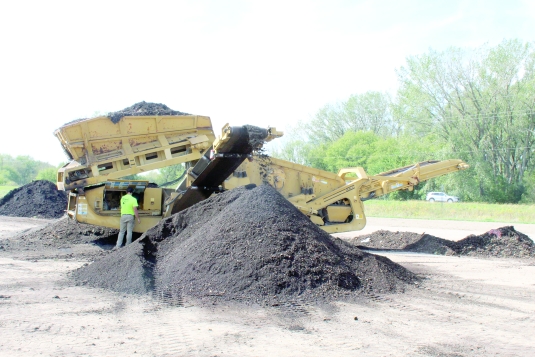
A large screener was brought onsite at the Waseca County Recycling Center last week to perform the final step before compost produced on site is ready for sale. Area residents can now purchase the material for use in gardens, raised beds, flower pots and landscaping at a price of $25 a ton or about one cent per pound. Amounts of material purchased at a time can range from bucketloads to trailers full.Star Eagle photo by Deb Bently
Compost site offering first sales
Wed, 10/15/2025 - 11:30pm
Built in 2023 thanks to a grant, the Waseca County compost site located south of Waseca along Highway 13 is now offering compost for sale. Recycling supervisor Tammie Bramer clarifies the recycling center has had compost available for purchase since 2021, but this is the first time material from the 4.5 acre area visible along the highway has been available for purchase.
The price is $25 a ton, which works out to about a penny a pound.
“People can buy it by the trailer load, a pickup full, or a five-gallon bucket,” describes Bramer. “It all depends on how they want to use it.” She mentions households sometimes purchase it to fill raised garden beds.
Bramer does not market the material as “dirt” because, although it has most of the same properties and may be even richer than typical soil in certain microbes and nutrients, it is not the black dirt someone might purchase from a landscaper. It can, however, be used in all the same ways. To dispel some misconceptions she has heard, Bramer reports the compost does not have any unpleasant smell and is not “mulch,” which is typically used for covering large areas of open ground.
Compost produced at a different location on county property has been for sale since 2021; Bramer tells of having purchased some herself for porch pots. She says the largest single customer has likely been the city of Waseca, which used truckloads of it when landscaping the city dog park and other locations.
That seems fitting given the city regularly brings truckloads of leaves and yard waste to deposit at the site. Though compost can become dirt-like in only a few months under optimal circumstances, Bramer seems pleased with the two-year turnaround.
To keep the product as “clean” as possible, Bramer mentions the county accepts only “yard waste.” She names grass clippings, fallen leaves, and end-of-season garden plants as comprising most of the raw material. All waste is to be deposited in the compost site following instructions from the recycling center staff. If large bags are used to deliver the material, the bags must be emptied out and discarded elsewhere, not left on the “windrow”--the long line of material with open space around it–on the field. Any sticks must be smaller than a person’s pinky finger. Food products are not to be added, except for any aging vegetables that might come along with garden waste.
Once material has begun the process of decomposing, it is turned periodically using large equipment in use at the recycling center. Gradually, the material becomes dirt-like.
The final step, which occurred late in September, is to “screen” the compost. A large piece of equipment called a “screener” was rented from Timm’s Trucking of Morristown. The company also supplied an operator and a large loader for collecting the material, loading it into the screener, and removing the various stacks of material.
Bramer explains larger-sized waste was returned to the windrow; material with the consistency of soil has been placed at the northwest corner of the compost acreage ready for customer pick-up. People may purchase as much as they wish, she says; recycling center staff will help with any purchase, including using an on-site Bobcat to help load it into vehicles or containers.
Anyone wishing to make a purchase should stop at the center office first; vehicles or containers are weighed empty, then weighed after being filled to determine how much material has been loaded.