
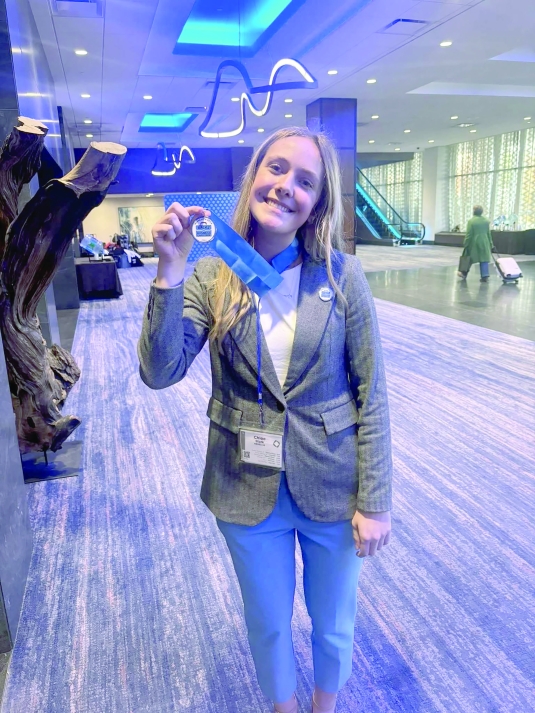
Chloe Stork will be competing at the national level DECA competition in Orlando, Florida in April. She won the opportunity during the state tournament on March 2, 3 and 4.
Chloe Stork headed to national business competition
Wed, 03/26/2025 - 8:14pm
NRHEG Junior Chloe Stork, daughter of Dan and Stacy Stork of New Richland, says she can barely believe it.
Chloe is among five people in her category statewide who will be representing Minnesota at the DECA national-level competition in Orlando, Florida from April 26 to 29. She won the honor while competing in the organization’s state contest held in the Twin Cities March 2 to 4.
Chloe was one of ten NRHEG students who had advanced to state-level competition after making a strong showing in the District 1 competition in Owatonna on Jan. 10. Also competing at state were Harbor Cromwell, Kyera Eustice, Cole Hutchens, Gavin Lewison, Carter Martens, Devon Nelton, Makenna Reeder, Wyatt Tuttle, and Owen Wayne.
Chloe is in her second year in DECA and has competed in a number of different categories.
NRHEG DECA coach Michael Meihak states having a national–level competitor from the local program is impressive on many levels. First, Chloe was one of at least 64 competitors in the “Hotel and Lodging” management category. Second, the current NRHEG DECA program is only in its third year, having been formed by Lise Weegman, who was the school’s business teacher at the time, in the 2022-2023 school year. Finally, and a point of personal victory for Meihak, “It was fantastic to hear the name of a small school like NRHEG announced from the stage.” Meihak points out the competition tends to be dominated by large schools–for example, the Wayzata district had 170 students competing at state. In those larger districts, students can register for DECA as a class and have daily access to work time and guidance. NRHEG’s team has weekly practices.
Chloe mentions the “Hotel and Lodging” competition includes scores of a number of different types. First, as are competitors in all categories, participants are given 60 minutes to take a 100-question multiple-choice test. Some questions ask about the business world and business practices in general. Others are specific to the lodging industry. Although competitors eventually learn their scores on the tests, they do not yet know how well they’ve done as their round of competition continues.
The second element of the round is a “role play” scene. “We’re given a summary of a scenario,” she explains. “It describes what role we’re taking, who we’re meeting with, and what the purpose of the meeting is.” In one round this past weekend, Chloe describes, the scenario was that she worked for a large, successful hotel chain which wanted to open a line of hotels particularly friendly to families and to people traveling with children.
After reading the description, “We have ten minutes to come up with a plan.” The only tools available during the planning phase are paper and a writing utensil. “So we can take some notes as we go in to our meeting, but that’s all.”
Competitors then have a strictly enforced seven-minute meeting. They enter the room, introduce themselves, and work to appear as professional as possible as they present their plans to the judge, who sits across a table from them and listens. “The judge doesn’t say anything,” Chloe mentions. As the seven minutes end, competitors finish and leave the room, again all the while adhering to professional-level expectations.
The score from the role play scenario has two parts. One is for the viability of the plan. The other is for how well the competitor met professional standards such as appearance, personal interaction, mode of speaking, and more–including the quality of their opening and closing handshakes.
Both at district and state level, Chloe describes, the first round of competition included a test and two role-playing scenarios. Those who advanced to the next round completed another test and took part in one role play.
At state competition, Meihak summarizes, 12 competitors advanced to the championship round in each category. The top five became eligible to compete at the national level.
Somewhat ironically, Chloe could not be present either at the awards following the first round or those announcing the championship.
“It was a crazy week,” she admits. Since she and many of the other nine state-level competitors are also in winter sports programs, the group left the competition venue each day as their schedule allowed. Chloe only learned she had been advanced to the championship level after finishing Monday night’s girls’ basketball game. Similarly, after she completed the elements of the finals round Tuesday morning, she and team members returned to school.
The award ceremony was not until about 4 p.m. that day. Chloe’s parents were the ones to deliver the news of her accomplishment.
“I could barely believe it,” she said, mentioning the advantages many of her competitors from larger schools have.
Chloe’s parents and Michael and Sarah Meihak will also be traveling to Orlando for the national event. She admits she’s somewhat nervous about the level of competition she will be facing there; she notes there will be more than 10,000 students competing in the numerous categories. “I’m not really expecting to win,” she says. “My plan is to do my best to represent NRHEG.”