
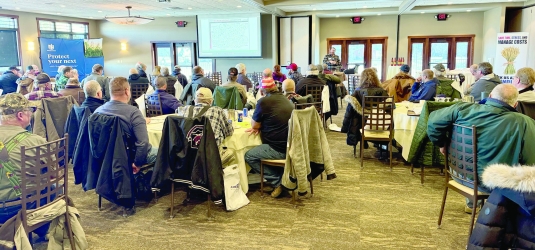
Dale Viktora speaking to a big crowd at the 25th Annual Ag Summit held at Wedgewood Cove on February 6.
The Ag Summit and bugs in a jug
Wed, 02/26/2025 - 8:07pm
By AL BATT
Contributing writer
The weather woodchuck had promised us another six weeks of winter. The local woodchucks did so by sleeping through Groundhog Day.
I appreciated being given another six weeks to take down the Christmas tree, but I put little stock in rodent-based meteorology.
Groundhog Day was important, but not as important as the 25th Annual Ag Summit held on Feb. 6 at Wedgewood Cove in Albert Lea. It was sponsored by AgriSompo, Nationwide and Farmers Mutual Insurance Company (of Manchester), and presented by a fine alignment of Americana Insurance Group (offices in Albert Lea, Wells and Ellendale) and Commerce Bank of Geneva.
Louis Pasteur wasn’t there. He was a French microbiologist and chemist, whose groundbreaking research in chemistry resulted in remarkable breakthroughs in understanding the causes and prevention of diseases. Pasteur's quote, "Chance favors the prepared mind," underscores the importance of being well-prepared and knowledgeable to capitalize on opportunities. My father took little me to Farmer’s Union and Farm Bureau meetings held upstairs at the creamery to get some learning. Today, he’d also attend the Ag Summit. School is never out.
Here are the Ag Summit presenters and some of the information they provided.
Tom Sorenson, Agency Director of Americana Insurance Group, summarized producer statistics, trends and averages, reviewed base prices and harvest prices, and recapped loss ratios. Sorenson was named agent of the year by the Big I, the largest association for independent agents in the state.
Nick Paulson, an Associate Professor & Director of Graduate Programs at the University of Illinois and a graduate of Albert Lea High School, gave a talk titled Farm Income, Risk Management & Policy Outlook—a tour of hot topics of farming for 2025 and the future. Forecasts based on futures contracts show soybeans at $10.20 and corn at $4.30 in 2025-26. Minnesota's average corn yield in 2024 was 174 bushels per acre, the same as in 2019 and less than the 185 bushels in 2023. The Minnesota average soybean yield in 2024 was 45 bushels, the same as in 2019, but lower than the 48 bushels in 2023. Because farm payment programs are such a small part of a gigantic budget, drastic changes to the Farm Bill aren’t anticipated. A survey representative of the U.S. population found that 85% supported payments to farmers for natural disasters harming crops, and 80% favored making crop insurance protection more affordable. The estimated composition of U.S. corn and soybean use for the 2024-25 marketing year is that 38% of corn will go to feed, 37% to ethanol, 16% to exports and 9% to food. Soybean splits are 46% for meal production, 43% for exports, 6% for oil, and 5% for oil for biofuels. Brazil is stiff competition—it might be 50 years behind the U.S., but it’s catching up. Brazil benefited from this country’s loss of China as a trade partner for a year, and that business hasn’t been fully recovered.
Dale Viktora, a field agronomist with Beck’s Hybrids, originally from Ellendale and a graduate of NRHEG, made a presentation titled: Future Focused Yields: Biological & Nitrogen Management that touched on the importance of practical nitrogen management, and how the biological space in agriculture can enhance yields and profitability. A biological is a product that contains cultures of living microorganisms. Biologicals are sometimes called “bugs in a jug.” It seems unfair, but plants can lose nitrogen with both too much rain and too little rain. Biologicals might allow a farmer to cut back on fertilizer.
Matt Kruger of Pine Island, an account manager with Truterra, presented Carbon Credits and 45z Updates. Kruger offered the truism, “All models are wrong; some are useful.” Farmers can generate carbon credits by adopting practices (primarily no-till and strip-till) to reduce emissions or sequester carbon on their land, and carbon markets may provide them with income opportunities through carbon credit sales. Truterra is a Land O’Lakes company. An interesting aside is that Land O’Lakes has a Pine Island plant that produces cheese powder used in Cheetos.
Presenter Jolene Honkomp, a Benefits Advisor with Noah Insurance Group, addressed Land as Your Legacy and when to plan the future of your farm. The challenge is that 97% of all U.S. farms are family farms. Despite the many advantages of family businesses, it’s estimated that only 30% of family businesses pass to the second generation, 12% of family businesses pass to the third generation, and only 3% of family businesses reach the fourth generation. Over the next 20 years, 70% of farmland will transfer ownership. There will be obstacles: mortality, greed, conflict, fear, inconvenience, control or uncertainty. Honkomp included several helpful quotes. “Laughter relieves stress and boredom, boosts engagement and well-being, and spurs not only creativity and collaboration, but also analytic precision and productivity.” That was from Alison Beard‘s article in the Harvard Business Review. The other quote was by Winston Churchill, “Success is not final, failure is not fatal: It is the courage to continue that counts.” She recommended beginning a succession plan immediately because tomorrow starts today.
There was an Agricultural Forum Panel, a question-and-answer session with experts representing diverse services providing their thoughts and answers.
It was a pleasant way to spend a morning before flinging a fang into some fine food.
I learned a lot and was given a nifty backscratcher.
Life is good.