
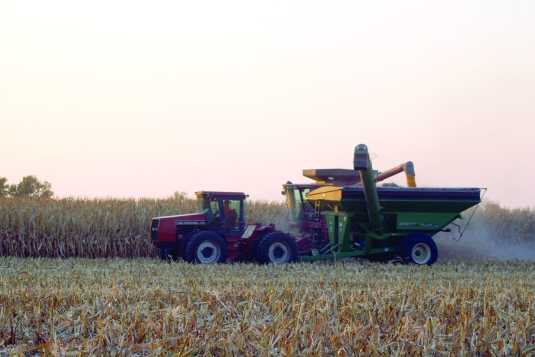
Waseca County farmers enjoyed dry weather and easy access to fields during the 2024 harvest.
2024 farming season in review
Thu, 11/21/2024 - 12:00am
The 2024 Harvest is history for most and, unlike last year, it meant disappointing but not unexpected yields, particularly on the corn side. Much of the crop looked subpar from the road, and in most cases, looks did not deceive. Soybean yields were mediocre in most cases and not generally on a par with 2023. Corn yields were better as one went east. One wasn’t surprised as yields started to trickle in. Why were yields as poor as they were this time around?
We had excess moisture for a large part of the growing season. We went into the winter in the fall of 2023 with a soil profile that was deceptively full in many places. Good rainfall in September after the crop matured and bountiful moisture in October replenished some of the moisture we had used up during a dry June, July and late August. Winter took its time finding its stride. Winter snowfall was scant, and the frost depth remained shallow to nonexistent. The snow that did fall tended to melt and percolate into the soil rather than running off. As an added bonus, it rained on Christmas Eve and Christmas Day, amounting to 1.5” – 2” depending upon location. That soaked in as well.
By mid-February, estimates had the soil moisture profile at nearly 80% capacity down to 4’. Any of the temporary snow cover was gone by mid-March. Even though precipitation for March was below normal, it added another couple inches to the profile. April came in with rain, but by April 13th, some were able to find ground that was fit to plant. For three days anyway. Then it rained again, delaying planting until the week of April 21st. Planting conditions were fit once again and some were even able to get their soybeans planted before the rains returned and halted progress until May 11th. Most of the fields were planted and there was a collective sigh of relief. The feeling seemed to be, hey, we got this. Little did we know…
We received heavy rain from about May 20th through the end of the month. The total in New Richland for May was 8.4”, not unlike what we had received in May of 2023. Nothing to get shook about just yet. Like 2023 there were reduced stands and areas of fields that warranted replanting. That was done in quick fashion before it rained again. It didn’t take long and that’s exactly what it did. What appeared to be a nice start similar to last year had suddenly deteriorated into a potential crop insurance claim. Or had it? If we could get it to stop raining, we were confident it would be OK.
Rainfall for the month of June was substantially above normal. In New Richland, it was over 9” above the June normal of 5.38” at the SROC in Waseca. By the time June was over, we had received 23.08” of rain since the 1st of May. After the first measurable rain on July 2nd, we’d received 23.78” from May 1st. The normal May – September growing season precipitation at the SROC in Waseca is 23.72”. We suddenly knew we were in trouble. Soils were so wet that applying additional nitrogen in the corn was nearly impossible with a ground rig. Aerial availability was a crapshoot.
Herbicide applications were also in jeopardy in many fields, setting the stage for some major escapes of waterhemp, foxtail and barnyardgrass. We were well on our way to an insurance claim scenario in the corn. There was still some hope for the soybeans, even though they were struggling as well with wet feet. Precipitation in July backed off luckily and some were able to apply nitrogen in the corn. Additionally they were able to stab in soybeans where there were drown out spots or large areas were missing entirely. July still provided 3.63” of rain, most of it during the first two weeks of the month. Then we started hearing cries for rain towards the end of the month. Careful what you wish for.
August was another wet one, although the crop was able to stay above water, where there was crop, and additionally it was taking up more moisture to maintain the yield producing factory. 7.63” fell.
While our growing season precipitation was excessive, there were still some positives, some of them surprising. Rootworm pressure was greatly diminished after what should’ve been an easy winter for the pests. Rootworm beetle traps reflected that. Apparently like many soil borne insects, they still need oxygen to survive. One might’ve surmised that the wet season meant a lot of corn leaf disease. There was a fair amount that showed up late, including southern rust, northern corn leaf blight (NCLB), but unlikely had much of an impact on yields. The tar spot that everyone worries about constantly was present, but the infestations weren’t heavy or widespread in most fields. It is, however, a warning sign that we are likely building inoculum, so it’s going to require closer monitoring as time moves forward.
What on paper should’ve been a banner year for white mold year in soybeans, turned out to be far less than anticipated. The shorter soybeans and late canopy formation were likely partially responsible. Earlier maturing varieties that were done flowering by August 1st were a factor as well. Once flowering ceases, it’s more difficult for the disease to mount an offensive. SDS (sudden death syndrome) was expected to be a factor with the wet spring. While there were some signs of earlier fusarium infections, SDS wasn’t the factor it could’ve been with good soil moisture from August carrying the crop to the finish line. SDS symptoms tend to be worse in seasons with a drier August. The rapid adoption of seed treatments to control SDS was a big factor.
Soybean aphids were back at it again and some treatment was warranted. Generally the infestations were late enough (R6) that insecticide applications were questionable. We confirmed what we’d known for several years, that the synthetic pyrethroids were no longer very effective on soybean aphids due to the resistance. Cheap, yes, but no longer effective. Many just allowed the aphids to multiply, knowing they’d unlikely have a yield impact. Many were done throwing money at a crop with questionable yields and lower prices.
Our GDU accumulation for the growing season was again well above normal, thanks in large part to the warm September and frost that held off until October 7th. At Waseca, the growing season (May – September) Growing Degree Units totaled 2781 this season, 272 GDUs or 11% more than the normal season total of 2509. This was crucial, particularly for those who had replanted soybeans as late as July 14th. The season GDU total was a little misleading as we were typically operating with very close to normal GDU’s for much of the season. It was difficult to amass above normal GDU’s much of May and June when it was cloudy and measurable precip was recorded on more than half of the days for each month. The warm dry September was a boon to crop maturity, however. What appeared to be a wet, later maturing corn crop suddenly morphed into a drier, earlier than anticipated harvest. Fears of light test weight corn were put to rest. While it was very warm in September, it cooled down at night, allowing respiration to occur normally.
Soybean harvest began in earnest for many about the week of September 22nd. It was so dry that soybean harvest was done in several cases by October 1st, allowing operators to ease into their corn whenever they were mentally prepared. By the time many started picking corn, the moisture had fallen into the low to mid-teens on the earlier maturing hybrids planted early. This meant the corn could virtually be harvested at will, with some able to dump it directly into the bin or do some minimal drying. Harvest went faster than most could recall. With dry crops, reduced yields and large equipment, it didn’t take long.
So how did this growing season turn out for most after the devastating rainfall? On the early soybeans, some yields were reported as high as the upper 60’s with most falling in the 50 - 55 bu./acre area as the harvest season progressed. Well off the pace from the past three growing seasons. Better than they might’ve been, but tempered by disappointment from those who hoped they might be better than that. Moving west, and particularly where hail and rainfall was higher, soybeans were worse than those figures. As one moved east across I-35 and beyond, yields were better as rainfall totals lessened. Areas of MN to the north that had been stricken by drought the previous year had vastly improved crops as well.
In South Central MN, corn yields basically followed a, “What you see is what you get,” format this year. Where water had ponded, it was apparent denitrification and/or leaching had occurred where there was actually crop there to harvest anyway. Stands were reduced in many fields. Some warranted replanting areas. Other fields had water and saturated soils remain too late to allow replanting. Yields for corn planted on last year’s soybean ground were typically better than their corn on corn counterparts. There are exceptions, but corn on corn with its additional input costs was harder to make money on straight up. With an insurance payment, it may have leveled the playing field somewhat.
Something that was readily apparent looking at corn fields after harvest was the amount of corn on the ground. Much of it came from corn that had dried down well into the mid-teens in moisture before harvest. When the ears were grabbed by the snapping rolls, it frequently resulted in kernels shattering and not getting in the combine. Other areas where the plants were very short due to the excess moisture, there were ears placed so low to the ground that when the snapping rolls grabbed them, it was frequently in the middle of the ear. This resulted in ears broken in two on the ground with kernels scattered about. The result will be an abundance of volunteer corn in many of next year’s soybean fields. In the meantime, wildlife will reap the benefits until it’s buried under the snow or the ground is tilled.
Corn yields were about as anticipated with the occasional blip on the radar screen. As expected, 165 – 175 bu./acre caught most of the yields. Not bad for the 1990’s perhaps, but well off the pace for today’s production. What was even more incredible was some of the replant corn actually yielded as well and in some cases better than the initial planting. That wasn’t surprising in some instances where there wasn’t anything left after the initial planting. Even in areas where the crop was sufficient to leave, some reported better yields in adjacent areas where they’d replanted. That might not have been the case had it frozen about mid-September. Harvest moisture too was surprisingly dry considering the planting date. Well above normal temperatures in September and October dried the corn down rapidly, particularly with the unheard-of 90+ degree highs October 1st & 2nd.
To sum up, so-so soybean yields with poor corn yields for the 2024 harvest. Corn and soybean prices are down, but so are fertilizer prices. Luckily some had bought up their insurance levels, so they were able to maintain their incomes and live to fight another day. And speaking of that, we were lucky to receive the rain from Halloween to November 6th. It came gently and provided some much-needed moisture for fall tillage and anhydrous ammonia applications, not to mention putting a little fuel in the tank for the 2025 crop.