
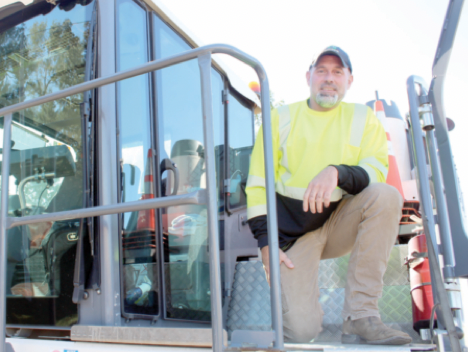
Ulland Brothers Inc. began the work of “rehabilitating” C.R. 64 bright and early the morning of Monday, Sept. 24.
‘Rehabilitation’ complete
Wed, 10/16/2024 - 11:30pm
A two-mile portion of Waseca County Highway 64 is a whole new road these days. The section of asphalt extends northward from State Highway 30 about 3 miles west of New Richland.
During the June 4 meeting of the Waseca County commissioners, county engineer Jim Kollar told board members he had received three bids to “rehabilitate” the stretch of road, which he described as being “in poor condition.” First paved in 1999, it was not originally on the construction schedule for this year. The most recent traffic count for the road was taken a few years back, but the road sees an average of 81 vehicles a day. Kollar reported sufficient “local option sales tax” monies were available to cover the job: The lowest bid of the three he had received was nearly $824,000, about 4 percent lower than he had estimated it would be.
Ulland Brothers Inc. began the work of “rehabilitating” C.R. 64 bright and early the morning of Monday, Sept. 24. “Reclaimers,” road working equipment 30 feet long, 10 feet wide and 12 feet tall, started at the south end of the road and moved northward. When they advanced, they moved slightly faster than walking speed, but also had to make frequent stops for quality control. Grinders on the reclaimers dug through the 7 inches or so of asphalt which had been on the road for more than two decades and about 2 inches down into the “aggregate” (sand and gravel) base underneath. All that material was mixed together inside the machine and put back down, now quite a bit deeper and less dense than it had been before.
Andrew Graupmann, engineering technician with the Waseca County Highway Department, was present to measure and confirm the aggregate was being reached to the expected 9-inch depth. Much of the time, two reclaimers worked in parallel, one slightly ahead of the other, together grinding up a swath of roadway roughly 12 feet wide.
Behind them, a water truck sprayed the newly agitated material, and two different types of machines moved across the surface to press it back down. Their objective was to turn the “reclaimed” material into the base upon which the new road surface would be laid.
First in line was the “sheeps’ foot,” whose five-foot-diameter compaction drum has evenly spaced rectangular protrusions which deliver extra pressure. Not only that, but the entire machine vibrates; the ground shakes within 10 or more feet of it. The five-foot wide trail it leaves has regularly-spaced rectangular pits about 5 inches deep.
Not far behind the sheeps’ foot was a “motor grader,” the big, open-framed machine also commonly used to grade gravel roads in summer and clear snow in winter. The other, a roller, seems to have only tires, seven of them offset, so they deliver even, downward pressure.
“Until it gets resurfaced next week, it will be just like a gravel road,” observed Graupmann, explaining that traffic would continue the process of compaction. Traffic would also help reveal any inconsistencies in the reclaimed asphalt by creating potholes, which could then be, to use one worker’s word, “resolved.”
On Oct. 3 and 4, a work crew comprised of different workers and new types of equipment returned. Stretched down the center of the two-mile run of road was a strong, blue cord whose purpose is to mark a straight line. The largest machine in use for this part of the project was a “paver” capable of laying down a 14-foot-wide strip of asphalt to selected depths. For C.R. 64, the paver traveled the length of the road four times.
Matt Carlson, a project manager with Ulland Brothers, was not only in charge of the worksite Oct. 3 and 4, he is also the one who evaluated the road prior to submitting the bid which won the contract. Carlson, 31, has been with Ulland Brothers since 2013.
Carlson explained the specifications for this job call for two “lifts,” layers of asphalt put down one on top of each other. The bottom layer is specified to be 2.5 inches thick, the top, 2 inches. Each side should have a 2-percent grade, that is, should angle downward from the center of the road at a rate of 2 feet in every 100. Putting the asphalt down in two layers rather than all at once, he says, “creates a smoother ride.”
Because the paver is laying two lifts each on the north- and southbound lanes, it must go each direction twice. A mammoth machine about 15 feet wide and 25 feet long, it must wait for the 275-degree blacktop material to arrive and be laid down in “windrows” in front of it. According to Carlson, 30 trucks are constantly making the 70-mile round trip run to the company’s facility in Glenville.
Referred to as “belly dumps,” they are capable of carrying more than 20 tons of material, enough to pave about 135 feet of roadway, always depending on the depth and width it's being laid at. Even with 30 trucks on the job, the paver must occasionally wait at a standstill.
Once the material arrives, the machine has the ability to redistribute it across the 14-foot lane width according to the 2.5-inch, 2-foot-grade specifications. Two workers constantly watch the material for clumps or uneven surfaces. One walks ahead of the paver scanning the windrow. Carlson explains clumps might begin to form if a portion of the material has cooled faster than the rest. Another worker rides on a “catwalk” at the back of the paver, watching to see that the smooth surface is uninterrupted behind him. At one point he sees a clump and steps off the catwalk onto the just-laid asphalt, carrying a shovel and a smoothing tool with a handle about as long as that on a broom.
The asphalt is steaming. His shoes leave footprints.
He digs out the clump, pours replacement material into the gap, and smooths it over as though his tool is a giant trowel. Then he picks up his shovel and tool and catches up with the paver, stepping back onto the catwalk, which is less than a foot above the just-laid surface.
About a mile north of all this commotion, Ulland Brothers paving manager DJ Kruse arrives with a Bobcat on a trailer. He and a few other crew members, he explains, will be putting paving material at the ends of driveways along the road to create an asphalt ramp which will protect the road edge as traffic enters and leaves the driving lanes. “Only” about 15 tons of blacktop material will be needed for the task, he says, since only two driveways and a few field roads intersect with 64.
Asked what he understands about roads that everyday folk usually don’t, Kruse says he’s too deeply immersed in the process to guess. In answer to further questions, he mentions that newly laid roads are “tender” for a time on hot days when the sun shines down and heats them, which is why compaction is so important.
He refers to a quality control worker with a “nuclear” measuring device who is testing surfaces behind the paver. The “nuke,” he says, measures how much “air” is in the roadway. The compacting crew, he explains, will be the last to leave the worksite. The road can read no more than six percent “air” if it is going to meet specifications.
According to job manager Carlson, from beginning to end, the job of “reclaiming” the original road surface, leveling the new base, laying down the two “lifts” of new asphalt, “shouldering,” and then “striping” and “signing” the road called for between 20 and 25 workers and nearly as many different types of machines. Roughly six days of work were required, but the number is difficult to pin down, he says, depending on whether one counts the necessary days of waiting in between tasks.
Though the June bid date for C.R. 64 was later in the construction season than his company would typically take on a new project, he points out, the job is a “small” one, easily taken care of in between other, larger jobs.
Carlson classifies Ulland Brothers as being one of the five largest highway construction companies in Minnesota, depending on the criteria used. He notes that, between the company’s Northern and Southern divisions, they pave asphalt throughout most of the state of Minnesota, along with parts of Iowa from Northern Iowa up to International Falls on the border of Canada. It being late in the May-to-November season, many of them are already completed.
Asked what he knows about roadways that typical drivers don’t, his response is a quick laugh. “I know what it takes to make them last.” He goes on to explain that most of the traveling public has no way to know the many steps and details which make it possible for a road to withstand up to 25 years of traffic and changing weather conditions.
He admits to frequently checking back on past company projects, examining the surface to see how well it’s holding up.