
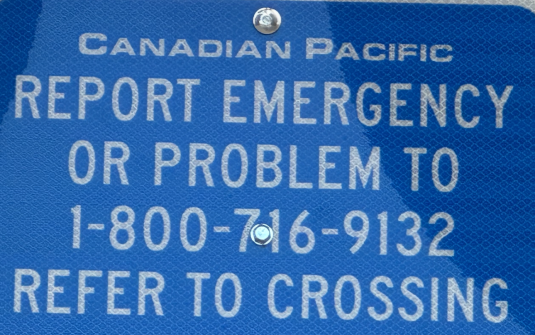
SIGNS OF REPAIR - Signs like these, colored a reflective blue, appear at every railroad crossing. In speaking with people in the construction field, Deb learned hearing from drivers about the condition of a railroad crossing might help influence railroad companies to allow local agencies to make repairs.
Before you blame the railroad
Wed, 06/24/2026 - 11:00pm
A while back, the newspaper was contacted by an area reader who wanted us to highlight the condition of area railroad crossings. His implication, of course, is that the crossings are rough, causing many drivers to go looking for the “best” path by swinging wide as they drive over the tracks.
I did some research on the topic, visiting the railroad company’s website and speaking informally with a few people who work in road construction.
To provide the quick version first, area drivers may be the ones with the most influence when it comes to improving railroad crossings. At every crossing is a bright blue sign that offers a phone number drivers can call to report an emergency or a problem. I only began noticing them after their presence was pointed out to me, so you may never have noticed them either, but they’re there.
Along with the phone number is a specific identification number for that particular crossing. Callers don’t have to go through any acrobatics to clarify which location they’re providing input about: Just give the I.D. Perhaps the more people railways hear from regarding the status of certain crossings, the more open they will be to allowing local highway crews to make repairs or upgrades.
Now the somewhat longer version, encouraging you not to express yourself harshly when you make those phone calls.
During my conversations, it was pointed out to me that there are many thousands of railroad crossings on U.S. highways. Railroad companies have easements associated with those crossings which extend out into the roadway on both sides. If a construction agency wants to perform any work within those easements, even on its own road near the railroad tracks, it must get authorization from the railroad company. With so many crossings and so many highway projects going on all the time, planners say they often feel frustrated with how long it takes to get that authorization from the company’s national headquarters–if they receive authorization at all.
So it’s easy to see why the idea of trying to repair the roadway next to and between railway tracks makes construction planners roll their eyes. They may be dismayed at the condition of the road, but frustrated in their efforts to get timely feedback and paperwork from the nationally based companies which are cautious about allowing the repairs.
I have to admit, as a driver who also frequently swings wide to find the best path across our area’s many crossings, my sympathies were with the construction workers as my research began. My thoughts may have been something like, “Why do these huge national corporations have so little concern for everyday folks?”
However, my perusal of the railroad company’s information about work done on or near crossings provided another, very important, perspective. To summarize–and pretty certainly to oversimplify–every train represents millions of dollars worth of equipment and cargo. In and around each train are railway employees, as well as everyday folks waiting at crossings and even in nearby buildings. Train companies are cautious about allowing large-scale work near their crossings because a derailment or accident at any one of them could not only endanger many people, it would be expensive on a scale most of us have trouble imagining. During a “worst-case” accident, there would be many tons of falling materials potentially leaving the rails at dangerous speeds, along with a possible release of hazardous chemicals. Imagine the time and work needed to clean up even if only a few railway cars leave the tracks.
From another angle, the railway wants to be well informed about any work taking place near its tracks, so it can take precautions to keep those workers from being injured. Train traffic might have to be rerouted or delayed.
So as you can tell, as I considered the information railway companies provide online, my perspective broadened. After all, dealing with a rough railway crossing is frustrating and inconvenient, but I can keep doing it a while longer if it means keeping people safe.
So, if you feel it’s warranted, go ahead and use the 800 number to let the railway companies know if you believe crossings you drive over are unsatisfactory. But please don’t be harsh about it; they’re approaching the problem from a much larger perspective than you are.