
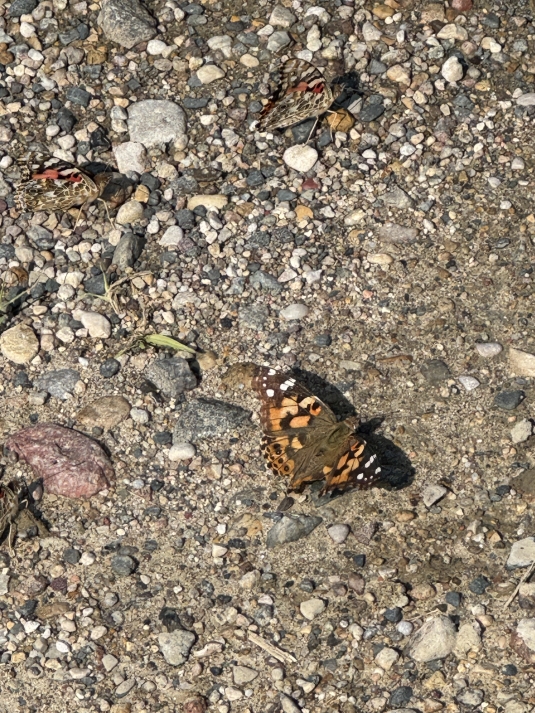
BLENDED BEAUTY - There are three painted lady butterflies in this picture, but only one is readily visible. The other two have their wings closed and are blending in with the sand and pebbles of a gravel road. Star Eagle photo by Deb Bently
Thirsty butterflies decorate the driveway
Wed, 08/12/2026 - 11:00pm
After a recent rain, there was a puddle at the end of my driveway. Now that the water has drained and evaporated, a patch of mud remains.
I cannot be unhappy about it, because hundreds of butterflies are using it as a place to get water. In numbers I believe I have never seen before, they settle on the mud and stay there for extended periods, occasionally opening and closing their wings.
There are some bright yellow ones I have learned are clouded sulphurs. They are particularly easy to see on the wet-dark mud, looking like the first leaves of some late-sprouting exotic plant. Mixed in with them is a roughly equal number of painted lady butterflies. These are much more difficult to see. They are perhaps half again larger than the sulphurs, but their colors are plainer and darker–greys and oranges. When their wings are closed, the warm colors are hidden, leaving a mottled pattern that blends in remarkably well with the small pebbles in the gravel road. When that’s the case, the most reliable way to spot them is to look for their shadows.
As I come and go in my car, I feel a bit guilty for disturbing them.
On the other hand, they rise in a cloud and surround the car, making me feel like the grand marshal in a parade–surrounded by colorful, fluttering confetti that, rather than falling from the sky, rises from below.
Along with the crowd of confetti at the mud puddle, there is also a rich scattering of butterflies along the length of the gravel road. At least for the time being, I have taken to driving as though a child might dash out of the nearby cornfield at any moment. At half or less of my usual speed, I watch for the triangle-shaped outlines or shadows and steer to the far side of the road. Most get out of my way promptly, but some are still holding to the road as they disappear under my hood: in their case, I hope I am going slowly enough that I will do them no harm when they launch upward.
To my gratification, the butterflies don’t seem to remain disturbed for long, landing again as soon as the commotion is over.
Hoping to take advantage of that, I took my camera and walked slowly to the end of my driveway. The fountain of butterfly confetti was even more dramatic when it surrounded only me. As I found an opportune spot and stood still, they all settled down, taking no notice as long as I displayed only minimal movement. When I lifted my camera or turned myself to face a slightly different direction, the closest ones would fly up; those a bit further away stayed on the ground, but seemed to flutter nervously.
As I enjoyed the novelty of my circumstances and tried to capture a photo that would help others appreciate what it was like to be there, I couldn’t help chuckling. Beneath me on the roadway was a sort of visual Morse Code. A painted lady invisible except for its shadow would open its wings, becoming a bright spot of color for a moment before it closed them again and disappeared from sight. Then a different, nearby set of colors would appear and be gone–the effect was compelling.
It was punctuated by a much smaller butterfly in the same orange and black color scheme. Only an inch or so across with their wings wide open, these tiny drinkers looked like young children who had followed the grownups on an outing. Called pearl crescents, though, some research informs me they are actually fully mature at their diminutive size.
In the visual Morse Code performance I was watching, the pearl crescents stood out despite being so small because they opened their wings more often and left them that way a bit longer than the painted ladies.
Speaking of research, it turns out butterflies drink through a “proboscis,” a long, straw-like tube which coils up under their faces until they are ready either to harvest nectar from flowers or drink water. Reportedly, it is almost entirely males who drink water in the way called “puddling.” They are also known to drink from drops of dew or, hmmm, puddles of animal urine.
Thanks to drinking…fluids…the males acquire minerals and substances not available from flower nectar. They then share these nutrients with the females during mating.
The facts and information are valuable, of course. I wish the butterflies well. Perhaps more importantly, I am grateful for their communal visit to my driveway. It is a remarkable privilege to be showered by a fountain of living confetti.